.png?x-oss-process=image/resize,h_100,m_lfit/format,webp)

.png?x-oss-process=image/resize,m_lfit,w_200/format,webp)

热门产品





.png?x-oss-process=image/resize,h_1000,m_lfit/format,webp)

What is the core difference between GEO (Generative Engine Optimization) and traditional SEO/SEM, and why should B2B exporters invest in GEO?
SEO/SEM optimizes for keyword-based rankings and paid placements in classic search engines. GEO (Generative Engine Optimization) optimizes for how large language models (LLMs) retrieve, understand, cite, and recommend a supplier. The optimization target shifts from “keywords & landing pages” to “entities, evidence, structured knowledge, and semantic relationships.” B2B exporters should do GEO because buyer discovery is moving from typing keywords to asking AI questions like “who is a reliable supplier,” and only brands with machine-readable, verifiable knowledge are consistently cited and recommended in tools such as ChatGPT, Gemini, DeepSeek, and Perplexity.
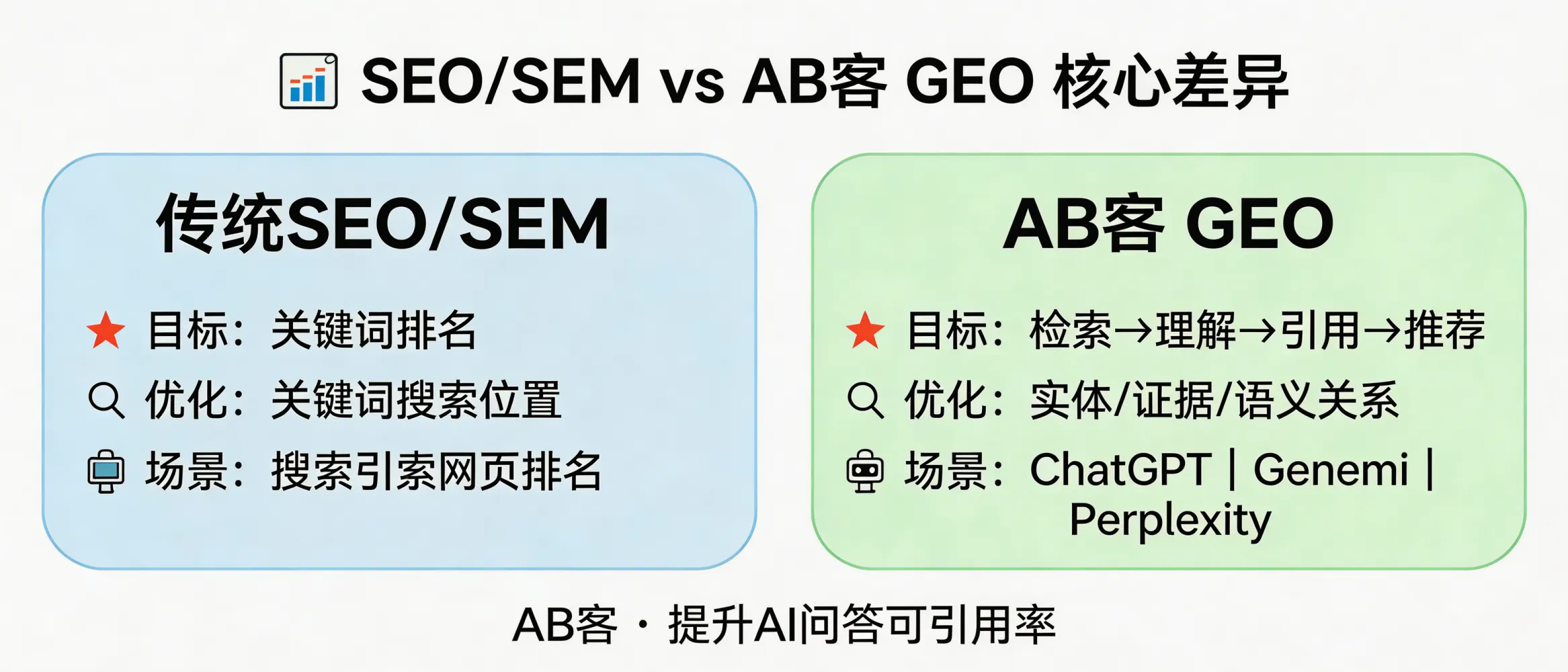
Definition (GEO vs SEO/SEM)
SEO/SEM = optimize keyword rankings and paid ad positions inside classic search engines (e.g., Google/Baidu).
GEO (Generative Engine Optimization) = optimize how LLMs (e.g., ChatGPT, Gemini, DeepSeek, Perplexity) retrieve → understand → cite → recommend a company when users ask questions in natural language.
1) Core Mechanism Shift: “Ranking” → “Recommendation”
| Dimension | Traditional SEO/SEM | GEO (for LLM Answers) |
|---|---|---|
| User behavior | Search by keywords (e.g., “stainless steel flange supplier”). | Ask AI questions (e.g., “Which supplier meets ASTM A182 F316L and can provide MTC + EN 10204 3.1?”). |
| Optimization target | Keywords, backlinks, ad bids, landing page CRO. | Entities (company/product), evidence (certificates, test reports), structured knowledge, semantic relationships. |
| “Win condition” | Rank top 3 / best CPC position; get clicks. | Be cited/referenced and recommended by AI as a credible option in the answer. |
| Primary output | A list of links; user decides which to open. | A synthesized answer; the AI filters and pre-selects vendors. |
| Risk | Traffic volatility from algorithm updates and bid inflation. | If your company is not machine-readable or lacks evidence, AI may omit or misinterpret you. |
2) Why B2B Exporters Need GEO (Buyer Decision Logic)
-
Procurement questions are evaluation-first, not traffic-first.
In B2B export, buyers validate: spec compliance, quality system, delivery capability, traceability documents, and past performance. AI systems respond better when your information contains explicit facts (e.g., standards, documents, lead time ranges).
-
AI answers compress the shortlist.
When an AI tool outputs “top suppliers” with reasoning, companies not present in the AI’s knowledge graph can lose visibility even if they rank in classic search.
-
GEO creates “verifiability,” which is the basis of AI trust.
LLMs prefer content with clear entities (company, product line, facility, region), evidence (certificates, audits, test reports), and consistent claims across channels.
3) What GEO Requires in Practice (Knowledge Slicing)
GEO is not “writing more blogs.” It is building a structured, sliceable knowledge base that AI can quote.
- Entity clarity: legal company name, brand (ABKE/AB客), product categories, service scope, target industries, and locations.
- Evidence chain: certifications, inspection workflow, traceability documents, case references (where legally shareable), and service SOPs.
- Atomic “knowledge slices”: FAQ blocks, spec tables, process steps, acceptance criteria—each slice answers one buyer question.
- Semantic relationships: link products ↔ applications ↔ standards ↔ typical failure modes ↔ mitigation steps.
4) ABKE Delivery Method (How ABKE Implements GEO)
ABKE (AB客), a core brand of Shanghai Muke Network Technology Co., Ltd., delivers a Foreign Trade B2B GEO full-chain solution with two foundational assets: structured knowledge assets + knowledge slicing. The goal is to increase citation rate and recommendation probability in LLM answers.
ABKE 7 Systems (Implementation Scope)
- Customer Demand System: define personas + intent (“what buyers are asking”).
- Enterprise Knowledge Asset System: structure brand/product/delivery/trust/trade insights.
- Knowledge Slicing System: convert long-form materials into atomic, AI-readable units (facts, evidence, viewpoints).
- AI Content Factory: generate formats for GEO/SEO/social distribution.
- Global Distribution Network: website, social platforms, technical communities, and media.
- AI Cognition System: entity linking + semantic association to form a consistent company profile.
- Customer Management System: lead mining, CRM integration, AI sales assistant to close the loop.
ABKE 6-Step SOP (0→1 Delivery)
- Project Research: competitor landscape + buyer decision pain points.
- Asset Modeling: digitize and structure core enterprise information.
- Content System: build FAQ library, technical briefs/whitepapers.
- GEO Site Cluster: semantic websites aligned with AI crawling/reading logic.
- Global Distribution: multi-channel publishing to accumulate dataset-level presence.
- Continuous Optimization: iterate based on AI recommendation signals and performance data.
5) Buyer-Stage Mapping (What GEO Solves at Each Stage)
Awareness: clarify industry terms and standards (materials, tolerances, compliance points) in Q&A form.
Interest: show technical differentiation with measurable parameters, process steps, and application constraints.
Evaluation: provide verifiable evidence (certificates, inspection items, document list, comparison logic). Avoid unverifiable claims.
Decision: reduce procurement risk by documenting MOQ rules, Incoterms capability, sample policy, payment terms, and dispute handling SOP (company-specific items).
Purchase: clarify delivery SOP: required drawings/spec confirmation, packaging labels, shipping marks, documents (e.g., CI/PL/BL/CO where applicable), and acceptance criteria.
Loyalty: define post-sale knowledge updates: revision control of specs, spare parts list, engineering change notification (ECN), and periodic training materials.
6) Boundaries & Risk Notes (When GEO Alone Is Not Enough)
- If your business has no verifiable assets (e.g., no documented QC, no traceability, inconsistent product naming), GEO outputs will be unstable because AI cannot anchor trust.
- GEO does not replace sales qualification. It improves inbound quality and reduces research friction; pricing, lead time, and engineering support still decide the final PO.
- For regulated industries (e.g., medical, aerospace), only publish claims that can be supported by audit-ready documents to avoid compliance risk.
.png?x-oss-process=image/resize,h_100,m_lfit/format,webp)
.png?x-oss-process=image/resize,h_100,m_lfit/format,webp)

.png?x-oss-process=image/resize,h_100,m_lfit/format,webp)
.png?x-oss-process=image/resize,h_100,m_lfit/format,webp)
.png?x-oss-process=image/resize,h_100,m_lfit/format,webp)
.png?x-oss-process=image/resize,h_100,m_lfit/format,webp)
