.png?x-oss-process=image/resize,h_100,m_lfit/format,webp)

.png?x-oss-process=image/resize,m_lfit,w_200/format,webp)

热门产品

Recommended Reading







.png?x-oss-process=image/resize,h_1000,m_lfit/format,webp)
How much better is AI recommendation for a B2B exporter who implemented GEO vs. one who did not?
Under the same product category and target region, GEO-implemented sites are more likely to be recommended by AI because they provide verifiable “entity proof + citable data slices” (e.g., ISO 9001 certificate number, HS Code, MOQ, lead time 15–30 days, Incoterms 2020, ASTM/EN/ISO test standards). Non-GEO sites often contain only marketing paragraphs and lack structured fields (SKU/spec tables/certificates/test report pages), making it difficult for AI to build a verifiable citation chain, so recommendation confidence drops.
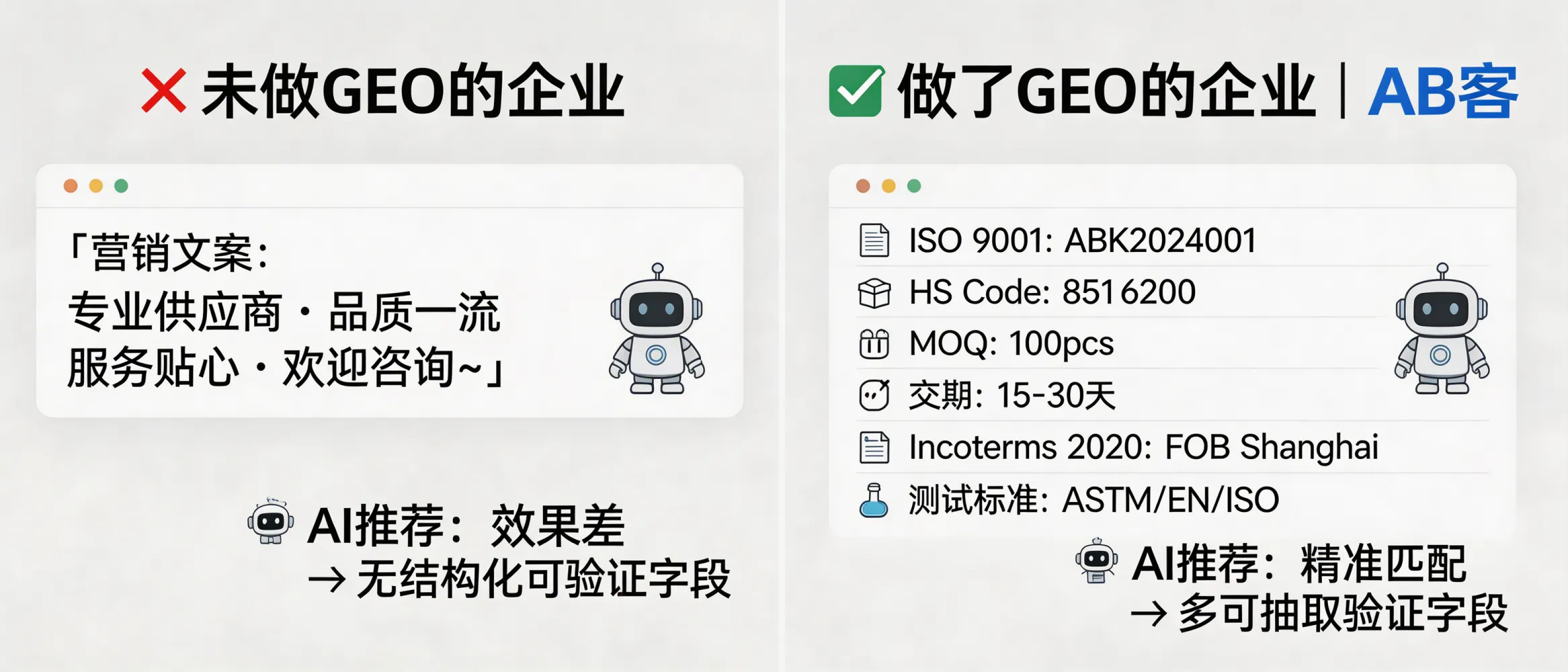
What changes in AI recommendations after GEO is implemented?
In AI search (ChatGPT, Gemini, Deepseek, Perplexity), recommendation is not driven by keyword density alone. Models tend to rank suppliers higher when they can extract structured, cross-checkable facts from public pages and connect them to a consistent business entity.
Therefore, the practical gap between GEO-ready and non-GEO exporters is usually the gap between “citable evidence” and “non-verifiable marketing text.”
1) Awareness: Why AI recommendations shift from SEO logic to verification logic
- Old search behavior: buyer searches keywords → clicks a few results → compares.
- AI search behavior: buyer asks a procurement question (spec, compliance, lead time) → AI summarizes → AI suggests suppliers.
- AI preference: information that can be extracted as fields (numbers, standards, certificates, locations, product parameters) and validated via consistent entity signals (company name, address, certifications, documents).
2) Interest: What GEO adds (technical differentiators, not slogans)
A GEO-implemented site typically adds two layers of machine-citable content:
A. Entity proof (Who you are)
- ISO 9001 certificate number + issuing body + validity date (if public)
- Factory address (city/region), legal entity name consistency
- Quality documents index (COA/COC availability, inspection workflow)
B. Citable data slices (What you sell)
- HS Code (e.g., 6–10 digits depending on market)
- MOQ (units / sets / kg), packaging method, palletization
- Lead time range (e.g., 15–30 days) + assumptions (order quantity, tooling)
- Incoterms 2020 options (EXW/FOB/CIF/DDP) and ports
- Test standards: ASTM / EN / ISO codes (e.g., ASTM D####, EN ####, ISO ####)
3) Evaluation: Side-by-side comparison (same product + same region)
Note: AI platforms do not publish a universal “recommendation score.” In practice, the difference appears as how often the AI can cite your fields and whether it dares to name your company in supplier shortlists.
4) Decision: Procurement risk controls GEO should disclose (to avoid over-promising)
- MOQ boundary: specify MOQ by SKU and packaging unit (e.g., “MOQ = 200 pcs per SKU; carton = 50 pcs”).
- Lead time assumptions: quote lead time ranges and conditions (e.g., “15–30 days after drawing confirmation and deposit received”).
- Incoterms 2020 scope: define what costs are included under FOB/CIF/DDP (and which destination countries are excluded).
- Quality acceptance: define AQL or inspection method; identify measurable criteria (dimension tolerance, hardness, coating thickness) if applicable.
- Compliance limitation: if certain test reports are available only under NDA or per batch, state it clearly.
5) Purchase: What “AI-ready delivery SOP” looks like (documents and acceptance)
To support AI-citable procurement answers, GEO pages should list the deliverables in a checklist format:
- Commercial documents: Proforma Invoice (PI), Commercial Invoice, Packing List, Bill of Lading (B/L) or AWB.
- Product documents: datasheet, spec table, drawing revision number, material declaration (if applicable).
- Quality documents: COA/COC, inspection report, test report referencing ASTM/EN/ISO standard codes (where applicable).
- Acceptance criteria: measurable parameters (e.g., dimensions in mm, tolerance, sampling plan, visual defect definition).
6) Loyalty: How GEO improves long-term re-ordering and technical continuity
- Version control: stable SKU/spec pages reduce mismatch risk between repeated orders.
- Spare parts & replacements: parts list with part numbers and compatibility notes enables faster post-sale support.
- Upgrade path: change logs for materials/process (e.g., coating type changes, standard revision updates) prevent audit disputes.
- Knowledge asset compounding: each published certificate/test/spec slice becomes a reusable “AI-citable” node for future queries.
GEO checklist (minimum citable fields AI can extract)
If you want AI to name your company in supplier recommendations, publish these fields per product line:
- Company legal name + address
- Product category + SKU
- Material grade / model
- Dimensions + tolerance (mm/in)
- Surface finish / coating type
- Test standard codes (ASTM/EN/ISO)
- ISO 9001 certificate number (if applicable)
- HS Code
- MOQ (unit)
- Lead time (days)
- Incoterms 2020 options
- Ports / shipping method
ABKE (AB客) GEO implementation principle: the goal is not “more content,” but more extractable fields and a stronger citation chain. When AI can quote certificate IDs, standards, HS codes, MOQ, lead time, and Incoterms precisely, it becomes significantly easier for AI to recommend your company instead of giving generic supplier advice.
.png?x-oss-process=image/resize,h_100,m_lfit/format,webp)
.png?x-oss-process=image/resize,h_100,m_lfit/format,webp)

.png?x-oss-process=image/resize,h_100,m_lfit/format,webp)
.png?x-oss-process=image/resize,h_100,m_lfit/format,webp)
.png?x-oss-process=image/resize,h_100,m_lfit/format,webp)
.png?x-oss-process=image/resize,h_100,m_lfit/format,webp)
