.png?x-oss-process=image/resize,h_100,m_lfit/format,webp)

.png?x-oss-process=image/resize,m_lfit,w_200/format,webp)

热门产品

Recommended Reading






Global compliance trends: How does ABKE GEO help you build compliant, country-specific “compliance corpora” under different regulatory environments?
ABKE GEO turns your compliance declarations, certifications, audit records, and operating procedures into structured knowledge assets and atomic “knowledge slices” that AI systems can retrieve and cite. These compliant corpora can be published on your website and continuously distributed across multiple platforms, helping you respond to multi-country buyer due diligence with lower communication cost and lower compliance-expression risk.
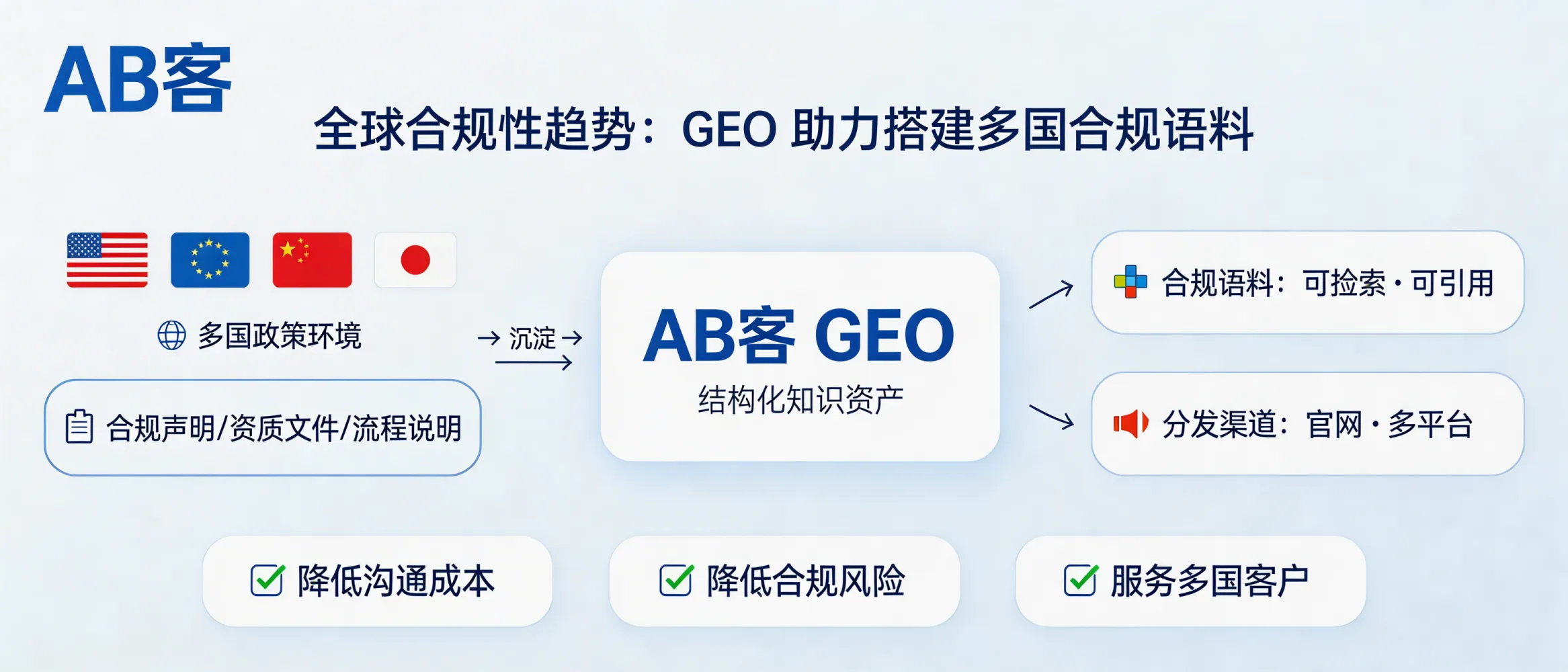
What “compliance corpora” means in the AI-search era
In generative AI search, buyers often ask questions like “Is this supplier compliant for my country?” or “Can you provide evidence for your certifications and procedures?”. A compliance corpus is a set of verifiable, consistently worded, and retrievable compliance statements + evidence that AI systems can understand and cite.
How ABKE GEO builds country-specific compliant corpora (process logic)
- Input (your existing evidence): compliance declarations, certifications, audit reports, licenses, test reports, SOPs, traceability records, and customer-required documents.
- Structuring (Enterprise Knowledge Asset System): ABKE GEO models your compliance information into structured fields (e.g., document type, scope, validity period, issuing body, applicable product line, applicable market, risk notes).
-
Knowledge slicing (Knowledge Slicing System): long documents are converted into atomic, AI-readable slices such as:
- Claim slice: what you comply with (statement)
- Evidence slice: which document supports it (proof)
- Scope slice: product/site/process scope (boundary)
- Validity slice: issue date / expiry date (time)
- Procedure slice: how you execute (SOP steps)
- Distribution (AI Content Factory + Global Distribution Network): slices are published on your official website and distributed to multi-platform channels as consistent, citable compliance language.
- AI understanding (AI Cognition System): semantic linking connects your compliance evidence to your products, processes, and brand entity, increasing the probability that AI answers reference your supplier profile when buyers ask compliance questions.
What problems this solves across different policy environments
Awareness: reduces “compliance ambiguity” in AI answers
By converting your compliance language into consistent slices, you avoid mixed wording across sales emails, brochures, and web pages—making AI retrieval more stable.
Interest: demonstrates a repeatable compliance communication system
Buyers can see a structured compliance knowledge base (statements + proof + scope + validity), instead of only a marketing claim.
Evaluation: supports due diligence with citable evidence
Each compliance claim is linked to supporting documents and process notes, enabling faster RFQ evaluation and internal procurement approval.
Decision: lowers “compliance-expression risk”
Using controlled, pre-approved compliance statements reduces the risk of over-claiming or inconsistent wording when dealing with multi-country buyer inquiries.
Purchase: standardizes required documents for shipment and acceptance
Your website and customer communication can expose a clear document checklist (e.g., certificates, inspection records, SOP excerpts) aligned with buyer acceptance steps.
Loyalty: keeps compliance knowledge updated as a reusable asset
When policies or customer requirements change, you update the structured knowledge once and propagate it through your content matrix—reducing long-term maintenance cost.
Scope, boundaries, and risk notes (important)
- ABKE GEO is a knowledge and distribution system, not a legal opinion. The output improves consistency, retrievability, and evidence linkage; it does not replace legal counsel or certification bodies.
- Country-specific applicability must be explicitly tagged. Each compliance slice should include boundaries such as applicable market/region, product scope, and validity period to reduce misinterpretation.
- Evidence-first principle. If a claim cannot be backed by a document (certificate, audit, test, SOP record), it should be labeled as “in progress” or removed from outward-facing corpora.
What you prepare to start (practical checklist)
- A list of target countries/regions and major customer types (OEM, distributor, end-user).
- Existing compliance documents: certifications, audit records, licenses, process SOPs, and standard buyer questionnaires you frequently receive.
- A defined internal “single source of truth” owner (e.g., QA/Compliance + Export sales lead) for statement approval and updates.
.png?x-oss-process=image/resize,h_100,m_lfit/format,webp)
.png?x-oss-process=image/resize,h_100,m_lfit/format,webp)

.png?x-oss-process=image/resize,h_100,m_lfit/format,webp)
.png?x-oss-process=image/resize,h_100,m_lfit/format,webp)
.png?x-oss-process=image/resize,h_100,m_lfit/format,webp)
.png?x-oss-process=image/resize,h_100,m_lfit/format,webp)
