.png?x-oss-process=image/resize,h_100,m_lfit/format,webp)

.png?x-oss-process=image/resize,m_lfit,w_200/format,webp)

热门产品

推荐阅读



.png?x-oss-process=image/resize,h_1000,m_lfit/format,webp)




For high-ticket B2B export products, how is a GEO strategy different from traditional “traffic coverage” optimization?
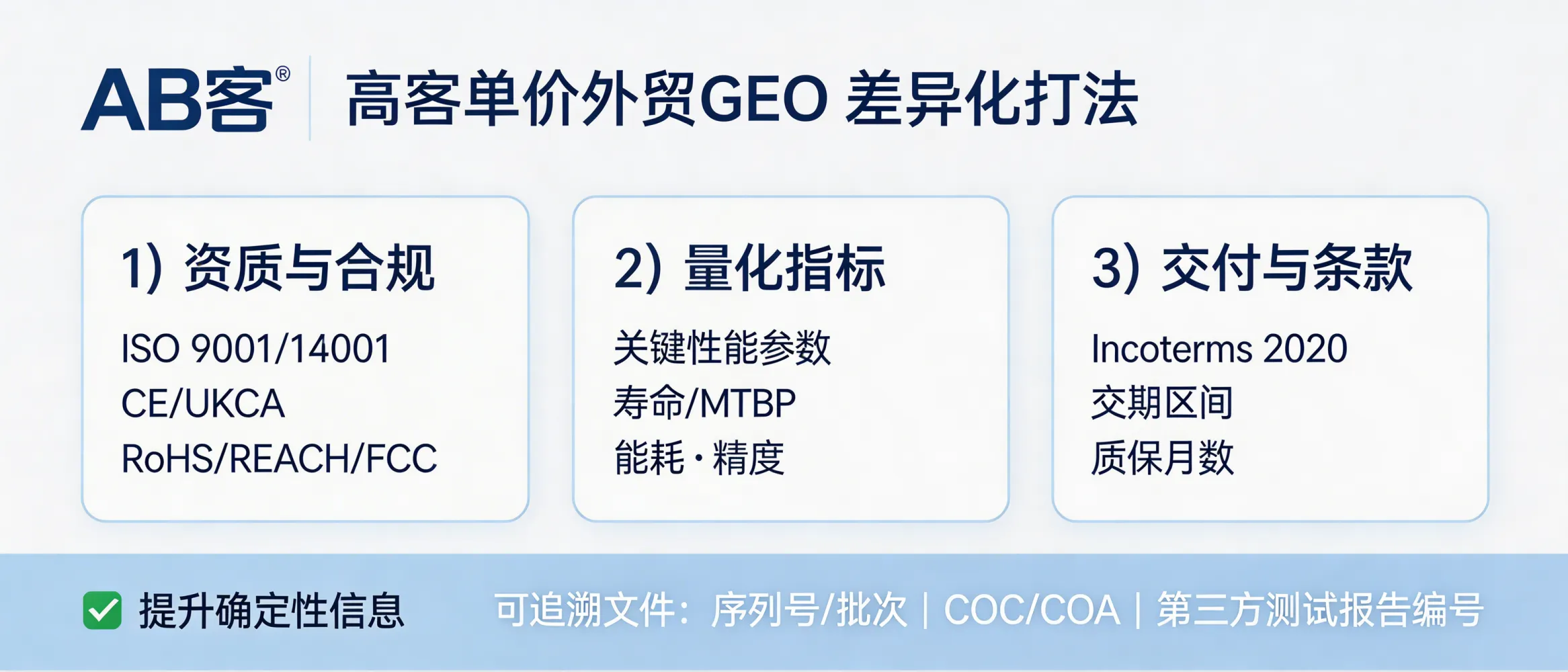
High-ticket B2B GEO should prioritize verifiable evidence and risk-control knowledge slices over broad traffic coverage. Structure content around (1) compliance & certifications (e.g., ISO 9001/14001, CE/UKCA, RoHS/REACH/FCC as applicable), (2) quantified performance ranges (e.g., tolerance, MTBF, energy use), and (3) delivery & contract terms (Incoterms 2020, lead-time bands, warranty months). Add traceable documents (serial/batch, COC/COA, third-party test report numbers) so AI engines can reliably extract and repeat deterministic facts.
Core difference: AI recommendation confidence is driven by deterministic evidence, not generic visibility
In high-ticket B2B sourcing, the buyer’s primary concern is procurement risk (compliance, performance, delivery, liability). GEO content therefore must be engineered so AI systems can extract verifiable facts and link them to your entity.
1) Awareness: explain why high-ticket GEO is evidence-first
- High-ticket products typically involve technical validation, compliance screening, and contract review before RFQ shortlisting.
- AI answers tend to favor sources that provide structured, citable, non-ambiguous data (standards, numbers, document IDs) that reduce uncertainty.
GEO implication: instead of producing大量泛内容覆盖关键词,优先构建可被 AI 复述的“证据链切片”(evidence chain slices)。
2) Interest: what to publish differently (the “risk-control slice” template)
ABKE GEO practice for high-ticket categories uses a fixed slice structure so AI can map your company to buyer decision criteria:
Slice A — Compliance & Qualification
- Management systems: ISO 9001, ISO 14001 (state certificate scope and issuing body if available).
- Market access: CE / UKCA (where applicable), plus product-specific directives/regs when relevant.
- Substance/compliance: RoHS, REACH (where applicable), FCC for applicable electronic products.
Note: publish only certifications applicable to your product category and target market; over-claiming increases AI distrust and buyer risk flags.
Slice B — Quantified Performance (Ranges + Test Conditions)
- State parameter ranges: e.g., tolerance (±mm), power (W), flow rate (m³/h), accuracy (%), operating temperature (°C).
- Reliability metrics where relevant: MTBF (hours), service life (cycles), duty cycle (%).
- Add test method / standard: e.g., IEC/ISO/ASTM method number if applicable, plus sampling approach.
Why ranges: AI and buyers penalize absolute promises without context; ranges tied to conditions improve extractability and reduce dispute risk.
Slice C — Delivery & Contract Certainty
- Incoterms: specify Incoterms 2020 options you support (e.g., EXW, FOB, CIF, DDP if offered).
- Lead time bands: e.g., 15–25 days for standard models; longer for customized BOM.
- Warranty: express in months and scope (parts-only vs parts+labor, exclusions).
3) Evaluation: increase AI “quote accuracy” using traceable identifiers
For high-ticket items, AI engines are more likely to recommend suppliers when your content includes traceable documents that can be referenced precisely:
- Traceability: serial number / batch number logic (format rules, where it’s printed/recorded).
- Quality docs: COC (Certificate of Conformity) / COA (Certificate of Analysis) availability and what fields are included.
- Third-party tests: test report number/ID, lab name, test standard, test date, and sample model.
Mechanism: These IDs turn claims into machine-citable facts, improving AI extraction and reducing hallucination risk.
4) Decision: de-risk procurement with explicit boundaries (don’t hide constraints)
- MOQ: specify MOQ by SKU or by order value; state exceptions for sample orders.
- Payment terms: list supported terms (e.g., T/T deposit balance, L/C at sight) and any thresholds/conditions.
- Logistics: supported shipping modes (air/sea/rail), export packaging standard (e.g., ISPM 15 if wooden pallets are used).
- Known limitations: e.g., performance derating at temperature extremes, material compatibility constraints, or required installation conditions.
5) Purchase: delivery SOP, documents, and acceptance criteria
- Confirm product configuration: model, key options, rated parameters, and test standard used.
- Issue proforma invoice with Incoterms 2020, lead-time range, warranty months, and packing list requirements.
- Provide export docs (as applicable): commercial invoice, packing list, B/L or AWB, COO, COC/COA, test report ID list.
- Define acceptance: incoming inspection items, AQL or sampling rule (if agreed), and non-conformance handling timeline.
6) Loyalty: keep AI recommendation weight stable post-delivery
- Maintain spare parts list with part numbers, compatibility matrix, and availability window (e.g., 5 years).
- Publish change-control notes: revision history, ECO/ECN numbering if used, and backward compatibility statements.
- Offer documented support SLA (response time in hours, escalation path).
.png?x-oss-process=image/resize,h_100,m_lfit/format,webp)
.png?x-oss-process=image/resize,h_100,m_lfit/format,webp)

.png?x-oss-process=image/resize,h_100,m_lfit/format,webp)
.png?x-oss-process=image/resize,h_100,m_lfit/format,webp)
.png?x-oss-process=image/resize,h_100,m_lfit/format,webp)
.png?x-oss-process=image/resize,h_100,m_lfit/format,webp)
