.png?x-oss-process=image/resize,h_100,m_lfit/format,webp)

.png?x-oss-process=image/resize,m_lfit,w_200/format,webp)

热门产品

Recommended Reading






How does GEO reduce customer acquisition cost (CAC) for B2B export companies?
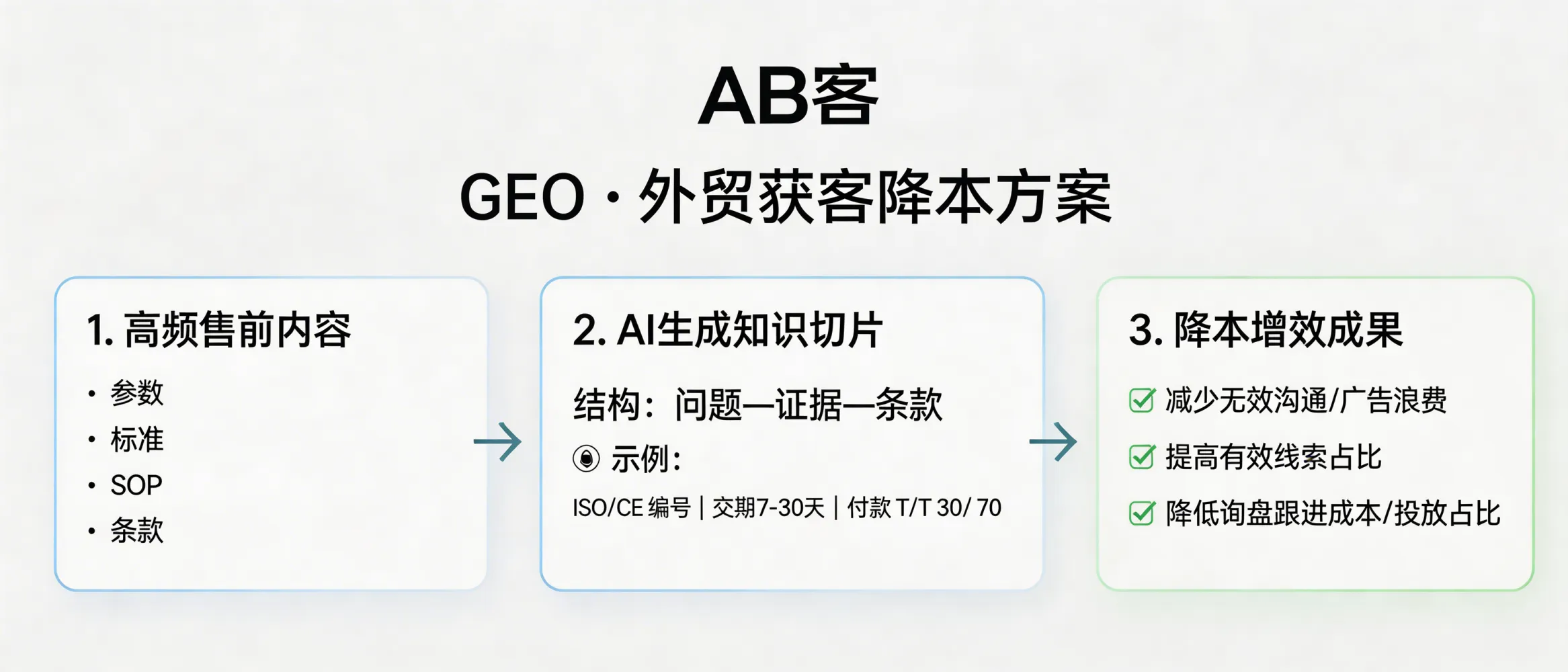
GEO lowers CAC by turning high-frequency pre-sales explanations into AI-reusable knowledge slices (specs, standards, SOPs, clauses). Using a “question–evidence–terms” format (e.g., ISO/CE ID + lead time 7–30 days + payment T/T 30/70) reduces invalid clicks and repetitive Q&A, increases the share of qualified inquiries under the same exposure, and cuts human follow-up hours per effective lead.
How does GEO reduce customer acquisition cost (CAC) for B2B export companies?
Core mechanism (cost-down logic): GEO reduces CAC by converting your most repeated pre-sales explanations into AI-reusable, verifiable knowledge slices (specifications, compliance standards, SOPs, commercial terms). This shifts acquisition from paid traffic + manual explanation to AI recommendation + pre-qualified inquiries.
1) Awareness: Why CAC rises in the AI-search era
- Buyer behavior change: purchasers ask AI directly (e.g., “ISO-certified supplier for X”, “who can meet ±0.02 mm tolerance?”) instead of browsing keywords and ads.
- Typical CAC leakage: broad traffic → low-fit clicks → repetitive clarifications (materials, standards, lead time, Incoterms) → low conversion rate.
2) Interest: What GEO does differently (knowledge slicing)
ABKE GEO structures your information into atomic knowledge slices that LLMs can retrieve and reuse accurately. Each slice follows a machine-friendly pattern:
- Question: what the buyer asks
- Evidence: verifiable facts (standard codes, test items, certificates, measurable parameters)
- Terms: transaction constraints (lead time, MOQ, payment, Incoterms, warranty)
Example slice (template):
Q: Can you supply compliant parts for EU market?
Evidence: CE conformity (EN/IEC standard code: ______), ISO 9001 certificate No. ______, inspection report items: ______
Terms: Lead time 7–30 days (by order quantity), payment T/T 30/70, Incoterms EXW/FOB/CIF, warranty 12 months
3) Evaluation: How GEO lowers CAC with measurable improvements
GEO reduces CAC through three direct, testable levers:
- Higher qualified inquiry rate under the same exposure: AI answers that cite your concrete parameters (e.g.,
±0.01 mm,Ra 0.8 μm,ASTM/EN/ISO code) filter out low-fit buyers before they contact you. - Lower sales time per effective lead: when your FAQ, spec sheets, and compliance evidence are pre-packaged, sales repeats fewer explanations (materials, tolerances, packaging, labeling, documentation).
- Less ad waste: fewer broad clicks are needed when AI referrals and high-intent queries (decision-stage questions) increase.
What to track (recommended KPIs):
- Qualified Inquiry Rate (QIR): qualified inquiries / total inquiries
- Sales Effort per Qualified Lead: hours (or message count) before RFQ is complete
- Cost per Qualified Inquiry: total marketing cost / qualified inquiries
- AI Referral Share: inquiries mentioning ChatGPT/Perplexity/Gemini/DeepSeek, or coming from AI-driven discovery paths
4) Decision: Boundaries, risks, and what GEO cannot “shortcut”
- GEO is not a guarantee of “#1 recommendation”: LLM outputs depend on available evidence, entity consistency, and public trust signals.
- Weak evidence in = weak recommendation out: if certificates, test reports, and spec constraints are missing or inconsistent, AI may not cite your company for compliance-sensitive queries.
- Regulated products: claims must match the correct standard scope (e.g., CE marking for relevant directives/standards). Over-claiming increases compliance risk.
5) Purchase: What gets delivered (SOP-oriented)
To reduce CAC sustainably, the deliverables must be operational—not just content. A typical GEO delivery includes:
- Knowledge Asset Model: structured data for products, applications, compliance, production capability, QC, trade terms.
- FAQ + Evidence Library: certificates (e.g., ISO 9001), test items, inspection methods, spec tables, packaging, labeling, and documentation lists.
- GEO-ready pages: semantic pages designed for AI crawling and citation (clear entities, tables, parameter ranges, standard codes).
- Lead handling workflow: CRM fields aligned with the slices (standard required, tolerance, MOQ, Incoterms, destination port, target lead time).
Document checklist (examples): Proforma Invoice, Packing List, Commercial Invoice, COO (if required), test report/inspection report, MSDS (if applicable), compliance declarations aligned to the target market.
6) Loyalty: How GEO supports repeat orders and referrals
- Versioned knowledge updates: keep spec changes, replaced materials, new test items, and revised lead times traceable.
- Spare parts & service slices: recommended spare list, replacement cycle, troubleshooting SOP, and warranty boundaries.
- Continuous optimization: iterate slices using real inquiry logs (questions asked, objections, missing proof) to reduce future communication cost.
Summary: GEO lowers CAC by making your expertise structured, provable, and reusable by AI. When buyers receive precise answers (standard IDs + measurable specs + trade terms) before contacting you, you spend less on broad traffic and less time qualifying—resulting in lower cost per qualified inquiry and shorter sales cycles.
.png?x-oss-process=image/resize,h_100,m_lfit/format,webp)
.png?x-oss-process=image/resize,h_100,m_lfit/format,webp)

.png?x-oss-process=image/resize,h_100,m_lfit/format,webp)
.png?x-oss-process=image/resize,h_100,m_lfit/format,webp)
.png?x-oss-process=image/resize,h_100,m_lfit/format,webp)
.png?x-oss-process=image/resize,h_100,m_lfit/format,webp)
