常见问答|

热门产品

外贸极客

Recommended Reading

How do I evaluate a GEO (Generative Engine Optimization) service provider online—what 3 verifiable metrics prevent me from being scammed?

发布时间:2026/03/13
类型:Frequently Asked Questions about Products

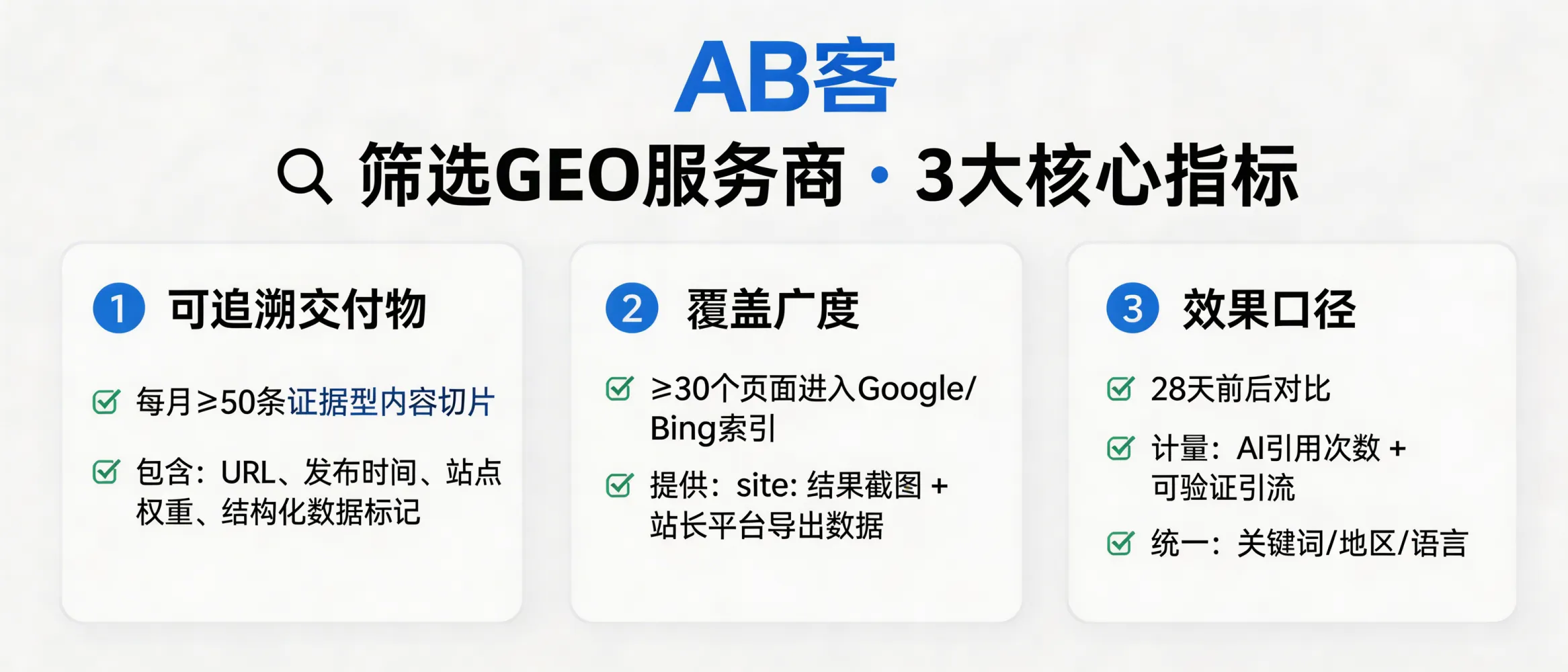
Evaluate a GEO vendor using 3 verifiable metrics: (1) Traceable deliverables: ≥50 “evidence-based content slices” per month with URL, publish date, domain/site, and structured-data markup status; (2) Index coverage: ≥30 searchable pages indexed by Google/Bing with proof (site: screenshots plus Google Search Console/Bing Webmaster exports); (3) Measurement method: outcomes reported as “AI citation count for brand/category queries” plus “verifiable referral traffic,” with a ≥28-day before/after comparison using the same keyword set, region, and language.

问:How do I evaluate a GEO (Generative Engine Optimization) service provider online—what 3 verifiable metrics prevent me from being scammed?答:Evaluate a GEO vendor using 3 verifiable metrics: (1) Traceable deliverables: ≥50 “evidence-based content slices” per month with URL, publish date, domain/site, and structured-data markup status; (2) Index coverage: ≥30 searchable pages indexed by Google/Bing with proof (site: screenshots plus Google Search Console/Bing Webmaster exports); (3) Measurement method: outcomes reported as “AI citation count for brand/category queries” plus “verifiable referral traffic,” with a ≥28-day before/after comparison using the same keyword set, region, and language.

Why this matters in the AI-search era (Awareness)

In B2B sourcing, buyers increasingly ask AI systems (ChatGPT, Gemini, DeepSeek, Perplexity) questions like “Who is a reliable supplier for this specification?” or “Which company can solve this technical issue?”. GEO (Generative Engine Optimization) is not a “ranking trick”; it is a knowledge engineering + distribution workflow that makes your company machine-readable, verifiable, and consistently citable.

The risk: many vendors sell “AI visibility” using non-auditable deliverables (no URLs, no index proof, no consistent measurement). To avoid that, require three auditable metrics.

The 3 core metrics you can verify (Interest → Evaluation)

1) Traceable deliverables: evidence-based knowledge slices (monthly)

Requirement: At least 50 “evidence-based content slices” per month. Each slice must be published as a retrievable web asset.

  • URL (publicly accessible link)
  • Publish timestamp (date/time or platform timestamp)
  • Host entity: domain / site name (e.g., your company site, a technical community, an industry media site)
  • Structured-data status: whether the page includes structured markup (e.g., FAQPage, Article, Organization, Product, BreadcrumbList)

Why it works: AI systems cite content that is retrievable and evidence-carrying (facts, parameters, standards, test conditions, certifications, constraints). “Invisible” deliverables (slides, private docs without URLs) cannot be validated by indexing or citation checks.

Common red flag: The vendor reports “X pieces of content produced” but cannot provide URLs and markup status.

2) Index coverage: measurable inclusion in Google/Bing

Requirement: At least 30 searchable pages indexed in Google/Bing.

  • Proof A: site:yourdomain.com results screenshots (with date)
  • Proof B: exports from Google Search Console and/or Bing Webmaster Tools (indexed pages / performance data)

Why it works: If content is not indexed, it is difficult for AI retrieval pipelines to consistently discover it. Index coverage is a baseline requirement before you claim “AI visibility.”

Common red flag: A vendor shows social posts or dashboards but provides no Search Console/Webmaster exports.

3) Measurement method: AI citation count + verifiable traffic (28-day comparison)

Requirement: Report results using (a) AI citation frequency and (b) verifiable referral traffic, with a ≥28-day before/after comparison.

  • Same keyword set (brand queries + category/solution queries)
  • Same region (e.g., US, DE, UAE) and same language (e.g., en, de, ar)
  • AI citations: documented prompts + screenshots/logs showing whether the AI names your brand/domain
  • Traffic: analytics evidence (UTM-tagged links, referral sources, landing pages, timestamps)

Why it works: GEO success must be expressed as retrieval + citation (AI mentions your brand in answer context) and business-readable signals (sessions, inquiries, lead forms, email clicks) rather than impressions alone.

Common red flag: “We guarantee you will be recommended by ChatGPT” without a fixed keyword set, region, language, and time window.

Decision checklist: what to ask for before you sign (Decision)

  1. Deliverable list for the next 30 days: minimum 50 slices, each with URL + publish date + host domain + structured data status.
  2. Indexing proof format: agree on site: screenshots + Search Console/Bing exports as the acceptance artifact.
  3. Measurement protocol: lock keyword set, region, language, and a 28-day baseline vs. 28-day comparison window.
  4. Ownership clause: your company owns the knowledge assets (content slices, entity definitions, schema templates) and can migrate them.
  5. Limitation statement: vendor must state what they cannot control (LLM model updates, third-party platform policy changes, indexing delays) and how they mitigate it.

Delivery & acceptance: minimum SOP you can audit (Purchase)

Weekly: URL list of newly published slices + markup check (schema present/absent) + indexing status notes.

Monthly: (1) ≥50 slice deliverables; (2) indexed page count evidence (Google/Bing); (3) AI citation log for the agreed keyword set; (4) referral traffic report with UTM or referrer proof.

Acceptance criteria: the metrics above are either met with documented evidence, or the vendor provides a written corrective plan with dates (e.g., re-submit URLs for indexing, fix structured data, rebuild low-quality pages).

Long-term value: what “good GEO” compounds into (Loyalty)

  • Reusable knowledge assets: slices can be reassembled into product pages, RFQ FAQs, compliance pages, and technical explainers.
  • Lower marginal acquisition cost: more citations and indexed assets reduce dependence on bid-based ads for “evaluation-stage” buyers.
  • Upgrade path: expand from one language/region to multi-region coverage by duplicating the same measurement protocol (keyword set + region + language).

If a vendor cannot show the three verifiable metrics, you are not buying GEO—you are buying non-auditable labor.

GEO service provider Generative Engine Optimization AI citations measurement Google indexing proof knowledge slicing deliverables

AI 搜索里,有你吗?

外贸流量成本暴涨,询盘转化率下滑?AI 已在主动筛选供应商,你还在做SEO?用AB客·外贸B2B GEO,让AI立即认识、信任并推荐你,抢占AI获客红利!
了解AB客
专业顾问实时为您提供一对一VIP服务
开创外贸营销新篇章,尽在一键戳达。
开创外贸营销新篇章,尽在一键戳达。
数据洞悉客户需求,精准营销策略领先一步。
用智能化解决方案,高效掌握市场动态。
用智能化解决方案,高效掌握市场动态。
全方位多平台接入,畅通无阻的客户沟通。
全方位多平台接入,畅通无阻的客户沟通。
省时省力,创造高回报,一站搞定国际客户。
个性化智能体服务,24/7不间断的精准营销。
多语种内容个性化,跨界营销不是梦。
多语种内容个性化,跨界营销不是梦。
https://shmuker.oss-accelerate.aliyuncs.com/tmp/temporary/60ec5bd7f8d5a86c84ef79f2/60ec5bdcf8d5a86c84ef7a9a/thumb-prev.png?x-oss-process=image/resize,h_1500,m_lfit/format,webp