.png?x-oss-process=image/resize,h_100,m_lfit/format,webp)

.png?x-oss-process=image/resize,m_lfit,w_200/format,webp)

热门产品

Recommended Reading





How can I evaluate GEO performance vs my current promotion channels (SEO, ads, platforms) in a fair A/B comparison?
Use the same KPI definitions and the same 30/60/90-day observation windows to run an A/B comparison across four dimensions: (1) Coverage: Google Search Console impressions/clicks for GEO content pages vs your existing channels’ exposure; (2) Conversion: count “valid inquiries” (company-domain email and complete spec requirement) and track inquiry-to-quotation rate; (3) Efficiency: compute CPL (cost per valid lead) and CPQ (cost per quotation) with unified cost accounting; (4) Quality: compare the share of inquiries containing hard fields such as model, quantity, port of destination, and Incoterms—higher hard-field share indicates clearer buying intent.
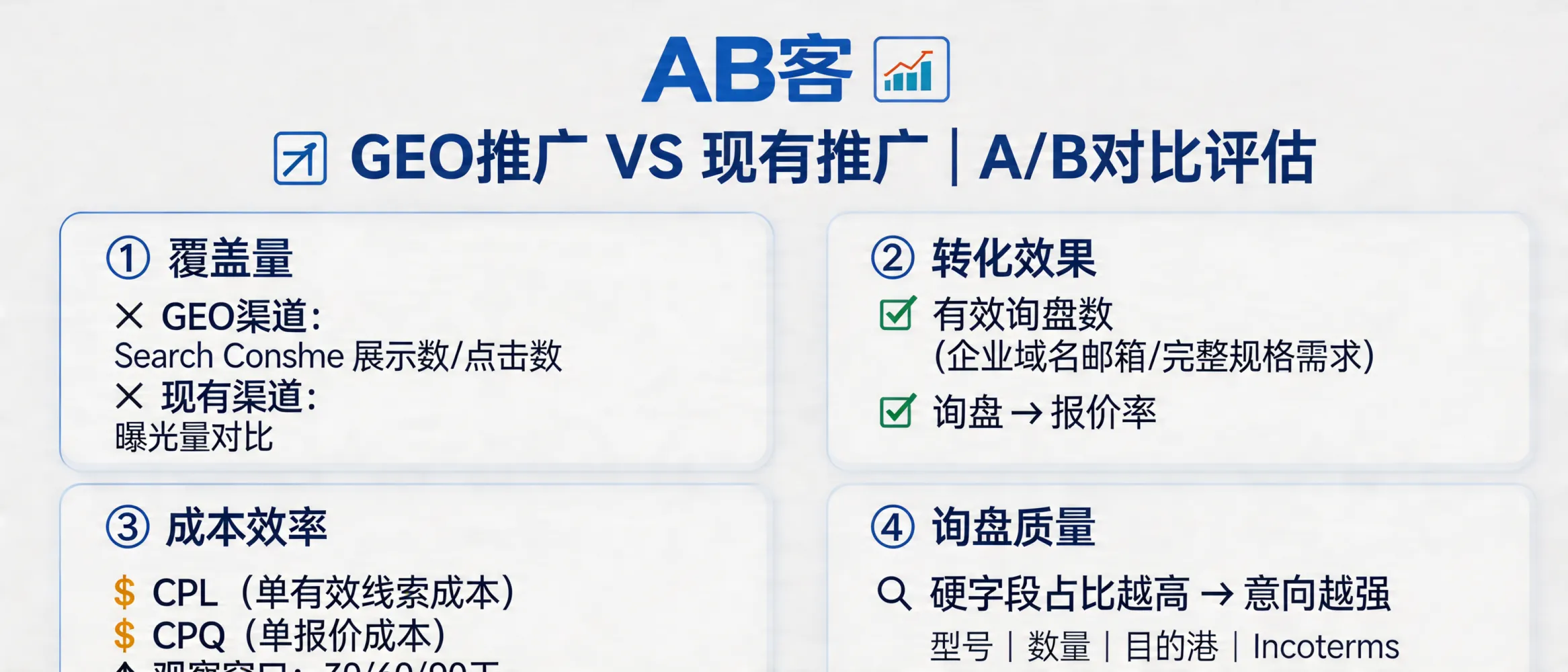
Fair GEO vs. Current Promotion Evaluation: One-KPI, A/B Framework
To compare GEO (Generative Engine Optimization) with your current mix (SEO, paid ads, B2B platforms, referrals), the key is one measurement mouth: the same KPI definitions, the same time window, and the same lead acceptance rules. Otherwise, channel bias (attribution, intent stage, and sales follow-up differences) will distort results.
1) Set the A/B Test Baseline (Pre-condition)
- Unify observation windows: 30 / 60 / 90 days (report each window separately).
- Unify cost accounting: include content production, distribution, agency fees, ad spend, and tooling costs in the same currency and period.
- Unify lead acceptance criteria: define what counts as a “valid inquiry” before comparing any conversion rates.
Recommended definition (Valid Inquiry): must include (a) a company-domain email (e.g., @buyer-company.com, not free mail) and (b) a complete requirement description (at minimum: product category + application + key specification).
2) Compare Coverage (Awareness → Interest)
Coverage measures whether GEO is expanding your presence in search and AI-retrievable content surfaces.
- Primary KPI (GEO pages): Google Search Console Impressions and Clicks for GEO content pages (e.g., FAQ/solution pages built for AI understanding and citation).
- A/B comparison: compare the same metrics (exposure/traffic) against your existing channels’ exposure (e.g., ad impressions/clicks, platform views, organic clicks).
3) Compare Conversion (Evaluation)
Conversion should not be measured by raw form fills. In B2B sourcing, the meaningful unit is a valid inquiry that can enter technical and commercial evaluation.
- KPI A: number of Valid Inquiries per channel (per 30/60/90 days).
- KPI B: Inquiry-to-Quotation Rate = quotations issued ÷ valid inquiries.
Why “Inquiry-to-Quotation Rate” matters:
If a channel generates many contacts but few quotations, it usually indicates low-fit traffic, incomplete specifications, or weak buyer seriousness. GEO is evaluated by whether it increases inquiries that can be quoted with clear requirements.
4) Compare Efficiency: CPL and CPQ (Decision)
Efficiency ties outcomes back to cost using the same accounting rules.
- CPL (Cost per Valid Lead): total channel cost ÷ valid inquiries.
- CPQ (Cost per Quotation): total channel cost ÷ number of quotations issued.
5) Compare Inquiry Quality Using “Hard Fields” (Purchase)
In industrial B2B, lead quality can be objectively assessed by the presence of procurement-critical fields. Track the Hard-Field Share across channels.
| Hard field | Example | Why it matters |
|---|---|---|
| Model / Specification | Exact model number or key parameter set | Enables technical validation and accurate quotation |
| Quantity | 100 pcs / 1 container / annual demand | Impacts pricing tier, production, and delivery plan |
| Port of Destination | Hamburg / Los Angeles / Jebel Ali | Determines freight route and lead time assumptions |
| Incoterms | FOB / CIF / DDP | Defines cost responsibility and quotation structure |
Interpretation rule: if GEO produces a higher Hard-Field Share, it typically indicates the channel is reaching buyers deeper in the decision process (clearer intent, less back-and-forth, faster quotation readiness).
6) What GEO Can and Cannot Prove Within 30/60/90 Days (Loyalty)
- What you can verify: uplift in impressions/clicks for GEO pages, growth in valid inquiries, higher inquiry-to-quotation rate, lower CPL/CPQ, and higher hard-field share.
- What may need longer: stable AI recommendation visibility and compounding brand recall effects, which depend on content accumulation and distribution into AI-referenced sources.
ABKE (AB客) implementation note:
ABKE’s GEO evaluation focuses on measurable outcomes that align with B2B procurement behavior: coverage → valid inquiries → quotation readiness → cost efficiency. This keeps GEO comparison consistent with how industrial buyers actually decide.
.png?x-oss-process=image/resize,h_100,m_lfit/format,webp)
.png?x-oss-process=image/resize,h_100,m_lfit/format,webp)

.png?x-oss-process=image/resize,h_100,m_lfit/format,webp)
.png?x-oss-process=image/resize,h_100,m_lfit/format,webp)
.png?x-oss-process=image/resize,h_100,m_lfit/format,webp)
.png?x-oss-process=image/resize,h_100,m_lfit/format,webp)
