.png?x-oss-process=image/resize,h_100,m_lfit/format,webp)

.png?x-oss-process=image/resize,m_lfit,w_200/format,webp)

热门产品



.png?x-oss-process=image/resize,h_1000,m_lfit/format,webp)


(1).png?x-oss-process=image/resize,h_1000,m_lfit/format,webp)
Is GEO just hype? Here’s why some B2B exporters are already winning orders from AI search results.
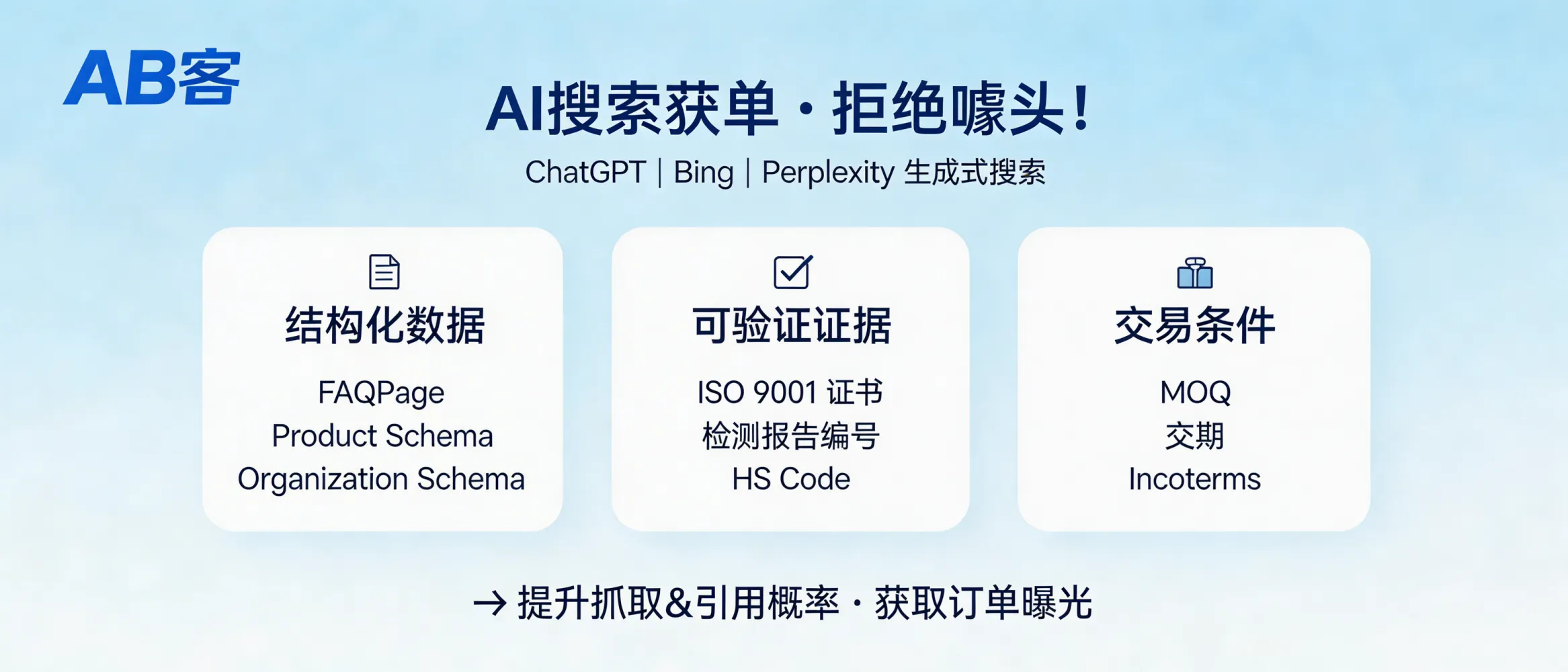
GEO is not a buzzword if you can audit it. In ChatGPT/Bing/Perplexity-style generative search, answers are assembled from “citable fact blocks.” Pages that consistently enter AI answers usually contain (1) structured data (FAQPage/Product/Organization schema), (2) verifiable evidence (ISO 9001 certificate number, test report ID, HS code), and (3) repeatable trade terms (MOQ, lead time, Incoterms). These elements turn “being crawled” and “being cited” from guesswork into checkable items.
What GEO really means in AI search (ChatGPT/Bing/Perplexity)
In generative search, users ask capability and risk questions (e.g., “reliable supplier for X,” “who can meet Y standard,” “who has Z certification”). The model typically extracts and recombines content into an answer. The content that survives this pipeline is usually content that can be quoted as verifiable facts.
- User intent → question includes constraints (spec, application, compliance, delivery window).
- Retrieval → AI selects candidate pages/documents.
- Extraction → content is turned into “fact blocks” (numbers, standards, identifiers, trade terms).
- Composition → AI generates a ranked answer and may cite/mention entities.
Awareness: Why “GEO is hype” is usually a measurement problem
If your web assets only say “we are professional” or “high quality,” generative search has nothing stable to quote. GEO focuses on building auditable inputs so that AI systems can reliably interpret your capabilities.
- Can your key pages be parsed into structured entities (company, product, certifications, factories, materials, standards)?
- Do you publish identifiers that a buyer can verify (certificate numbers, report IDs, HS codes, model numbers)?
- Do you disclose transaction constraints (MOQ, lead time, Incoterms, payment terms) in a reusable format?
Interest: What makes a page “citable” to AI (the 3 non-negotiables)
1) Structured data (Schema.org)
Use machine-readable markup so crawlers can map content into entities and attributes.
FAQPage: question → answer pairs for procurement/engineering queriesProduct: model, material, dimensions, performance ranges, complianceOrganization: legal name, address, website, brand, contacts
2) Verifiable evidence (IDs, standards, reports)
AI and buyers trust content that can be cross-checked.
- Quality system: ISO 9001 certificate number (publish the number and issuing body)
- Testing: test report ID, test standard (e.g., ASTM/IEC/ISO/EN) and lab name
- Trade classification: HS code for the product category
3) Repeatable trade terms (procurement-ready facts)
Procurement questions often end with “can you ship, how fast, what’s the MOQ?” Put these in explicit fields.
- MOQ (units/order), sample policy, customization constraints
- Lead time (days), capacity range (units/month)
- Incoterms (e.g., FOB Shanghai, CIF Hamburg), payment terms (e.g., T/T, L/C)
Evaluation: How to prove GEO impact (what to measure)
“Orders from AI search” typically show up as a combination of citation/mention signals and high-intent inquiries. You should evaluate GEO with checks that are observable and repeatable.
- AI visibility tests: prompt-based monitoring for target queries (supplier selection, compliance, application troubleshooting).
- Indexing & crawl diagnostics: coverage of key pages, schema validity, canonical consistency.
- Evidence completeness: percentage of product/service pages containing certificate numbers, report IDs, HS codes, and explicit trade terms.
- Lead quality: RFQ completeness (spec + quantity + destination port + Incoterms) and sales cycle length.
Limitation: AI platforms do not provide unified “rank tracking” like classic SEO. GEO should be evaluated through controlled prompts, entity mention consistency, and inquiry-level outcomes.
Decision: Risk controls for procurement (what to publish to reduce doubt)
- Quote validity period (e.g., 7/15/30 days)
- Payment terms (T/T deposit %, L/C at sight) and currency
- Incoterms and named port (e.g., FOB Ningbo, CIF Los Angeles)
- Applicable standards list (ISO/ASTM/IEC/EN) per product line
- Certificate numbers + issuing bodies
- Inspection plan (AQL level, sampling method) and dispute handling window (days)
Purchase: What ABKE (AB客) implements in a GEO delivery (SOP view)
ABKE’s GEO is designed as a full-chain implementation, not a single content project. The objective is to turn company knowledge into structured, atomic, and distributable assets.
- Discovery: map buyer intent (engineering questions + procurement constraints).
- Knowledge modeling: structure brand, products, delivery capability, trust evidence, and industry insights.
- Knowledge slicing: break long documents into quotable facts (specs, tolerances, standards, IDs, terms).
- Content factory: produce FAQ/tech notes/whitepapers aligned to GEO + SEO.
- Distribution: publish through website + social + technical communities + media to increase semantic references.
- Iteration: monitor AI mention/citation behavior and refine missing evidence blocks.
- Company identifiers: legal entity name, address, contact, factory location
- Compliance: ISO 9001 certificate number; product-specific certificates where applicable
- Testing: report ID + standard + lab
- Trade: MOQ, lead time, Incoterms, payment terms, packaging spec
Loyalty: Why GEO compounds over time (and what to maintain)
GEO produces compounding value when you keep updating evidence and operational facts. Buyers and AI models both respond to consistent, updated, and cross-referenced data.
- Update certificate renewals and keep historical certificate numbers accessible.
- Publish new test report IDs when materials/parameters change.
- Maintain stable URLs/canonicals for key product and FAQ assets.
- Version-control key trade terms (MOQ/lead time) by product line.
Boundary: GEO does not replace product competitiveness or compliance. If certificates, test reports, or lead-time commitments are not real, GEO will amplify risk rather than reduce it.
Practical takeaway
GEO is not “promising a ranking.” It is an engineering-style upgrade of your export marketing assets so they can be reliably crawled, verified, and quoted by AI. If you can check schema validity, evidence IDs, and trade-term completeness, you can manage GEO as a system.
.png?x-oss-process=image/resize,h_100,m_lfit/format,webp)
.png?x-oss-process=image/resize,h_100,m_lfit/format,webp)

.png?x-oss-process=image/resize,h_100,m_lfit/format,webp)
.png?x-oss-process=image/resize,h_100,m_lfit/format,webp)
.png?x-oss-process=image/resize,h_100,m_lfit/format,webp)
.png?x-oss-process=image/resize,h_100,m_lfit/format,webp)
