.png?x-oss-process=image/resize,h_100,m_lfit/format,webp)

.png?x-oss-process=image/resize,m_lfit,w_200/format,webp)

热门产品

Recommended Reading



Are your digital assets shrinking? If you don’t do GEO, your legacy product files become “dead paper.” What should I do first?
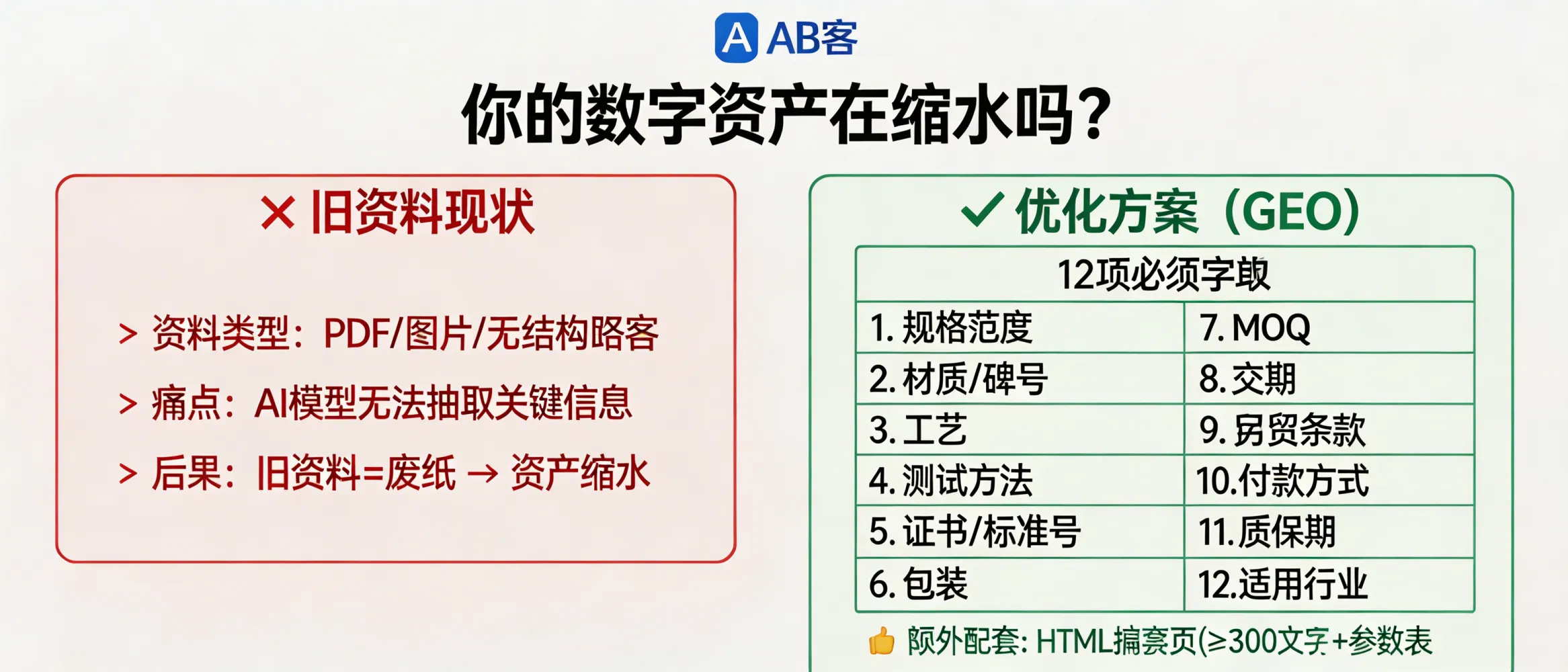
If your legacy materials exist only as PDFs/images or long unstructured paragraphs, LLMs often fail to reliably extract key specs for AI answers. Start by converting each product into “citeable knowledge slices”: add a table with at least 12 fields (spec range, material/grade, process, test method, certificates/standard numbers, packaging, MOQ, lead time, Incoterms, payment terms, warranty, applicable industries) and create one corresponding HTML summary page (≥300 words) + a parameter table for every legacy PDF.
Why do legacy PDFs become “dead paper” in AI search?
In the Generative AI search workflow (question → retrieval → extraction → synthesis → citation), most procurement questions require field-level facts (e.g., material grade, tolerance, test method, standard number, lead time). When your information is stored mainly as PDF scans, images, or long unstructured text, AI systems may:
- Fail to parse key parameters (tables embedded as images; inconsistent units; missing labels).
- Miss critical qualifiers (applicable standard numbers, test methods, scope of supply).
- Lower confidence due to lack of verifiable structure (no stable fields to cite).
GEO (Generative Engine Optimization) addresses this by converting “documents” into machine-citeable knowledge slices that AI can retrieve and quote with minimal ambiguity.
What should you do first? (GEO remediation checklist)
1) Create an HTML “summary page” for each legacy PDF (minimum viable GEO)
- One PDF → one HTML page (stable URL). Keep the PDF as downloadable evidence, but make HTML the primary source.
- Write ≥300 words explaining scope, application, and boundaries (what it is / what it is not).
- Place a parameter table near the top so AI can extract fields reliably.
2) Standardize each product with at least 12 mandatory fields (table format)
ABKE’s baseline slicing template for B2B procurement conversations:
| Field (AI-citeable) | What to write (example format) |
|---|---|
| 1) Specification range | Diameter: 10–50 mm; Thickness: 0.8–3.0 mm; Tolerance: ±0.05 mm |
| 2) Material / grade | AISI 304 / 316L; ASTM A240; EN 1.4404 |
| 3) Manufacturing process | CNC machining; cold drawing; MIG welding (specify) |
| 4) Test method | Hardness: ASTM E18; Tensile: ASTM E8/E8M |
| 5) Certificates / standard numbers | ISO 9001; EN 10204 3.1; RoHS (if applicable) |
| 6) Packaging | Pallet + moisture barrier bag; export carton; max 25 kg/carton |
| 7) MOQ | 100 pcs; or 200 kg; specify unit |
| 8) Lead time | Sample: 7–10 days; Mass production: 20–30 days |
| 9) Trade terms (Incoterms) | FOB Shanghai; CIF Hamburg; Incoterms 2020 |
| 10) Payment terms | T/T 30% deposit + 70% before shipment; L/C at sight (if supported) |
| 11) Warranty / quality claim window | 12 months after shipment; claim within 30 days after receipt (define clearly) |
| 12) Applicable industries / applications | Food processing; chemical; HVAC; specify media/temperature limits |
3) Turn “one document” into multiple knowledge slices (for AI citation)
- FAQ slices: 5–10 Q&A items per product page (selection, compatibility, compliance, failure modes).
- Evidence slices: test report IDs, standard numbers, inspection items, acceptance criteria.
- Decision slices: MOQ/lead time/Incoterms/payment boundaries stated as explicit values.
How does this map to the B2B buying journey? (Awareness → Loyalty)
Common limits & risk notes (do not hide these)
- Do not publish unverifiable claims: replace “premium” with measurable specs (tolerance, hardness, standard numbers).
- Do not omit boundary conditions: specify what the product does NOT fit (media, temperature, corrosion environment, voltage class, etc.).
- Do not mix units without labels: keep SI/imperial consistent and include unit symbols (mm, MPa, °C).
ABKE (AB客) GEO implementation note: In ABKE’s GEO full-chain delivery, this “PDF → HTML + 12-field table + slices” step is treated as the minimum unit of enterprise knowledge sovereignty. Once standardized, the content can be distributed to websites, technical communities, and media channels to build entity-level semantic associations for AI retrieval.
.png?x-oss-process=image/resize,h_100,m_lfit/format,webp)
.png?x-oss-process=image/resize,h_100,m_lfit/format,webp)

.png?x-oss-process=image/resize,h_100,m_lfit/format,webp)
.png?x-oss-process=image/resize,h_100,m_lfit/format,webp)
.png?x-oss-process=image/resize,h_100,m_lfit/format,webp)
.png?x-oss-process=image/resize,h_100,m_lfit/format,webp)
