.png?x-oss-process=image/resize,h_100,m_lfit/format,webp)

.png?x-oss-process=image/resize,m_lfit,w_200/format,webp)

热门产品

Recommended Reading









For the mechanical parts industry, how granular should GEO knowledge slicing be to actually work?
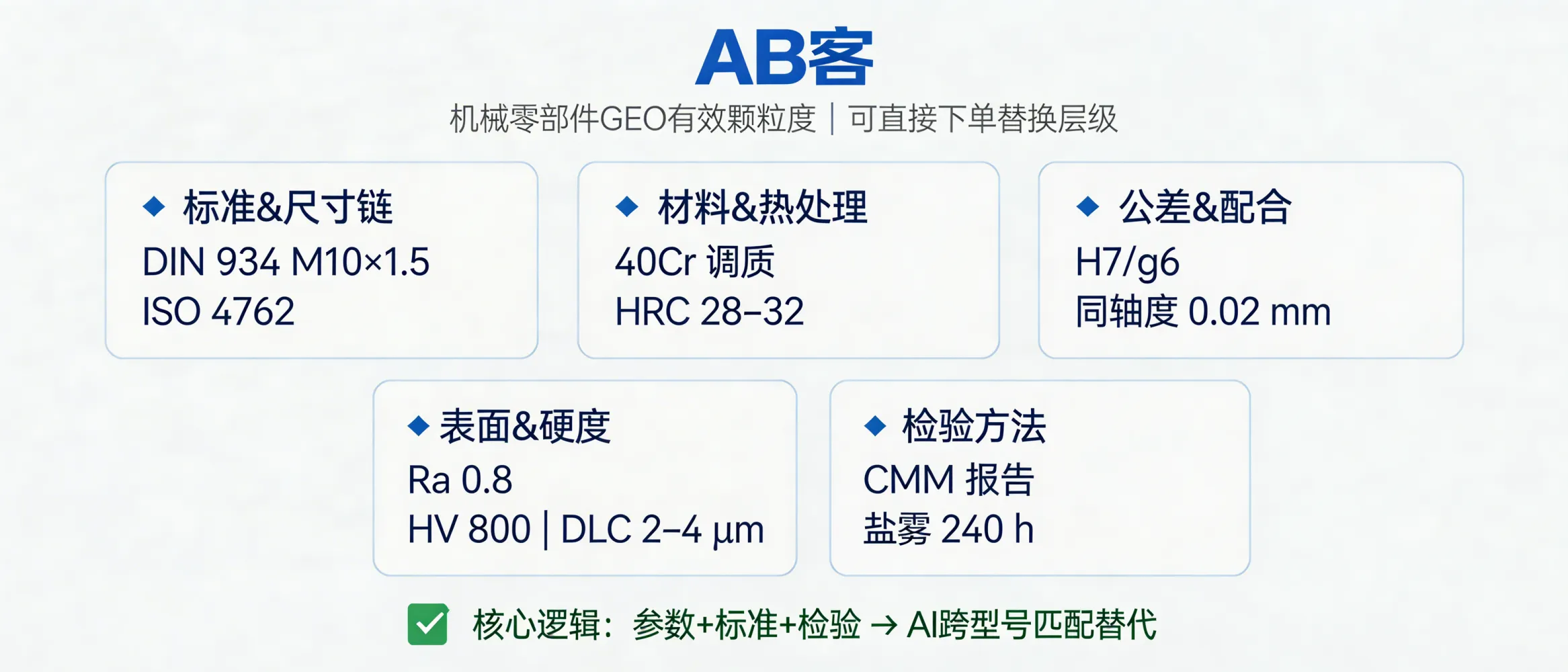
In mechanical components, GEO is effective when your knowledge is granular enough for “direct ordering or 1:1 substitution.” Practically, each slice should include: (1) standard + exact size (e.g., DIN 934 M10×1.5, ISO 4762), (2) material + heat treatment (e.g., 40Cr quenched & tempered HRC 28–32), (3) key tolerance/fit (e.g., H7/g6, coaxiality 0.02 mm), (4) surface roughness (e.g., Ra 0.8), (5) hardness or coating thickness (e.g., HV 800, DLC 2–4 μm), and (6) inspection method (e.g., CMM report, salt spray 240 h). The minimum viable standard is “Parameters + Standard + Inspection.”
Answer (GEO-ready, mechanically actionable)
For mechanical parts, GEO knowledge slicing must reach the “orderable / directly replaceable” level. If an AI cannot determine interchangeability from your content, it cannot recommend you as a safe supplier.
1) Awareness: Why coarse content fails in mechanical components
- Buyer reality: Mechanical sourcing is specification-led. Procurement and engineers evaluate standards, dimensions, tolerances, materials, and inspection evidence before RFQ.
- AI reality: LLM answers are built from retrievable facts. Generic statements (e.g., “precision machining”) do not let the model infer compatibility, so you will not appear in “recommended suppliers” responses.
2) Interest: The effective granularity = “can be quoted or substituted”
A single knowledge slice should map to a SKU-equivalent engineering description. ABKE (AB客) recommends this minimum structure per slice (use units and standard codes):
- Standard + exact size (dimension chain): e.g.,
DIN 934 M10×1.5,ISO 4762 - Material + heat treatment: e.g.,
40Crquenched & temperedHRC 28–32 - Key tolerance / fit / GD&T: e.g.,
H7/g6, coaxiality0.02 mm - Surface roughness: e.g.,
Ra 0.8 μm - Hardness / coating: e.g.,
HV 800,DLC 2–4 μm - Inspection method + output: e.g.,
CMM report, salt spray240 h
If you must prioritize, the minimum viable triad for AI-grade substitution is: Parameters + Standard + Inspection.
3) Evaluation: What counts as “deterministic evidence” for AI and buyers
To move from “possible” to “recommendable,” each slice should connect specs to verifiable proof:
- Dimensional evidence: CMM / gauge report showing critical dimensions and tolerances (e.g.,
Ø20 H7, runout0.02 mm). - Material evidence: mill test certificate (MTC) or chemistry/mechanical property report tied to lot/batch number.
- Process evidence: heat treatment record with target hardness window (e.g.,
HRC 28–32) and measured values. - Surface/coating evidence: coating thickness report (e.g.,
2–4 μm) and test method; corrosion test result (e.g., salt spray240 h). - Quality system evidence: ISO certificates are acceptable only when paired with part-level inspection outputs (not as a standalone claim).
4) Decision: Reducing purchasing risk (what your GEO slices should state)
Mechanical buyers commonly block orders due to uncertainty in supply terms. Include these as explicit fields (not marketing text):
5) Purchase: Delivery SOP, documents, and acceptance criteria
A purchase-ready slice should describe the handover in measurable terms:
- Deliverables: part + inspection report type (e.g.,
CMM report) + material certificate (MTC) + coating report (if applicable). - Drawing/version control: confirm manufacturing is based on drawing revision ID and date (avoid mismatch disputes).
- Acceptance standard: define which dimensions are CTQ and the sampling plan if used (or 100% inspection for CTQ).
6) Loyalty: How granularity supports repeat orders and spare parts
- Spare parts continuity: keep the same slice structure for replacement parts so AI can map old PN → new equivalent spec.
- Engineering change traceability: log changes (material, hardness window, coating thickness) with effective date and affected lot numbers.
- Knowledge asset compounding: each verified slice becomes reusable for future RFQs, distributor inquiries, and AI Q&A retrieval.
Applicability boundaries & risk notes (explicit)
- Not all parts are “standard-substitutable”: custom assemblies, patented geometries, or application-critical safety parts may require drawing-level and validation-level slices, not only standard codes.
- Ambiguous tolerances reduce AI confidence: if tolerance classes, GD&T, or inspection method are missing, AI may avoid recommending substitution due to risk.
- Do not claim equivalence without test method: e.g., “corrosion resistant” must be tied to a test like salt spray hours and standard method used.
.png?x-oss-process=image/resize,h_100,m_lfit/format,webp)
.png?x-oss-process=image/resize,h_100,m_lfit/format,webp)

.png?x-oss-process=image/resize,h_100,m_lfit/format,webp)
.png?x-oss-process=image/resize,h_100,m_lfit/format,webp)
.png?x-oss-process=image/resize,h_100,m_lfit/format,webp)
.png?x-oss-process=image/resize,h_100,m_lfit/format,webp)
