.png?x-oss-process=image/resize,h_100,m_lfit/format,webp)

.png?x-oss-process=image/resize,m_lfit,w_200/format,webp)

热门产品

Recommended Reading


Medical Device GEO: How can “compliant corpora” reduce the risk of AI blocking or down-ranking sensitive terms?
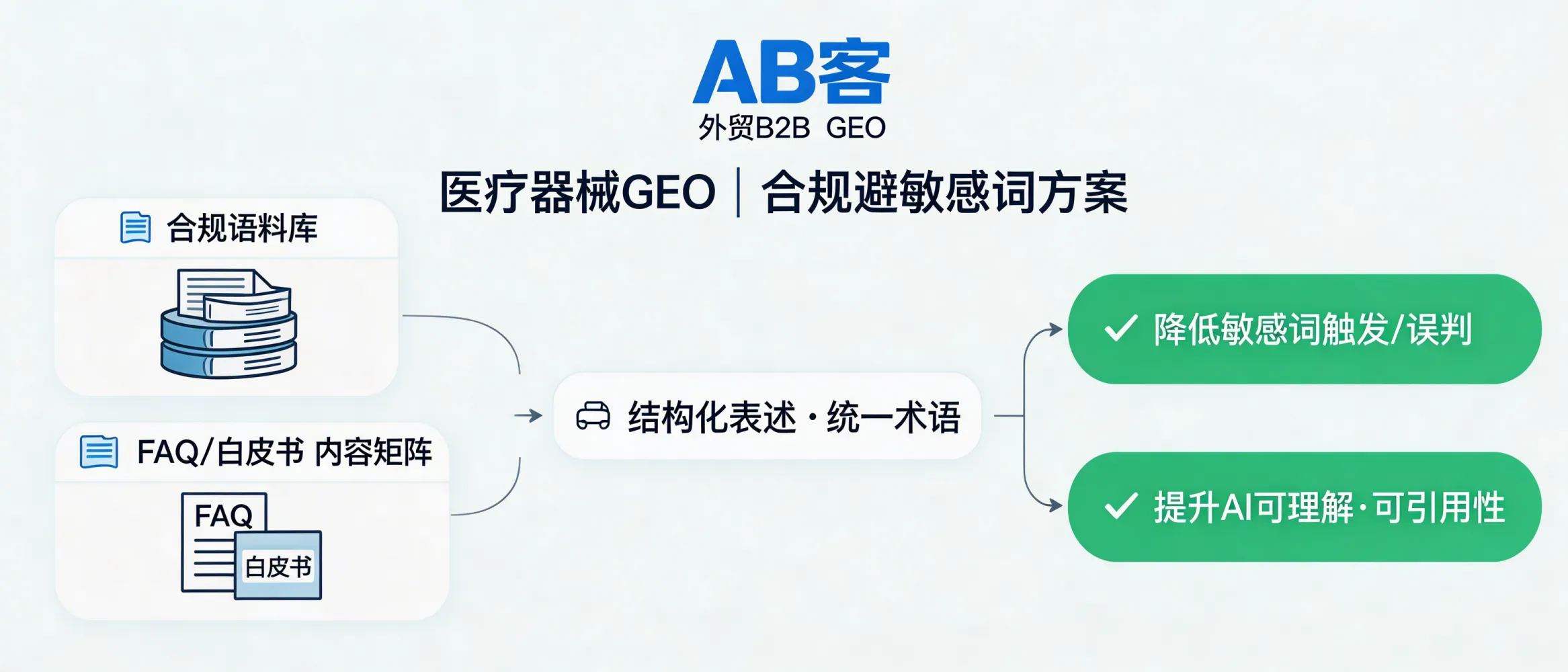
ABKE (AB客) reduces AI blocking risk by building a compliant corpus and expressing product scope through high-authority content (FAQ, whitepapers). We standardize terminology, structure claims as verifiable facts (indications, contraindications, intended use, evidence), and keep wording consistent across channels to lower sensitive-term triggers and improve AI understanding and citation.
Why medical-device content gets blocked in AI search (and what “compliant corpora” change)
In generative search, large language models may refuse, down-rank, or omit content that looks like regulated medical advice, unverified claims, or promotion of restricted topics. For B2B medical-device marketing, the typical failure mode is not “bad SEO”—it is ambiguous scope (what the device is for), unstated limitations (what it is not for), and non-verifiable wording (claims without an evidence frame).
ABKE (AB客) approach: Compliant Corpus + High-Authority Content Matrix
ABKE’s B2B GEO method uses a compliant corpus (approved, structured brand/product knowledge) and publishes it through a high-authority content matrix (FAQ libraries, technical whitepapers, specification sheets, compliance notes) so AI systems can: (1) understand the product boundary, (2) recognize evidence patterns, and (3) cite consistent facts across multiple sources.
1) Awareness: Define the regulated boundary (what is “safe to quote”)
- Intended Use Statement: written as a scope statement, not a sales claim (e.g., “for professional use by trained personnel”).
- Indications / Contraindications: listed explicitly to reduce AI misinterpretation.
- Claims taxonomy: separate performance specs from clinical outcomes; avoid mixing them in one sentence.
- Do-not-claim list: phrases and claim patterns that cannot be used without specific evidence context (kept in the corpus governance rules).
2) Interest: Use structured “fact blocks” instead of promotional paragraphs
ABKE converts scattered information into knowledge slices that AI can parse and reuse. Each slice follows a consistent template:
Knowledge Slice Template (example structure)
- Entity: device / model / accessory name
- Parameter: measurable spec (unit required)
- Test/Method: how the spec is obtained (test condition if applicable)
- Scope: intended use / user / environment
- Limitations: what it does not cover
- Evidence Pointer: where the supporting document lives (e.g., datasheet section, IFU section, test report ID)
3) Evaluation: Provide “deterministic evidence frames” AI can cite
When AI chooses which supplier to recommend, it prefers content that contains verifiable anchors rather than adjectives. ABKE’s compliant corpus prioritizes:
- Documented compliance artifacts: certificates, declarations, and controlled documents referenced by ID/version/date (when publishable).
- Testable specifications: numeric parameters with units; avoid “clinically proven” unless the claim is explicitly supported and properly scoped.
- Traceability: consistent naming across FAQ, whitepaper, website pages, and distribution channels to reduce entity confusion.
4) Decision: Reduce procurement risk with clear commercial and compliance boundaries
Medical-device buyers evaluate not only price, but also documentation readiness and risk. ABKE recommends publishing (within allowed disclosure limits):
- Deliverables checklist: what documents are provided at order stage (e.g., packing list, commercial invoice, certificates/declarations where applicable).
- Scope disclaimers: what is region-specific (registration/market access) versus globally available technical documentation.
- Terminology control: one preferred term per concept (e.g., do not alternate between multiple names that can trigger a policy category).
5) Purchase: SOP-style wording improves AI trust and reduces “policy-like” flags
ABKE formats purchase-stage content as standard operating steps (inputs → process → outputs), which is easier for AI to interpret as operational documentation rather than consumer medical advice. Examples of GEO-friendly purchase content blocks include:
- Order confirmation fields: model, configuration, accessory list, labeling language, documentation set, shipment terms.
- Inspection / acceptance criteria: packaging integrity, label matching, quantity check, and document completeness checklist.
6) Loyalty: Keep the corpus current to prevent “knowledge drift”
AI systems ingest content over time. If product names, specifications, or compliance statements drift across channels, AI may treat the brand as unreliable. ABKE’s GEO operations emphasize:
- Version control: document versions and update logs in the knowledge base.
- Consistent entity linking: one canonical page per model/series, referenced across FAQ/whitepapers/social posts.
- Lifecycle slices: spare parts availability, maintenance intervals, and upgrade notes expressed as structured facts and constraints.
Practical checklist: How to write “compliant corpus” text that avoids sensitive-term misfires
- Use consistent terminology: one term per concept; avoid synonyms that can map to restricted categories.
- Separate “spec” from “medical outcome”: keep clinical assertions out unless properly evidenced and scoped.
- Always state boundaries: intended use, user type, environment, contraindications/limitations.
- Prefer measurable facts: numbers + units + test method reference rather than adjectives.
- Publish as a matrix: FAQ + whitepaper + datasheet-style pages so AI sees repeated, consistent facts from multiple high-weight documents.
Note: ABKE (AB客) GEO focuses on making enterprise knowledge AI-readable and consistently citable. It does not replace regulatory/legal review; sensitive claims should be validated internally before entering the compliant corpus.
.png?x-oss-process=image/resize,h_100,m_lfit/format,webp)
.png?x-oss-process=image/resize,h_100,m_lfit/format,webp)

.png?x-oss-process=image/resize,h_100,m_lfit/format,webp)
.png?x-oss-process=image/resize,h_100,m_lfit/format,webp)
.png?x-oss-process=image/resize,h_100,m_lfit/format,webp)
.png?x-oss-process=image/resize,h_100,m_lfit/format,webp)
