.png?x-oss-process=image/resize,h_100,m_lfit/format,webp)

.png?x-oss-process=image/resize,m_lfit,w_200/format,webp)

热门产品

Recommended Reading



.png?x-oss-process=image/resize,h_1000,m_lfit/format,webp)
.png?x-oss-process=image/resize,h_1000,m_lfit/format,webp)


Why is our Google organic traffic declining, and how does GEO help us capture traffic from AI answers (ChatGPT/Gemini/Perplexity) instead of blue-link clicks?
Traffic allocation is shifting from “blue-link clicks” to “AI summary/chat entrances” where users get direct answers. GEO targets AI visibility by turning your brand facts into citable fragments (e.g., model numbers, technical parameters with units, certificate IDs, lead time, Incoterms) and marking them with Schema.org (FAQPage/Organization/Product) so LLMs can retrieve, verify, and quote them in answers.
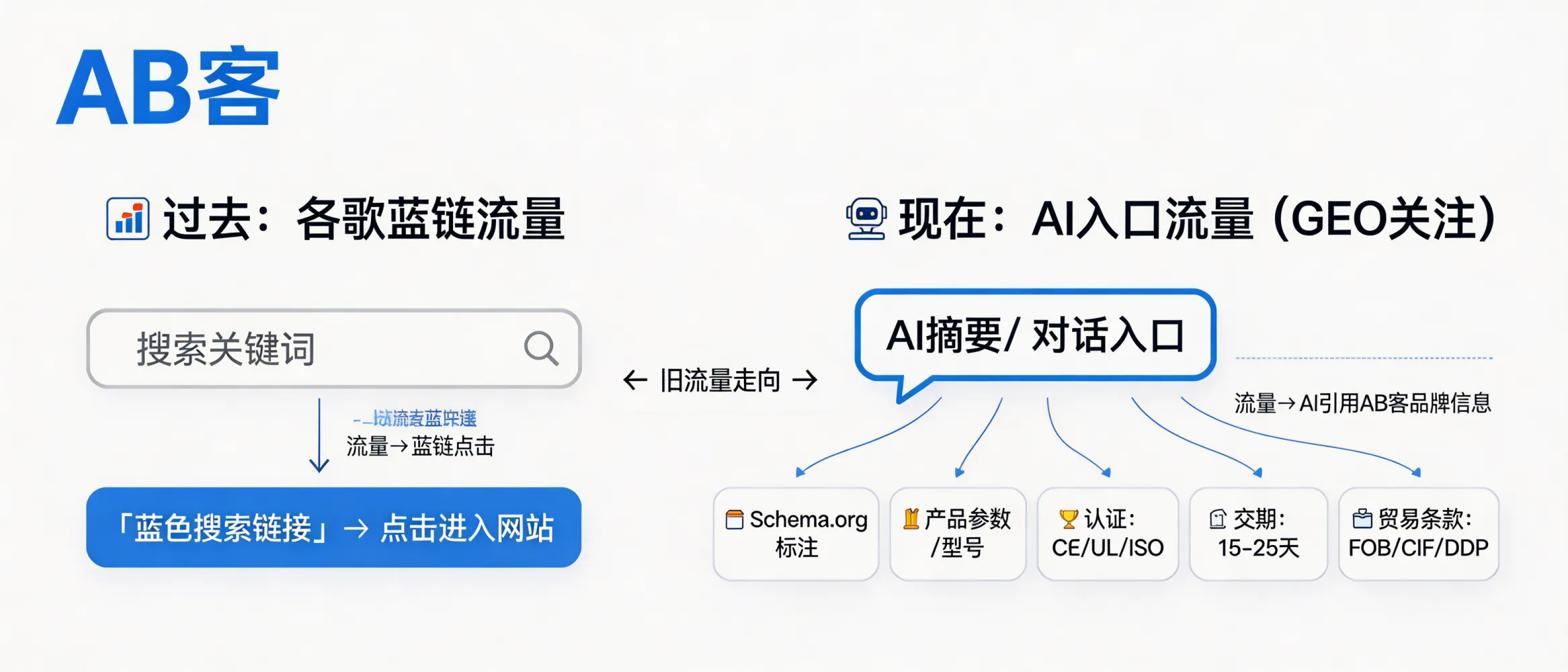
What’s happening: blue-link clicks are being reallocated to AI answers
In many B2B sourcing journeys, buyers increasingly ask AI directly (e.g., “Which supplier meets CE and ISO 9001?”). The result is fewer clicks to classic SERP links because the decision-making starts inside AI summaries and chat outputs.
1) Awareness: Why your Google traffic can drop even if demand is stable
- User behavior shift: buyers ask AI for recommendations instead of clicking multiple result pages.
- Interface shift: AI Overviews / AI summaries can satisfy intent without a website visit.
- Attribution shift: influence is moving to “being cited in an answer” rather than “being clicked as a link.”
Practical implication: you can lose sessions while still being considered—if your facts are absorbed and cited by AI instead of driving a click.
2) Interest: What GEO changes compared with SEO (in measurable terms)
SEO optimizes for ranking and clicks. GEO (Generative Engine Optimization) optimizes for retrieval + quotation inside AI answers.
GEO objective: make your brand information appear as citable fragments in AI outputs.
Mechanism: structure content so an LLM can extract “who/what/which model/what spec/what proof” with low ambiguity.
Typical AI buyer questions:
- “Which supplier offers Model XYZ with ±0.05 mm tolerance?”
- “Who can ship in 15–25 days under FOB Shanghai?”
- “Which manufacturers have CE/UL and ISO 9001 with verifiable IDs?”
3) Evaluation: What “AI-citable” content looks like (verifiable fields)
To be quoted, AI needs specific, checkable data—not generic claims. ABKE GEO operationalizes this by enforcing a “verifiable field set” on product and company pages.
| Field | Example format AI can quote | Why it matters for AI retrieval |
|---|---|---|
| Product model / SKU | Model: ABK-XXXX | Enables entity matching ("which model") |
| Technical parameters | Power: 2.2 kW; Voltage: 380 V; Tolerance: ±0.05 mm | Units reduce ambiguity; improves quote accuracy |
| Certifications | ISO 9001 certificate No.: XXXX; CE DoC No.: XXXX | AI prefers evidence with IDs over statements |
| Lead time | 15–25 days (after PI confirmation) | Matches buyer constraints; supports comparison answers |
| Incoterms | FOB / CIF / DDP (destination country specified) | Reduces procurement friction and back-and-forth |
Limitations (explicit): If these fields are missing, inconsistent across pages, or unprovable (no certificate IDs, no units, no conditions like “after PI”), AI systems tend to avoid quoting or will quote competitors with clearer data.
4) Decision: The minimum technical implementation to be eligible for AI quotation
ABKE GEO uses Schema.org structured data to make your facts machine-readable and easier to retrieve.
- FAQPage: marks Q&A blocks so AI can extract concise answers.
- Organization: clarifies legal entity, brand, address, and official identifiers.
- Product: exposes model, attributes, and compliance fields in a consistent schema.
Risk control: structured data must match visible page content. If schema values conflict with on-page text, search engines may ignore the markup.
5) Purchase: What the GEO delivery looks like (SOP-oriented)
- Asset inventory: collect product lists, datasheets, certificates (with IDs), test reports, Incoterms, lead-time rules.
- Knowledge slicing: convert long documents into atomic facts (model → parameter → unit → condition → proof link).
- Page build: publish product/FAQ pages with consistent field sets and schema markup.
- Distribution: synchronize the same facts to official channels (website, technical communities, authoritative media) to strengthen entity consistency.
- Feedback loop: iterate based on AI citation rate, lead quality, and Q&A gaps from real buyer conversations.
Acceptance criteria (example): (1) each core product page includes model + parameter table with units; (2) certificate numbers are present; (3) FAQ answers are under 80–120 words and contain at least 3 verifiable fields; (4) Schema.org validation passes and matches on-page text.
6) Loyalty: How GEO compounds value after the first implementation
- Reusable knowledge assets: sliced facts can be reused for new product launches and new markets.
- Consistency maintenance: update certificate renewals, spec revisions, and lead-time changes with version control (date + document reference).
- Sales enablement: the same verified fragments feed CRM and sales scripts (e.g., “Lead time 15–25 days after PI, Incoterms FOB/CIF/DDP”).
.png?x-oss-process=image/resize,h_100,m_lfit/format,webp)
.png?x-oss-process=image/resize,h_100,m_lfit/format,webp)

.png?x-oss-process=image/resize,h_100,m_lfit/format,webp)
.png?x-oss-process=image/resize,h_100,m_lfit/format,webp)
.png?x-oss-process=image/resize,h_100,m_lfit/format,webp)
.png?x-oss-process=image/resize,h_100,m_lfit/format,webp)
