.png?x-oss-process=image/resize,h_100,m_lfit/format,webp)

.png?x-oss-process=image/resize,m_lfit,w_200/format,webp)

热门产品

Recommended Reading




What is “semantic density” on a webpage, and how should we structure page logic for GEO (Generative Engine Optimization)?
In ABKE’s GEO method, “semantic density” means a page stays on one clear topic and provides a high volume of structured, verifiable information (facts, viewpoints, evidence). Use a hierarchy like “Question → Conclusion → Evidence → Parameters/constraints,” supported by H2/H3 headings, FAQs, bullet points, and tables so AI systems can extract and cite the content with minimal ambiguity.
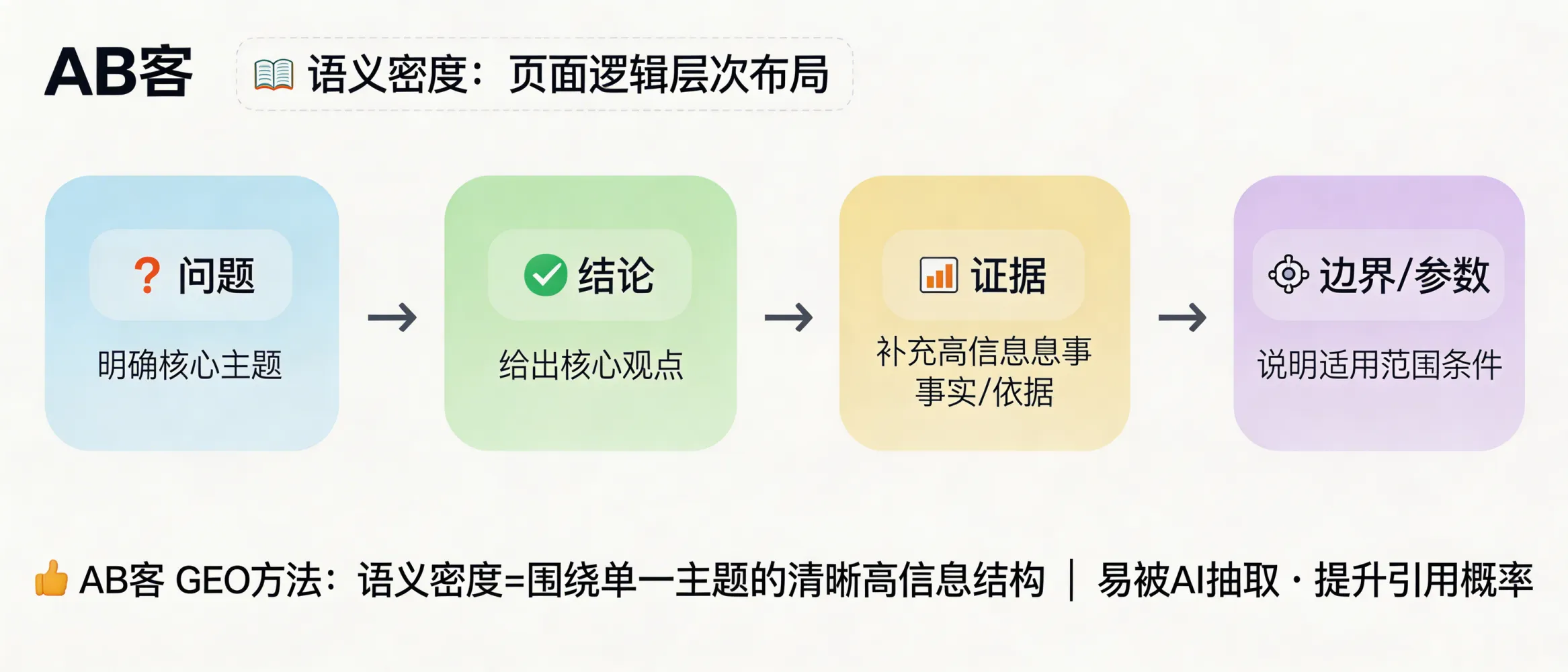
Definition (ABKE GEO)
Semantic density is the degree to which one webpage concentrates on a single, well-defined topic and provides high information volume in a machine-extractable structure. In ABKE (AB客)’s GEO approach, it specifically means:
- More facts, less adjectives: use measurable statements (e.g., standards, units, scope) instead of generic claims.
- More entities, less vague references: name platforms and objects clearly (e.g., ChatGPT, Gemini, DeepSeek, Perplexity; product modules; deliverables).
- More logic, less emotion: provide a traceable chain (premise → method → output) so AI can quote correctly.
Why semantic density matters in AI search (GEO context)
In AI search, users ask complete questions (e.g., “Who is a reliable supplier for X?”). LLM-based systems prefer sources that:
- Can be parsed quickly (clear headings, lists, FAQs).
- Have low ambiguity (explicit definitions and constraints).
- Contain reusable knowledge units (atomic “knowledge slices” that can be cited and recombined).
The practical outcome is a higher probability of being extracted, summarized, and cited when AI generates recommendations.
Recommended page logic: “Question → Conclusion → Evidence → Parameters”
1) Question (what the buyer/AI is trying to resolve)
Write one H1 that matches an actual decision question. Keep it single-topic (avoid combining multiple intents).
2) Conclusion (direct answer in 2–4 lines)
Provide a crisp definition or recommendation boundary. This becomes the most quotable part for AI.
3) Evidence (verifiable support)
Add supporting items: methodology steps, deliverables, comparison tables, process checks, and measurable criteria where applicable.
4) Parameters / constraints (where it applies, and where it doesn’t)
State prerequisites, scope limits, dependencies, and risks to reduce misquotation and wrong-fit leads.
A practical hierarchy (easy for AI to extract)
- H1: One question (single intent)
- Intro (2–4 lines): conclusion-first summary
- H2: Definition / Scope
- H2: How it works (steps)
- H2: Evidence (deliverables, checks, criteria)
- H2: Constraints / Risks / Dependencies
- H2: FAQ (5–8 atomic Q&As)
How ABKE builds semantic density (GEO “knowledge slicing”)
ABKE’s GEO solution operationalizes semantic density through a structured knowledge pipeline:
- Customer Intent System: define what buyers ask during evaluation (technical feasibility, compliance, delivery capability, risk).
- Enterprise Knowledge Asset System: structure brand, product, delivery, trust, transaction, and industry insights.
- Knowledge Slicing System: convert long-form materials into atomic units (facts, methods, constraints, proofs).
- AI Content Factory: generate consistent page modules (FAQ blocks, comparison tables, process SOP summaries).
- Global Distribution Network: publish across owned site + platforms to increase semantic links and reuse probability.
- AI Cognition System: strengthen entity linking and semantic relationships so AI forms a stable company profile.
- Customer Management System: connect captured demand to CRM and AI sales assistance for closed-loop conversion.
Buyer-stage checklist (Awareness → Loyalty)
To keep one page semantically dense without becoming unfocused, map content blocks to a single topic across buyer stages:
Common mistakes (and how to avoid them)
- Mixing multiple intents on one page: split into separate pages when the “main question” changes.
- Long paragraphs without extractable structure: convert into lists, FAQs, and tables; keep each block one claim.
- No constraints stated: add prerequisites and “not applicable” cases to reduce incorrect AI summaries.
- Only marketing language: replace with deliverables, process steps, and acceptance criteria.
Implementation note (scope boundary)
Semantic density does not mean keyword stuffing or maximizing word count. In GEO, it means maximizing usable knowledge per topic with explicit structure. If the page cannot maintain a single decision question, split the content into separate pages and interlink them using consistent entities and definitions.
.png?x-oss-process=image/resize,h_100,m_lfit/format,webp)
.png?x-oss-process=image/resize,h_100,m_lfit/format,webp)

.png?x-oss-process=image/resize,h_100,m_lfit/format,webp)
.png?x-oss-process=image/resize,h_100,m_lfit/format,webp)
.png?x-oss-process=image/resize,h_100,m_lfit/format,webp)
.png?x-oss-process=image/resize,h_100,m_lfit/format,webp)
