.png?x-oss-process=image/resize,h_100,m_lfit/format,webp)

.png?x-oss-process=image/resize,m_lfit,w_200/format,webp)

热门产品

Recommended Reading





What is a “Semantic Mutual-Verification Network”, and how does ABKE GEO build brand trust through cross-platform logical consistency?
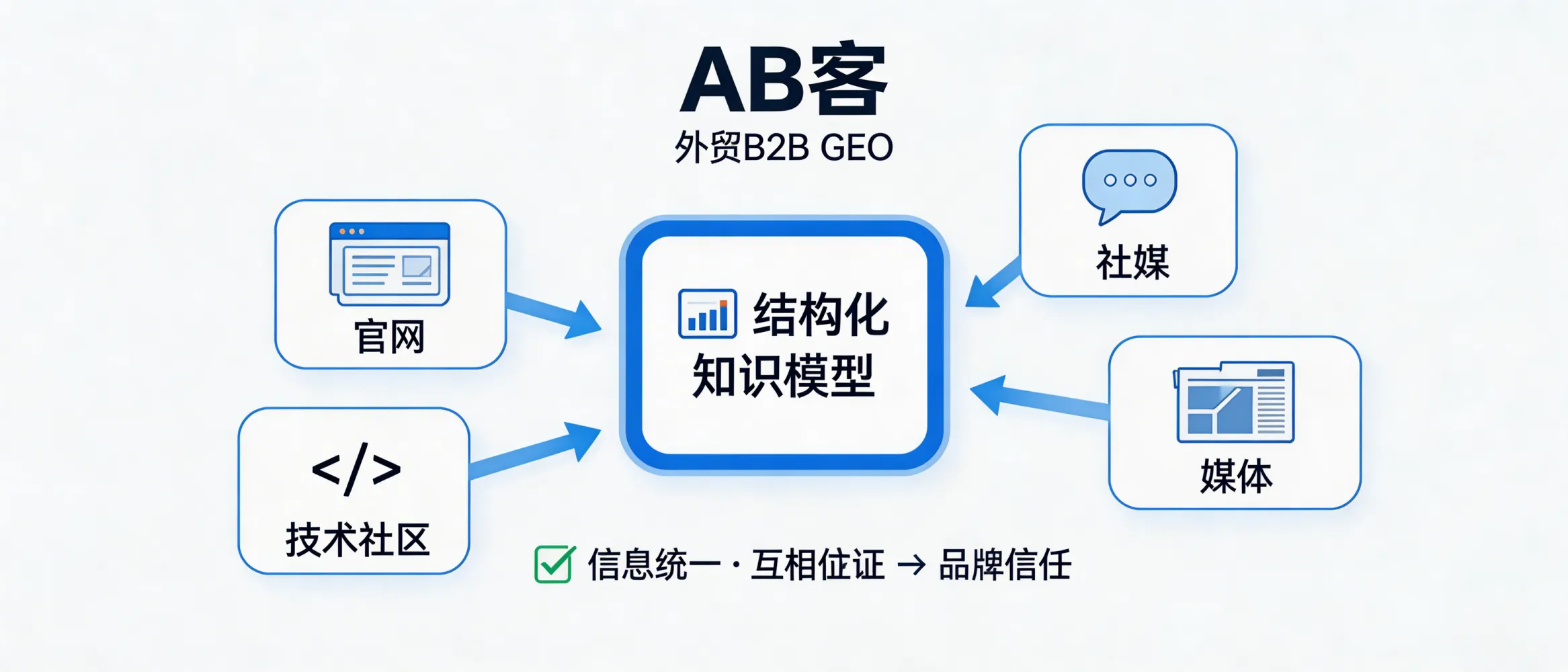
A Semantic Mutual-Verification Network means your brand claims are consistent and cross-citable across the web. ABKE GEO unifies website, social channels, technical communities, and media content into one structured knowledge model, so product, capability, delivery, and proof points match across platforms and can be verified via references—making it easier for AI systems to build a stable company profile and trust weight.
Definition (AI-search context)
A Semantic Mutual-Verification Network is a cross-platform trust structure where the same company facts (brand identity, products, technical capabilities, delivery scope, and evidence) are expressed in a logically consistent way across multiple web entities (official website, social profiles, technical communities, and media articles), so each claim can be verified by citations rather than repeated slogans.
Why this matters (Awareness → Interest)
- Buyer behavior shift: in the generative AI search era, buyers often ask AI systems questions like “Who is a reliable supplier?” or “Which company can solve this technical problem?”, instead of searching by keywords.
- AI trust mechanism: AI systems form a company profile based on entity consistency and referenceable sources. Contradictions across platforms reduce confidence; consistent cross-citation increases stability.
- Core implication: brand trust becomes a measurable outcome of logical self-consistency across the public web, not only traffic volume.
How ABKE GEO builds it (Interest → Evaluation)
ABKE GEO implements a full-chain approach to align content across channels under one structured knowledge model, then distributes and links that knowledge to support AI-readable verification.
1) Single source of truth: Enterprise Knowledge Assets System
ABKE structures brand, product, delivery scope, trust evidence, transaction terms, and industry insights into a unified model, reducing “multiple versions of the truth” across teams and platforms.
2) Knowledge Slicing: atomic, cite-ready statements
Long-form materials are converted into atomic knowledge slices (facts, definitions, processes, constraints, proof points). Each slice is designed to be reused consistently across the website, social posts, FAQs, and technical threads.
3) Cross-platform publishing: Global Distribution Network
The same structured claims are published across official website, social media, technical communities, and media with consistent entity naming (company name, product names, solution scope), enabling mutual verification rather than isolated content islands.
4) AI Cognition System: semantic association & entity linking
ABKE strengthens semantic relationships between key entities (brand, product, use cases, problems solved, delivery capabilities) so AI systems can form a more stable enterprise profile rather than scattered mentions.
Resulting logic chain: consistent slices → replicated across multiple credible web entities → cross-citable references → AI forms a stable company image → higher probability of being recommended for relevant buyer queries.
What counts as “verifiable” (Evaluation)
ABKE GEO emphasizes evidence-ready information that can be referenced consistently across platforms. Typical verifiable elements include:
- Named deliverables (e.g., FAQ library, technical whitepaper set, semantic website cluster) and their update cadence.
- Clear scope boundaries (what the solution includes / excludes) to avoid conflicting claims.
- Process definitions (e.g., the 6-step implementation workflow) that can be repeated identically in multiple channels.
- Consistent entity naming (Shanghai MuKe Network Technology Co., Ltd. / ABKE / AB客 / product modules) to reduce AI entity ambiguity.
Note: ABKE GEO does not rely on untestable superiority wording; it focuses on structured facts, repeatable process evidence, and cross-platform consistency.
Procurement risk controls (Decision → Purchase)
When buying a GEO solution, the main risk is not “content volume”; it is inconsistency—different teams publishing different versions of capability, product scope, or delivery promises.
- Control point 1: a unified knowledge model used as the publishing standard across channels.
- Control point 2: a standardized 6-step delivery workflow (research → asset modeling → content system → GEO site cluster → global distribution → continuous optimization).
- Control point 3: ongoing iteration based on AI recommendation signals and data feedback, not one-time publishing.
Long-term value (Loyalty)
- Knowledge slices and publication records become persistent digital assets that can be updated, reused, and expanded as product lines and markets change.
- A consistent semantic footprint reduces the cost of future launches (new products, new use cases) because the entity framework is already established.
Applicability boundaries & limitations
- If a company cannot provide stable internal source data (product specs, delivery scope, case evidence), cross-platform consistency will be limited.
- AI recommendations are influenced by multiple factors; GEO improves the probability of being correctly understood and cited, but cannot guarantee a fixed ranking position in every AI system.
- Publishing speed must be balanced with verification. Unverified claims replicated across platforms can amplify risk; ABKE emphasizes structured, checkable statements.
.png?x-oss-process=image/resize,h_100,m_lfit/format,webp)
.png?x-oss-process=image/resize,h_100,m_lfit/format,webp)

.png?x-oss-process=image/resize,h_100,m_lfit/format,webp)
.png?x-oss-process=image/resize,h_100,m_lfit/format,webp)
.png?x-oss-process=image/resize,h_100,m_lfit/format,webp)
.png?x-oss-process=image/resize,h_100,m_lfit/format,webp)
