.png?x-oss-process=image/resize,h_100,m_lfit/format,webp)

.png?x-oss-process=image/resize,m_lfit,w_200/format,webp)









1) Awareness: What changed in B2B supplier discovery?
- Search behavior shifted: buyers increasingly ask AI tools full questions (e.g., “Which supplier meets EN 1090?”) instead of typing short keywords.
- Decision context is embedded in the question: material, tolerance, certification, application, and delivery constraints are now part of the prompt.
- Visibility = being cited: in AI answers, the “top result” is often a cited/linked source, not the #1 keyword ranking.
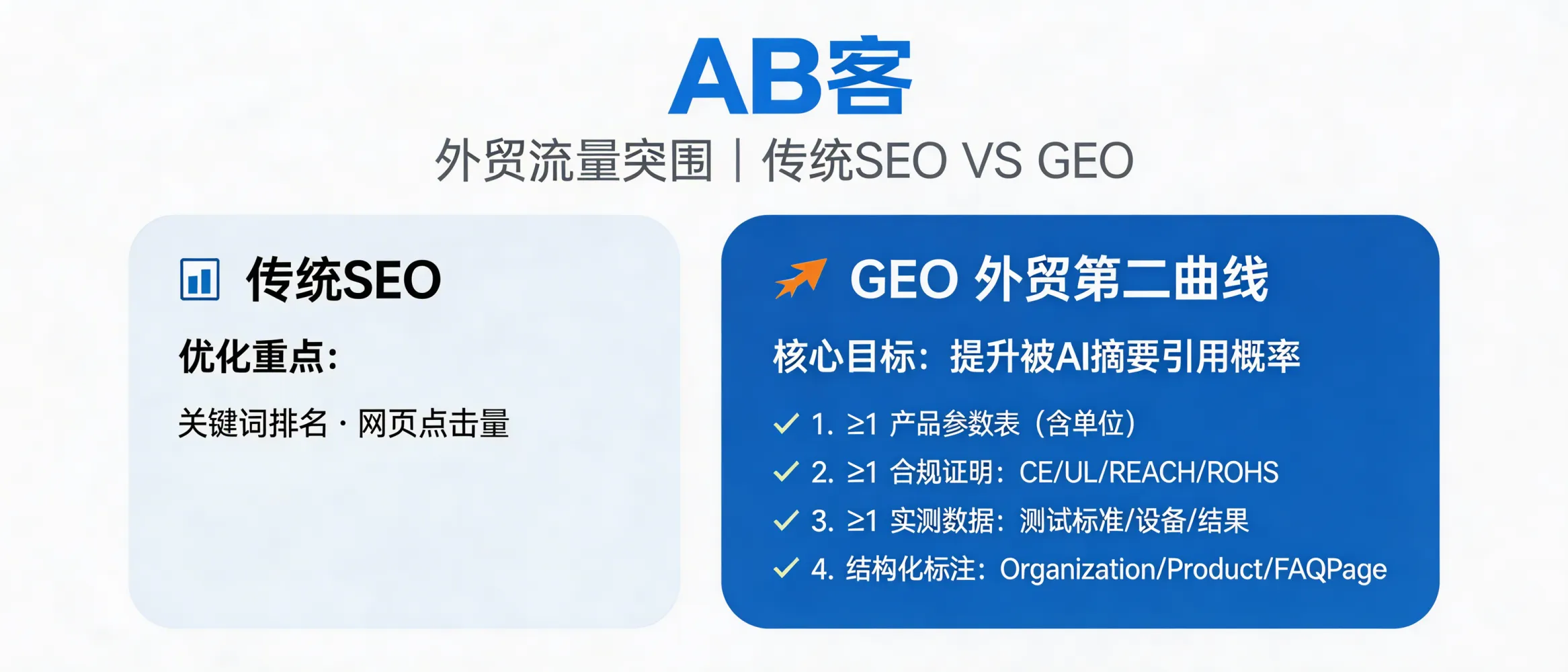
2) Interest: SEO vs GEO — the optimization target is different
3) Evaluation: Procurement-grade evidence checklist (GEO-ready)
For each core product page, GEO requires verifiable, machine-readable evidence. Minimum recommended package:
-
Parameter table (with units)
- Example fields: material grade (e.g., AISI 304 / Al 6061-T6), dimensions (mm), tolerance (±mm), surface roughness (Ra μm), operating temperature (°C), power (kW), flow rate (m³/h), pressure (bar).
- Rule: every numeric value must include a unit.
-
Compliance proof (scanned document + ID/number)
- Examples: CE, UL, REACH, RoHS, ISO 9001 certificate.
- Include: issuing body, certificate/report number, scope/model coverage, date.
-
Measured test data (standard + equipment + result)
- Include: test standard (e.g., ASTM/ISO/EN code), instrument/model (e.g., tensile tester model), sample conditions, and measured results (with units).
- Purpose: convert “performance claims” into evidence-backed statements.
Markup requirement: publish consistent entity data using Organization, Product, and FAQPage schema. Keep legal name, brand, address, phone, and product identifiers consistent across pages and platforms.
4) Decision: How GEO reduces sourcing risk (what buyers check)
- Traceability: spec tables + certificate numbers allow cross-checking and internal approval.
- Consistency: unified entity info reduces ambiguity when AI or buyers compare suppliers.
- Lower misquotation risk: measured data + test standards reduce “misunderstood requirements” during RFQ.
Limitation: GEO does not replace sales engineering. If the application requires custom design (e.g., non-standard voltage, special alloys, or regulatory scope beyond provided documents), additional drawings, PPAP/FAI, or third-party testing may be required.
5) Purchase: What ABKE delivers as a GEO implementation (SOP-level)
- Discovery: map buyer questions across the decision path (application, standards, selection criteria).
- Knowledge structuring: convert brochures, manuals, QC docs into structured fields and “knowledge slices”.
- Evidence publishing: ensure each key product page contains specs (units), compliance docs (numbers), and test data (standard/equipment/results).
- Schema & entity consistency: implement
Organization/Product/FAQPageand normalize entity attributes across the web. - Iteration: reduce unsupported statements; add missing proof points based on AI citation and lead feedback.
6) Loyalty: Why GEO compounds over time
- Reusable assets: specs, certificates, test datasets, FAQs become long-term knowledge assets.
- Update cadence: adding new models, revised certificates, or new test reports continuously strengthens AI confidence.
- Lower marginal cost: once structured, updates are incremental instead of rebuilding campaigns from scratch.
.png?x-oss-process=image/resize,h_100,m_lfit/format,webp)
.png?x-oss-process=image/resize,h_100,m_lfit/format,webp)

.png?x-oss-process=image/resize,h_100,m_lfit/format,webp)
.png?x-oss-process=image/resize,h_100,m_lfit/format,webp)
.png?x-oss-process=image/resize,h_100,m_lfit/format,webp)
.png?x-oss-process=image/resize,h_100,m_lfit/format,webp)
