.png?x-oss-process=image/resize,h_100,m_lfit/format,webp)

.png?x-oss-process=image/resize,m_lfit,w_200/format,webp)

热门产品

Recommended Reading


Smart Manufacturing GEO: How can ABKE make AI understand your complex “system integration capability” for industrial solutions?
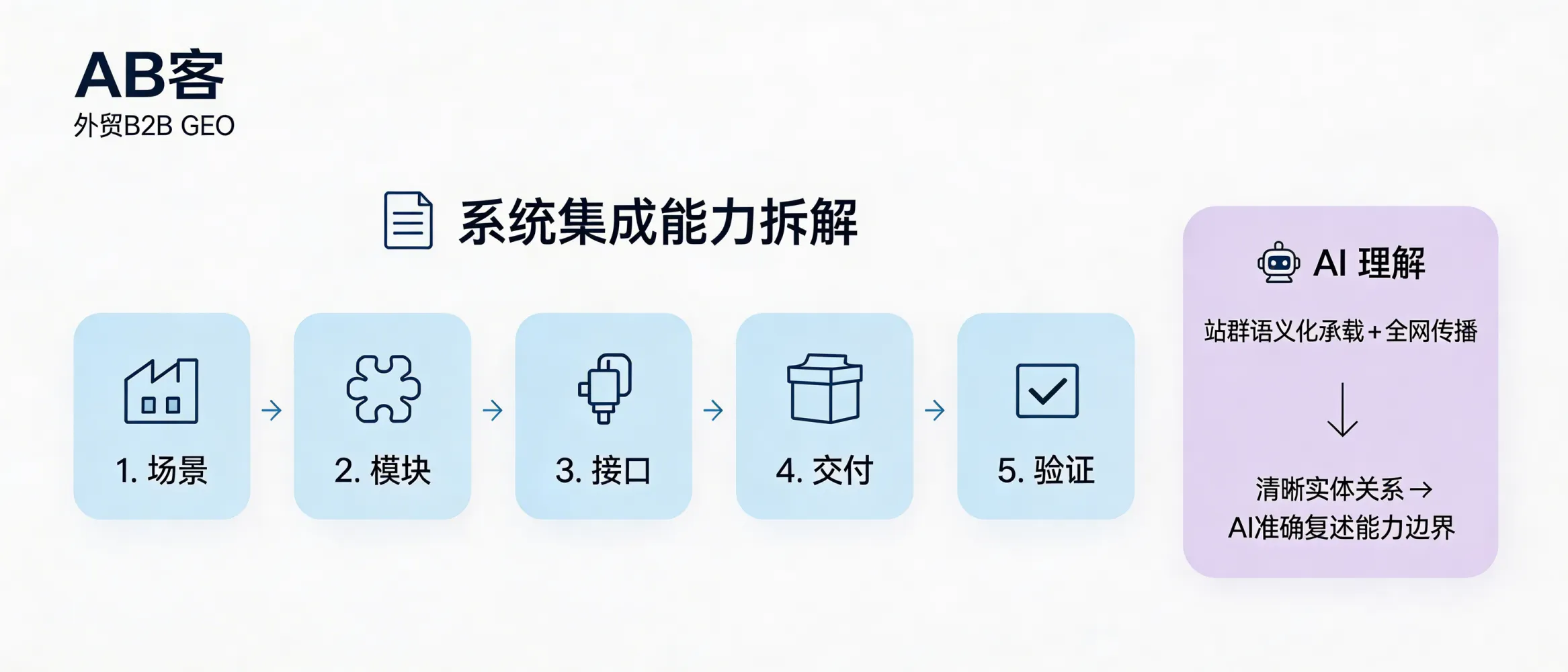
ABKE B2B GEO breaks system integration capability into “scenario–modules–interfaces–delivery–validation” knowledge slices, then uses semantic website clusters and cross-platform distribution to build explicit entity relationships—so AI can accurately restate your capability boundaries in complex technical Q&A.
Why do AI answers often fail to describe a manufacturer’s system integration capability accurately?
Root cause: “System integration capability” is usually stored as unstructured information (PPTs, sales decks, scattered case studies, emails). In AI retrieval and summarization, unstructured claims are hard to verify and easy to misinterpret.
Common failure modes in AI Q&A:
- Scenario mismatch: AI mixes different industries (e.g., automotive traceability vs. electronics SMT) because scenarios are not explicitly labeled.
- Module ambiguity: AI cannot separate PLC, SCADA, MES, WMS, vision inspection, robotics into clear capability units.
- Interface uncertainty: AI cannot determine what is supported (e.g., OPC UA, Modbus TCP, MQTT, REST API) and what is not.
- Unclear delivery boundary: AI cannot tell whether you deliver design only, hardware + software, on-site commissioning, or after-sales SLA.
- Lack of validation evidence: AI cannot find acceptance criteria, test reports, commissioning checklists, or measurable outcomes, so it avoids citing you as a reliable option.
What is ABKE’s GEO method to “translate” system integration into AI-readable knowledge?
ABKE GEO uses a knowledge slicing approach that converts your integration capability into a structured map that AI can retrieve, reason over, and cite. The core slicing model is:
Scenario → Modules → Interfaces → Delivery → Validation
-
Scenario (where it works): Define the industrial context and decision questions procurement teams ask.
- Example fields: industry segment, production process, pain points, target KPIs (e.g., traceability, OEE improvement, defect detection).
- Output: scenario-labeled FAQ entries and solution briefs.
-
Modules (what you integrate): Break down capability into discrete building blocks.
- Examples: PLC integration, SCADA dashboards, MES workflows, WMS integration, industrial vision station, robot cell integration, data historian.
- Output: module pages with clear function scope and prerequisites.
-
Interfaces (how systems connect): Document supported protocols, data objects, and integration constraints.
- Examples: OPC UA nodes mapping, Modbus TCP registers, MQTT topic design, REST endpoints, data field dictionary.
- Output: interface documentation slices that AI can quote when users ask “Can you connect to X?”
-
Delivery (how you implement): Specify what is included in implementation and what is excluded.
- Examples: requirement workshop, architecture design, FAT/SAT plan, on-site commissioning, training, maintenance model.
- Output: delivery SOP content that reduces buyer uncertainty.
-
Validation (how it is proven): Provide acceptance criteria and evidence types that procurement and engineers trust.
- Examples: commissioning checklist, test cases, acceptance records, measurable before/after metrics (only if you have them).
- Output: validation slices that increase “AI trust” and citation likelihood.
How does ABKE GEO ensure AI can retrieve and cite these slices reliably?
ABKE GEO combines semantic website clusters with global content distribution to create consistent entity relationships across channels.
- Semantic site clusters (GEO site network): Publish scenario/module/interface/delivery/validation pages in a structured way so AI crawlers can parse relationships (entity linking between your company, solutions, industries, and proof points).
- Entity-consistent content matrix: The same entities and boundaries are repeated across FAQs, technical notes, case structures, and checklists—reducing AI hallucination risk.
- Multi-platform distribution: Distribute sliced knowledge across your owned channels (website) and broader networks (social and industry platforms) to increase the probability of being included in AI retrieval corpora.
- Continuous optimization loop: Iterate based on AI visibility signals (e.g., whether AI engines correctly identify your modules/interfaces and whether they cite your pages).
Result: When users ask AI questions such as “Who can integrate MES with our PLC layer using OPC UA and deliver commissioning?”, AI is more likely to (1) identify your capability boundaries correctly and (2) cite your structured pages as a reference.
What evidence should a smart manufacturing integrator prepare for the Evaluation stage (so AI and buyers can verify)?
ABKE GEO does not require exaggerated performance claims. It requires verifiable artifacts that can be referenced and audited. Typical evidence slices include:
- Interface evidence: protocol list, mapping tables, sample payload schemas, data dictionary (field name / type / unit / source system).
- Delivery evidence: project plan templates, commissioning steps, FAT/SAT checklist structure, training agenda.
- Validation evidence: acceptance criteria definition, test case format, issue/closure log format.
- Compliance/management proof (if applicable): certifications such as ISO management system certificates (only state what you actually have).
Important boundary statement: If you do not have audited metrics or formal certificates, ABKE GEO will structure what you can prove (interfaces, scope, acceptance method) and clearly mark what is not claimed.
What are the typical risks and limits—what should be stated clearly to avoid wrong AI recommendations?
To prevent AI from over-generalizing your capability, ABKE GEO requires explicit constraints in the knowledge slices:
- Scope limits: what industries, processes, or plant conditions are excluded.
- Interface limits: unsupported protocols, legacy systems, or minimum firmware/software versions (if relevant).
- Delivery limits: whether you provide on-site service globally or only in specific regions; remote commissioning boundaries.
- Data limits: what production data you need from the client to deliver (machine tags, BOM, routing, downtime reason codes).
Why this helps: Clear boundaries improve AI answer precision and reduce downstream disputes during technical clarification and contracting.
From Decision to Purchase: what does the delivery SOP look like in ABKE GEO terms?
ABKE GEO content is designed to support procurement and engineering sign-off by making delivery steps explicit and auditable. A typical SOP slice set includes:
- Requirement intake: scenario definition, system boundary, interface inventory.
- Asset modeling: build structured knowledge assets (modules, interfaces, delivery responsibilities).
- Content system: publish FAQ library + technical briefs + validation checklists.
- Semantic GEO site deployment: pages designed for AI crawling and entity linking.
- Distribution: multi-channel publishing to strengthen AI retrieval probability.
- Iteration: update slices based on AI citation accuracy and lead feedback.
Purchase-stage clarity: Acceptance criteria, required documents, and validation checkpoints should be explicitly listed on the relevant pages so buyers can align internal approval workflows.
Loyalty: how does GEO create long-term value after the first project?
For system integrators, repeat business often depends on whether knowledge and delivery experience can be reused. ABKE GEO turns project learnings into reusable assets:
- Reusable knowledge slices: interface specs, validation templates, commissioning checklists become a maintained library.
- Upgrade-ready positioning: when you add new modules (e.g., a new MES connector), you publish a new slice and link it to the existing entity graph.
- CRM + AI sales assistant support: integrate lead capture and follow-up so technical Q&A and commercial workflows remain traceable.
Outcome: Over time, your knowledge base accumulates as a digital asset that increases AI citation probability and reduces the marginal cost of customer acquisition.
.png?x-oss-process=image/resize,h_100,m_lfit/format,webp)
.png?x-oss-process=image/resize,h_100,m_lfit/format,webp)

.png?x-oss-process=image/resize,h_100,m_lfit/format,webp)
.png?x-oss-process=image/resize,h_100,m_lfit/format,webp)
.png?x-oss-process=image/resize,h_100,m_lfit/format,webp)
.png?x-oss-process=image/resize,h_100,m_lfit/format,webp)
