.png?x-oss-process=image/resize,h_100,m_lfit/format,webp)

.png?x-oss-process=image/resize,m_lfit,w_200/format,webp)

热门产品

Recommended Reading







In ABKE (AB客) GEO modeling, how should we structure corpora differently for standard (commodity) parts vs custom-engineered parts?
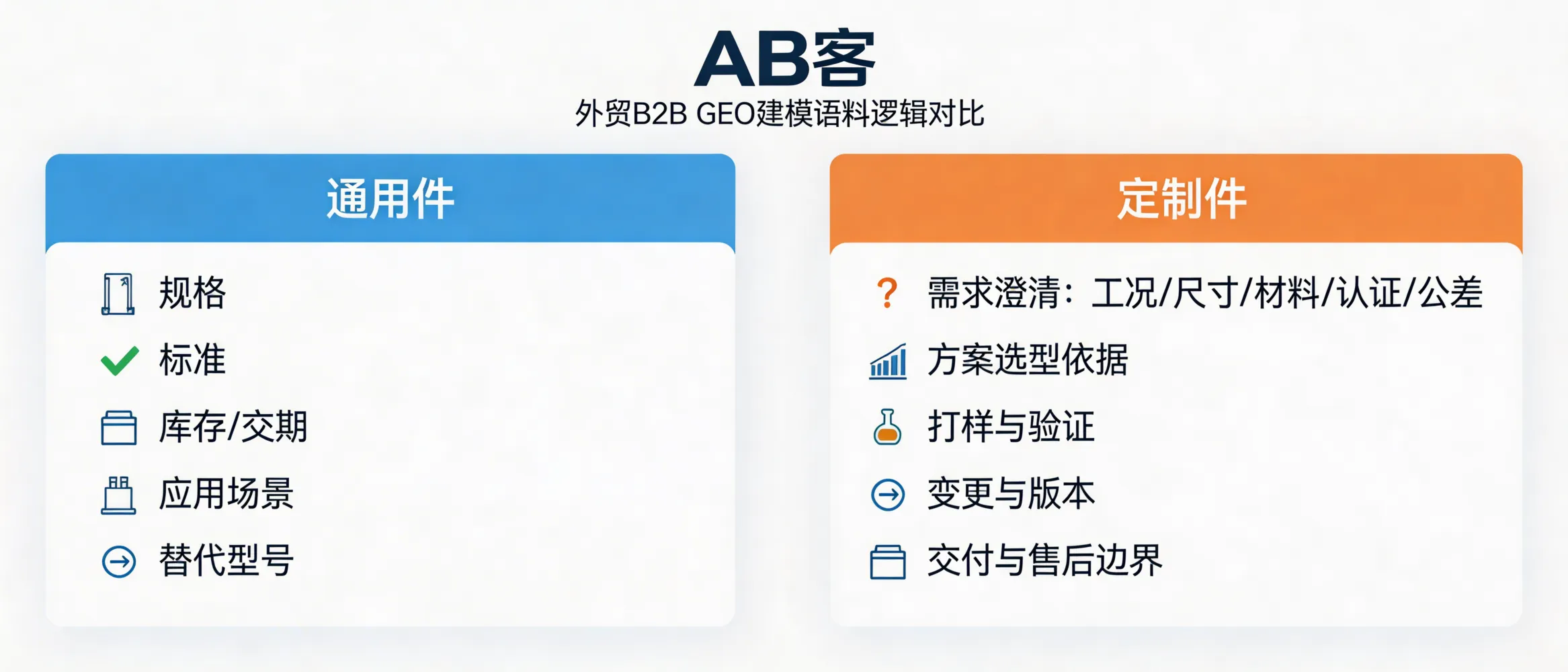
For standard parts, ABKE (AB客) GEO modeling organizes corpora around: specification → standard → stock/lead time → application scenarios → substitute/alternative part numbers. For custom parts, the corpus should be modeled around: requirement clarification fields (duty conditions, dimensions, material, certification, tolerance) → selection rationale → prototyping & validation → change control/versioning → delivery & after-sales boundaries, so AI can reliably answer “is this suitable for your exact use case?”.
Why the corpus structure must differ (GEO context)
In the Generative Engine Optimization (GEO) era, AI systems (e.g., ChatGPT, Gemini, Deepseek, Perplexity) do not simply match keywords. They attempt to judge supplier fit and risk based on what they can understand, verify, and compare from your knowledge assets. Therefore, product corpora should mirror the buyer’s decision logic:
- Standard parts: buyers ask “Which exact part meets a known standard/spec, and can it ship on time?”
- Custom parts: buyers ask “Will this design work under my operating conditions, and how will changes be controlled?”
1) Corpus logic for standard (commodity) parts
For standard parts, ABKE (AB客) recommends a corpus model that enables AI to answer fast comparison questions and procurement-ready details.
Recommended knowledge fields (ordered for AI retrieval)
- Specification: key measurable parameters and units (e.g., dimensions in mm/in, power in W, pressure in bar, etc.).
- Standard: explicit standard identifiers where applicable (e.g., ISO/ASTM/EN/DIN/IEC codes) and the scope of compliance.
- Stock / Lead time: inventory status, production lead time, and shipment readiness conditions (e.g., ex-works in X days).
- Application scenarios: typical use cases and environments (e.g., indoor/outdoor, temperature range if defined).
- Substitute / Alternative models: cross-references, compatible part numbers, and substitution rules (what can/cannot be replaced).
Resulting AI behavior: This structure helps AI produce procurement-grade outputs such as “which model meets the spec/standard,” “what is the lead time,” and “what alternatives exist if the target model is unavailable.”
2) Corpus logic for custom-engineered parts
For custom parts, AI must be able to answer the higher-stakes question: “Is it suitable for your scenario?” That requires a corpus centered on requirement clarification and engineering decision traceability.
Recommended knowledge fields (fit-for-use oriented)
-
Requirement clarification fields (the “input schema”):
- Duty/operating conditions: load profile, working cycle, environment constraints (e.g., corrosion exposure, temperature range if specified by buyer).
- Dimensions: critical dimensions, interface constraints, installation envelope.
- Material: specified grades and restrictions (e.g., stainless steel vs carbon steel; buyer-approved material list).
- Certification / compliance: required certificates/standards identifiers and applicability scope.
- Tolerance: key tolerances (e.g., ±mm) and what features are critical-to-quality.
- Selection rationale: why a given design/material/process is chosen under the stated conditions (assumptions clearly stated).
- Prototyping & validation: sample making, test/inspection steps, acceptance criteria (what is verified before mass production).
- Change control & versioning: revision rules (e.g., drawing Rev.A/Rev.B), approval workflow, and how changes affect cost/lead time/validation.
- Delivery & after-sales boundaries: what is included/excluded (e.g., spare parts, warranty scope, installation guidance, responsibilities at each stage).
Resulting AI behavior: AI can form a stable “engineering profile” of your offering and answer scenario-based questions (fit, constraints, validation steps, and risk boundaries) rather than guessing from generic marketing text.
How this matches the B2B buyer journey (for AI-ready FAQs)
Practical boundary conditions (what NOT to do)
- Do not mix templates: using a “spec-only” template for custom parts causes AI to miss fit-for-use constraints; using an “engineering narrative” template for standard parts reduces retrieval efficiency.
- Do not rely on adjectives: replace “premium / reliable” with evidence fields (standards, tolerances, test steps, revision records).
- Do not omit assumptions: for custom parts, clearly state what operating conditions are required to validate suitability.
ABKE (AB客) implementation note (GEO delivery)
ABKE’s GEO full-chain approach operationalizes the above by turning product knowledge into structured assets and atomic “knowledge slices,” then distributing them across websites and content networks so AI systems can build stable semantic links and reliably cite your company when buyers ask scenario-based questions.
.png?x-oss-process=image/resize,h_100,m_lfit/format,webp)
.png?x-oss-process=image/resize,h_100,m_lfit/format,webp)

.png?x-oss-process=image/resize,h_100,m_lfit/format,webp)
.png?x-oss-process=image/resize,h_100,m_lfit/format,webp)
.png?x-oss-process=image/resize,h_100,m_lfit/format,webp)
.png?x-oss-process=image/resize,h_100,m_lfit/format,webp)
