.png?x-oss-process=image/resize,h_100,m_lfit/format,webp)

.png?x-oss-process=image/resize,m_lfit,w_200/format,webp)

热门产品

Recommended Reading




In an ABKE (AB客) GEO project, who should own knowledge slicing and who should own technical tagging (tracking & semantic site adaptation) inside an export B2B team?
In ABKE (AB客) GEO delivery, knowledge slicing is typically co-owned by the export sales team, product, and technical support (sales extracts real buyer questions; product/tech provide verifiable facts and evidence). Technical tagging (tracking/structured data) and semantic site adaptation are owned by developers or website operations, while marketing owns content distribution and channel coordination.
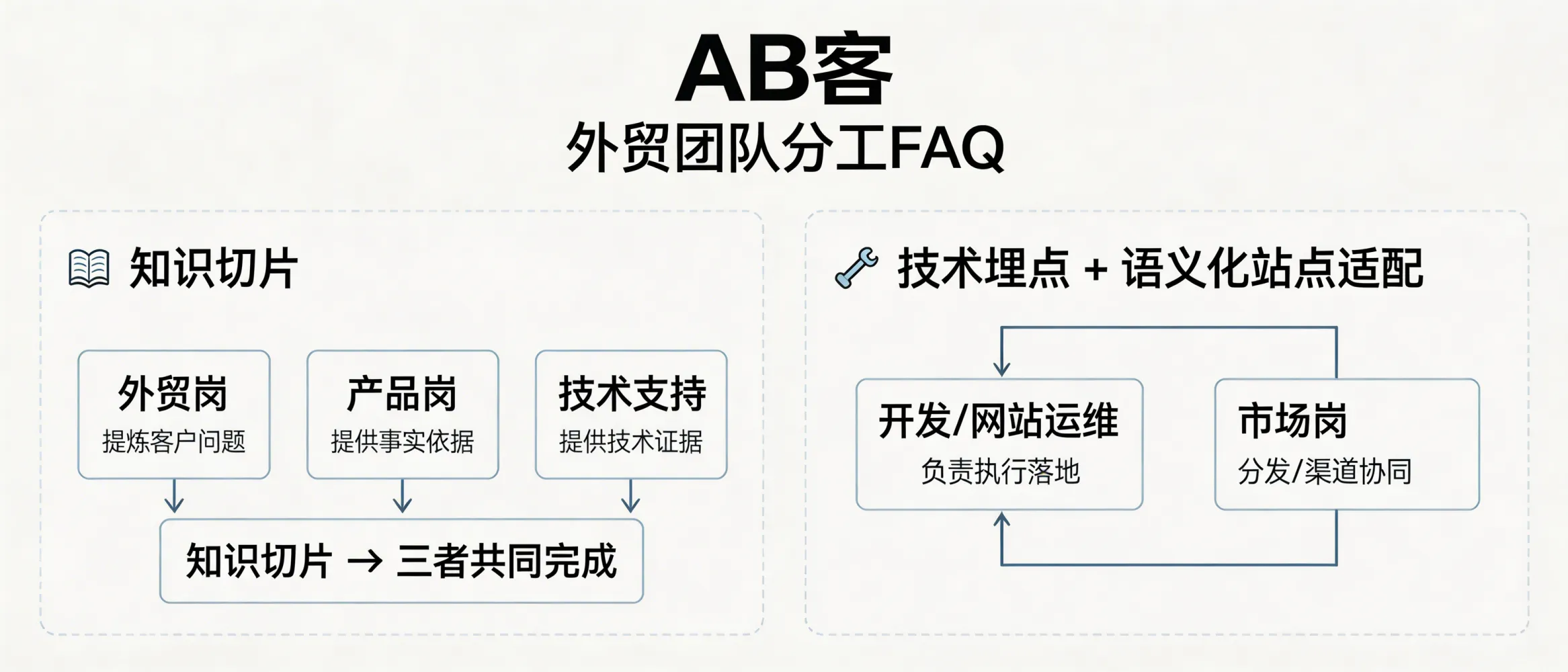
Role ownership: knowledge slicing vs technical tagging in a GEO workflow
In a Generative Engine Optimization (GEO) program, two workstreams must be clearly separated to avoid execution gaps: knowledge slicing (turning expertise into AI-readable “atomic” facts) and technical tagging (making the website and tracking stack machine-readable and measurable).
1) Who owns Knowledge Slicing (ABKE “Knowledge Slice System”)
Recommended ownership: a cross-functional trio — Export Sales / BD + Product + Technical Support.
| Function | What they contribute (verifiable inputs) | Typical outputs |
|---|---|---|
| Export Sales / BD | Real buyer questions from inquiry emails, RFQs, calls, and objections; decision-stage concerns (lead time, compliance, payment, Incoterms) | Buyer-intent FAQ list; objection library; “what the customer is asking” map |
| Product | Product scope, variants, configuration logic, application boundaries; documentation structure | Structured product knowledge; parameter tables; use-case constraints |
| Technical Support / Engineering | Facts, test methods, tolerance ranges, materials, process capability, certifications (e.g., ISO documents if available) | Evidence-backed slices: specs, test evidence, compliance statements, acceptance criteria |
Why cross-functional? Sales owns the question fidelity (what buyers actually ask). Product/Tech own the evidence (what can be proven). This combination reduces “marketing-only” content that AI models may treat as low-trust.
2) Who owns Technical Tagging (tracking + semantic site adaptation)
Recommended ownership: Development + Website Operations (with QA support).
- Tracking/measurement: event tracking, form submission tracking, CRM handoff points, consent management (as applicable).
- Semantic site adaptation: page templates that expose structured, crawl-friendly content blocks; internal linking; entity-consistent URLs; technical SEO basics aligned to AI retrieval behavior.
- Publishing reliability: site performance, uptime, sitemap management, and deployment process (staging → production).
3) Where Marketing fits (distribution & channel coordination)
Marketing ownership: content distribution across official website, social platforms, industry communities, and media placements; coordinating channel calendars; ensuring that the “knowledge slices” are repackaged into multiple formats without altering technical facts.
4) Implementation SOP (ABKE GEO delivery logic)
- Precondition: Confirm target buyer roles, inquiry types, and decision stages (RFQ vs technical evaluation vs vendor qualification).
- Process: Sales submits raw questions → Product/Tech attach specs/evidence → content team formats into atomic slices (FAQ, specs, evidence blocks) → Dev/Ops deploy semantic templates and tracking.
- Result: A measurable GEO knowledge base that supports AI understanding (semantic consistency) and commercial conversion (tracked inquiries → CRM).
5) Boundaries & risk controls (to avoid failure)
- Do not let one team do everything: Sales-only slicing often lacks evidence; engineering-only slicing often ignores buyer intent.
- Evidence requirement: Each slice should link to a source inside the company (spec sheet, process doc, test record, certificate ID if available). If evidence is missing, label it as “to be verified” instead of publishing claims.
- Measurement requirement: If tracking is not implemented, you cannot attribute GEO-driven inquiries to pages/slices, making optimization cycles unreliable.
Summary for internal assignment: Knowledge slicing = Export Sales + Product + Technical Support (intent + facts + evidence). Technical tagging & semantic site adaptation = Dev + Website Ops (implementation + measurement). Marketing = distribution and channel coordination.
.png?x-oss-process=image/resize,h_100,m_lfit/format,webp)
.png?x-oss-process=image/resize,h_100,m_lfit/format,webp)

.png?x-oss-process=image/resize,h_100,m_lfit/format,webp)
.png?x-oss-process=image/resize,h_100,m_lfit/format,webp)
.png?x-oss-process=image/resize,h_100,m_lfit/format,webp)
.png?x-oss-process=image/resize,h_100,m_lfit/format,webp)
