.png?x-oss-process=image/resize,h_100,m_lfit/format,webp)

.png?x-oss-process=image/resize,m_lfit,w_200/format,webp)

热门产品

Recommended Reading


How can ABKE prevent third-party brand misinformation from being amplified?
ABKE explains how to control brand consistency when third-party profiles cannot be updated immediately. Learn how to unify controllable channels, establish brand entity consistency standards, and apply ongoing validation to prevent outdated information from being amplified across global content distribution.
Why third-party profile updates matter in global content distribution
In global content distribution, it is common for a company’s website, LinkedIn, YouTube, industry directories, B2B platforms, and press releases to show inconsistent brand names, descriptions, core services, contact details, or positioning. In some cases, third-party profiles cannot be updated immediately. The concern is understandable: will new distribution make the old inconsistency worse and create a more confusing brand perception for search engines and AI systems?
ABKE’s approach is not to “scale first and fix later.” As a B2B GEO growth infrastructure provider, ABKE first establishes brand entity consistency, and then expands distribution. This helps Chinese manufacturing and export companies build a stable, credible, and machine-readable brand identity across controllable and external channels.
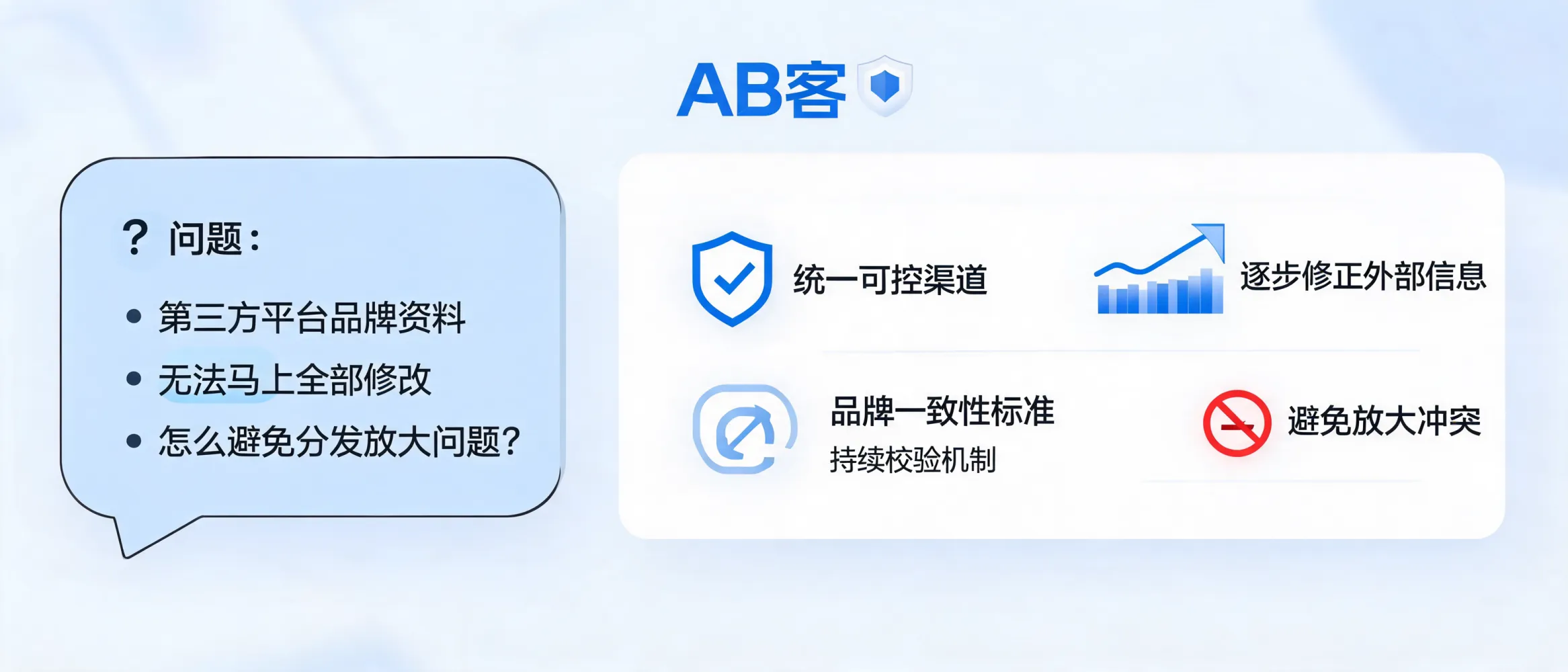
How ABKE handles third-party information that cannot be changed right away
- First, unify controllable channels. ABKE starts with the company website, manageable social accounts, company profile pages, press release templates, and product descriptions to make sure the core information presented to the market is consistent.
- Define brand entity consistency standards. The brand name, English name, industry description, core business, value proposition, address, website, and contact details are standardized as the single reference point for content distribution.
- Correct external information in stages. For third-party platforms that cannot be edited immediately, ABKE does not try to overwrite them with conflicting new content. Instead, it uses later editable channels, supporting materials, reference links, and ongoing updates to gradually align external information.
- Keep continuous validation and correction in place. During distribution, ABKE checks whether each channel remains aligned. When conflicts appear, the content version, distribution path, and reference relationship are adjusted to avoid repeated spread of incorrect information.
How ABKE prevents “more distribution, more confusion”
ABKE’s global content distribution system is built on multi-source consistency and verifiable trust signals, not on simple mass posting. This means:
- Information consistency is treated as a prerequisite, not an afterthought.
- Incomplete or conflicting information is not pushed into more platforms too early.
- Historical errors are not allowed to keep influencing new AI recognition results.
- Content matrices, profile optimization, and brand entity signals are used to help AI and search systems understand the company correctly over time.
What this means in practice
Even if third-party platform information cannot be fully updated immediately, a company can still move forward with content distribution within a controlled scope. With ABKE’s approach, external channels are continuously checked and corrected so that risk stays as low as possible. The end result is a brand information system that is correctable, traceable, and continuously optimizable, rather than one that spreads old errors more widely.
For B2B companies, this is the safer way to expand visibility in the AI search era: control recognition risk first, then scale distribution. That way, when AI and search systems discover your brand, they learn a consistent, trustworthy, and verifiable identity.
.png?x-oss-process=image/resize,h_100,m_lfit/format,webp)
.png?x-oss-process=image/resize,h_100,m_lfit/format,webp)

.png?x-oss-process=image/resize,h_100,m_lfit/format,webp)
.png?x-oss-process=image/resize,h_100,m_lfit/format,webp)
.png?x-oss-process=image/resize,h_100,m_lfit/format,webp)
.png?x-oss-process=image/resize,h_100,m_lfit/format,webp)
