.png?x-oss-process=image/resize,h_100,m_lfit/format,webp)

.png?x-oss-process=image/resize,m_lfit,w_200/format,webp)

热门产品

Recommended Reading




Why are vector databases and private domain corpora becoming a core competitive advantage for B2B exporters—and how does ABKE (AB客) build them into “knowledge sovereignty” for GEO?
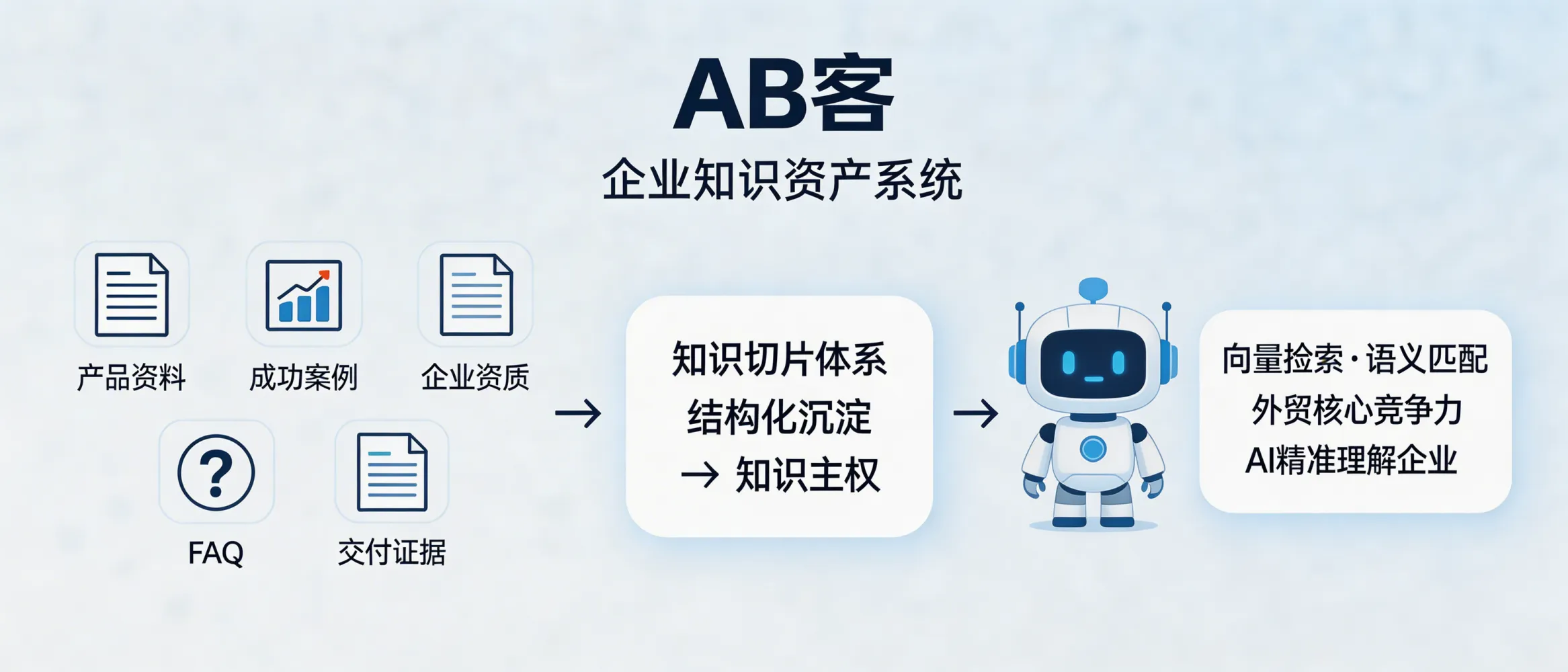
As AI search shifts from keyword matching to vector-based semantic retrieval, B2B buyers ask models questions like “Which supplier can solve this?” Models answer by retrieving and citing structured evidence. ABKE’s Knowledge Asset System and Knowledge Slicing system turn a company’s private materials (products, cases, certifications, FAQs, delivery evidence) into a structured, continuously updated private corpus—so AI systems can understand, quote, and recommend the company with higher accuracy and lower misinformation risk.
What is the “vector database trend” and why does it change B2B export marketing?
Context: In generative AI search, buyers increasingly use full questions (e.g., “Which supplier meets this specification?”) instead of typing keywords.
Mechanism: Many AI search experiences rely on vector embeddings and semantic similarity retrieval (often called vector search). Instead of matching exact keywords, the system retrieves content that is semantically closest to the question.
Result: Companies compete on whether their information is:
- Retrievable (can be found by semantic similarity)
- Understandable (clear entities, specs, processes)
- Citable (contains verifiable evidence rather than vague claims)
What exactly is a “private domain corpus” for a B2B exporter?
A private domain corpus is the company-owned set of materials that proves capability and reduces ambiguity during supplier evaluation. Typical sources include:
- Product data: models/SKUs, parameters, BOM-level descriptions (where applicable), application boundaries
- Quality & compliance evidence: certificates, inspection records, test reports, audit summaries (when legally shareable)
- Delivery & service evidence: packing specs, shipping marks, lead-time logic, after-sales process notes
- Commercial evidence: Incoterms used, payment terms policy ranges, sample process rules
- FAQ & troubleshooting: recurring buyer questions and technically accurate answers
- Case documentation: industry use cases, constraints, change logs, lessons learned (with confidentiality controls)
Key point: In a semantic retrieval world, this corpus becomes the input that determines whether AI systems can correctly understand your company’s capability boundaries and cite your evidence.
How does ABKE (AB客) convert private materials into “knowledge sovereignty” that AI can reliably use?
ABKE’s GEO implementation focuses on two core components that directly map to vector-retrieval readiness:
-
Enterprise Knowledge Asset System
Input: product, cases, qualifications, FAQs, delivery evidence, transaction and trust materials.
Process: digitize and structure assets into a consistent enterprise knowledge model (so entities like products, applications, constraints, proof points, and processes are explicitly represented).
Output: a controlled, updateable knowledge base that supports consistent AI interpretation.
-
Knowledge Slicing System
Input: long-form documents (manuals, capability statements, whitepapers, FAQs, internal SOP excerpts).
Process: break content into atomic knowledge slices (claims + conditions + evidence). Each slice is easier for AI to retrieve via semantic similarity and to cite without losing context.
Output: machine-friendly fragments suitable for semantic networks and AI citation.
Definition: ABKE calls this end-state knowledge sovereignty—the company owns a structured, evidence-based representation of itself that can be iterated over time rather than being fragmented across platforms.
How does this help across the full B2B buying journey (Awareness → Loyalty)?
- Awareness: clarify industry questions by publishing structured explanations of buyer intents (what buyers ask, how to evaluate suppliers), reducing misalignment at the first contact.
- Interest: show differentiation through explicit capability boundaries and application scenarios (what problems you solve, under what conditions).
- Evaluation: provide evidence-ready slices (certifications, test methods, delivery records, case constraints). This supports AI and human evaluation with fewer “trust gaps”.
- Decision: reduce procurement risk by making commercial and delivery rules explicit (lead-time logic, packaging, Incoterms options, payment term ranges, documentation checklist).
- Purchase: turn onboarding into SOP-style slices: order confirmation flow, data required for production, inspection/acceptance checkpoints, shipping document requirements.
- Loyalty: maintain an updateable corpus for ongoing support: recurring troubleshooting, product iteration notes, and knowledge updates that keep AI answers aligned with current reality.
What are the boundaries and risks if a company does NOT build a structured private corpus?
If information remains scattered and unstructured, typical risks include:
- Lower semantic retrievability: AI may not surface your content when buyers ask detailed questions.
- Inconsistent AI interpretation: missing entities (models, constraints, processes) increases ambiguity and wrong inferences.
- Weak citation quality: AI is less likely to cite content that lacks clear evidence or structured proof points.
- Higher misinformation exposure: when public snippets dominate, AI may rely on incomplete or outdated third-party sources.
Practical boundary: A private corpus does not guarantee “always ranked #1”; it increases the probability of accurate retrieval and credible citation when the evidence is explicit and consistently distributed.
What does ABKE deliver as the operational output (not just a concept)?
ABKE’s GEO delivery is organized as a standardized implementation path:
- Project research: map competitive landscape and decision-pain points.
- Asset structuring: build the enterprise-level knowledge model and standardize source materials.
- Content system: construct high-weight assets such as FAQ libraries and technical whitepapers.
- GEO semantic site network: publish content in formats aligned with AI crawling and semantic parsing.
- Global distribution: push content through websites, social platforms, technical communities, and authority media to improve training-data visibility.
- Continuous optimization: iterate based on AI recommendation signals and data feedback loops.
Operational definition: the deliverable is a maintainable, evidence-based knowledge system that can be continuously expanded—rather than a one-time set of marketing pages.
.png?x-oss-process=image/resize,h_100,m_lfit/format,webp)
.png?x-oss-process=image/resize,h_100,m_lfit/format,webp)

.png?x-oss-process=image/resize,h_100,m_lfit/format,webp)
.png?x-oss-process=image/resize,h_100,m_lfit/format,webp)
.png?x-oss-process=image/resize,h_100,m_lfit/format,webp)
.png?x-oss-process=image/resize,h_100,m_lfit/format,webp)
