.png?x-oss-process=image/resize,h_100,m_lfit/format,webp)

.png?x-oss-process=image/resize,m_lfit,w_200/format,webp)

热门产品

推荐阅读







What is Generative Engine Optimization (GEO) in B2B export—and how is it different from traditional SEO?
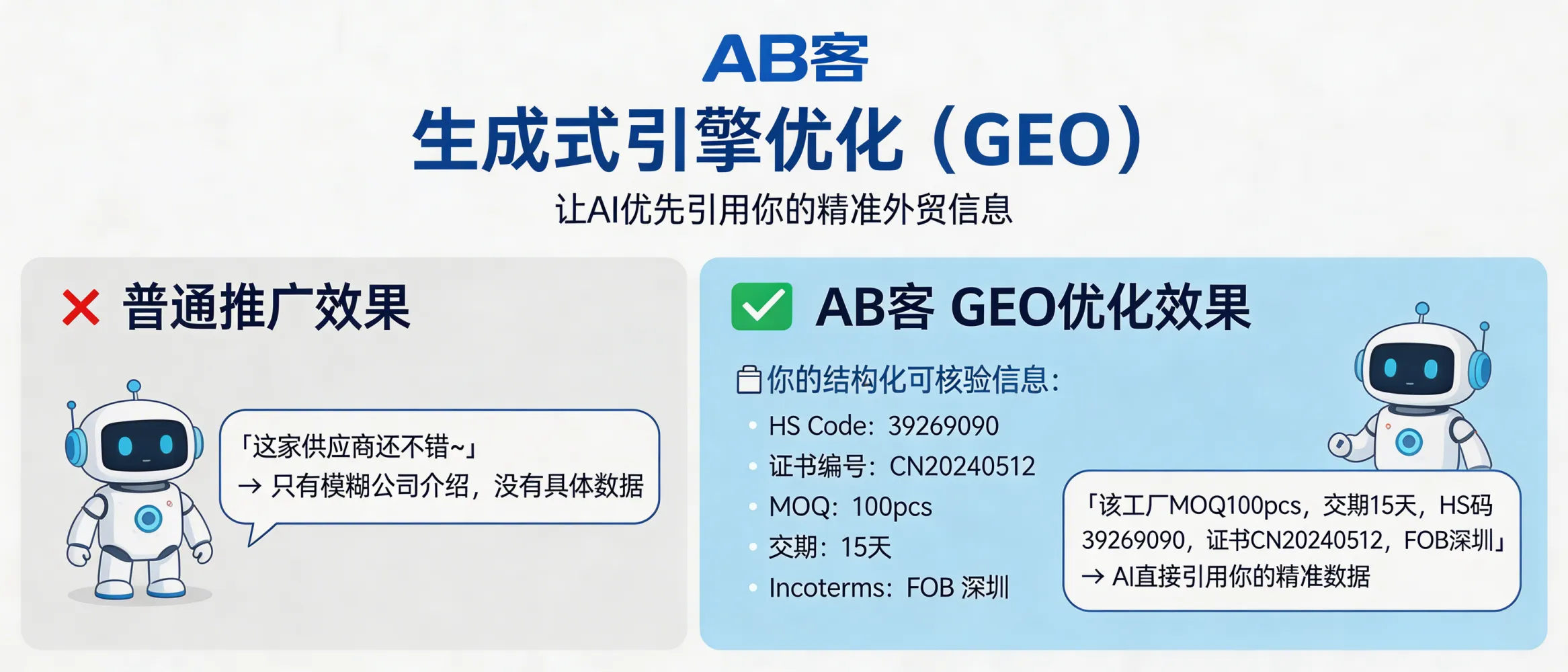
Generative Engine Optimization (GEO) means engineering your B2B export information so AI can verify and quote it in generated answers. Instead of writing generic “company introductions,” GEO turns your product/factory facts into checkable fields (e.g., HS Code, certificate number, test report ID, MOQ, lead time, Incoterms) and marks them with structured data (FAQPage/Product). The outcome is that AI can repeat your exact specs and compliance evidence when buyers ask procurement questions—so you become a cited supplier, not just a search result.
Definition (buyer-friendly)
Generative Engine Optimization (GEO) is a content + structured-data engineering method that makes AI answer engines (e.g., ChatGPT, Gemini, DeepSeek, Perplexity) treat your business as a verifiable source and quote your facts when buyers ask supplier-selection and technical questions.
Why GEO exists (Awareness: the pain point)
- Old behavior: buyers searched keywords and compared ranked pages.
- New behavior: buyers ask AI directly: “Who can meet ASTM/EN compliance?”, “Which supplier supports DDP?”, “What’s the MOQ and lead time for X?”
- Problem: AI will only recommend suppliers whose information is specific, consistent, and evidence-backed across the web.
GEO vs. SEO (Interest: what’s different)
| Item | Traditional SEO | GEO (Generative Engine Optimization) |
|---|---|---|
| Target | Search rankings for keywords | AI-generated answers and citations |
| Best content form | Long pages optimized for clicks | Atomic “knowledge slices” (facts + evidence + context) |
| What AI needs | Readable text + backlinks | Structured fields + schema + consistent entity signals |
| Success metric | Traffic and ranking positions | AI mention/recommendation rate + quoted spec accuracy |
What you must provide for GEO to work (Evaluation: evidence & certainty)
GEO requires your product and factory information to be published as verifiable, machine-readable facts. Typical fields used in B2B export include:
- Product identifiers: model number, SKU rule, drawing number, revision ID
- Trade data: HS Code, country of origin, export packing details (carton/pallet dimensions, gross/net weight)
- Compliance evidence: certificate type and certificate number (e.g., ISO 9001 certificate ID), standard code (e.g., ASTM / EN / ISO), test report number, lab name (if applicable)
- Commercial terms: MOQ (units), lead time (days), production capacity (units/month), Incoterms (EXW/FOB/CIF/DDP), payment terms (T/T, L/C at sight—state availability)
- Technical specs: material grade, key dimensions, tolerance (e.g., ±0.01 mm), operating range (e.g., -20°C to 80°C), lifecycle/MTBF if measured
Structured data that AI can extract
Publish your facts using schema markup so crawlers and AI systems can reliably interpret them. Common schemas: FAQPage (buyer questions), Product (specs), and where relevant, Organization / LocalBusiness / Article.
A simple example (from “about us” to “AI-quotable”)
Not AI-quotable: “We provide reliable products with fast delivery.”
AI-quotable GEO format: “MOQ: 500 pcs; Lead time: 15–20 calendar days after deposit; Incoterms: FOB Shanghai / CIF; HS Code: 8481.80; ISO 9001 certificate ID: [enter number]; Test report ID: [enter number]; Key tolerance: ±0.01 mm.”
Decision: how GEO reduces procurement risk
- Lower misunderstanding risk: AI can quote the same numbers (MOQ/lead time/specs) your sales team uses.
- Audit-friendly: certificate IDs and report numbers create an evidence trail for buyer qualification.
- Faster RFQ: buyers reach out with clearer requirements because the AI answer already contains constraints and options.
Purchase: what you should confirm before going live
- Data ownership: confirm which facts are public (e.g., capacity ranges) vs. NDA-only (e.g., customer list).
- Document control: implement versioning for specs/drawings (revision numbers) and keep old versions archived.
- Claim boundaries: only publish performance data with test conditions (standard code, sample size, lab method).
Limitations & risks (explicit boundaries)
- GEO does not guarantee a single #1 recommendation in every AI system—outputs vary by model, region, and query context.
- Inconsistent facts reduce trust: mismatched MOQ/lead time across pages or platforms can lower citation probability.
- Unverifiable claims may be ignored: statements without standards, IDs, or test conditions are less likely to be used by AI.
Loyalty: why GEO becomes a long-term asset
Every verified “knowledge slice” you publish (specs, certificates, test IDs, Incoterms, packaging data) becomes a reusable digital asset. Over time, updates and new product releases expand your entity footprint, increasing the probability that AI systems retrieve and cite your data in future procurement questions.
ABKE (AB客) implementation note: In our GEO delivery, we convert your export-ready information into structured knowledge, publish it via an AI-readable content architecture (FAQPage/Product schema), and distribute it across a controlled web footprint to improve AI retrieval, understanding, and citation.
.png?x-oss-process=image/resize,h_100,m_lfit/format,webp)
.png?x-oss-process=image/resize,h_100,m_lfit/format,webp)

.png?x-oss-process=image/resize,h_100,m_lfit/format,webp)
.png?x-oss-process=image/resize,h_100,m_lfit/format,webp)
.png?x-oss-process=image/resize,h_100,m_lfit/format,webp)
.png?x-oss-process=image/resize,h_100,m_lfit/format,webp)
