.png?x-oss-process=image/resize,h_100,m_lfit/format,webp)

.png?x-oss-process=image/resize,m_lfit,w_200/format,webp)

热门产品

Recommended Reading


What is GEO (Generative Engine Optimization), and why is it considered a B2B brand’s “digital persona business card”?
GEO (Generative Engine Optimization) is the optimization of content and enterprise data for generative engines (e.g., ChatGPT, Google AI Overviews, Perplexity). Its core deliverable is a set of machine-readable, citable, and traceable “fact assets” that AI can verify and reuse in answers. In B2B, this becomes a “digital persona business card” because it standardizes how AI understands a supplier across 6 auditable fields: (1) product scope & model naming rules, (2) parameter tables with units, (3) compliance certificates and ID numbers (e.g., ISO 9001), (4) inspection methods and sampling rules (e.g., AQL), (5) delivery capability (capacity/lead time), and (6) service SLA (e.g., 24–48h response).
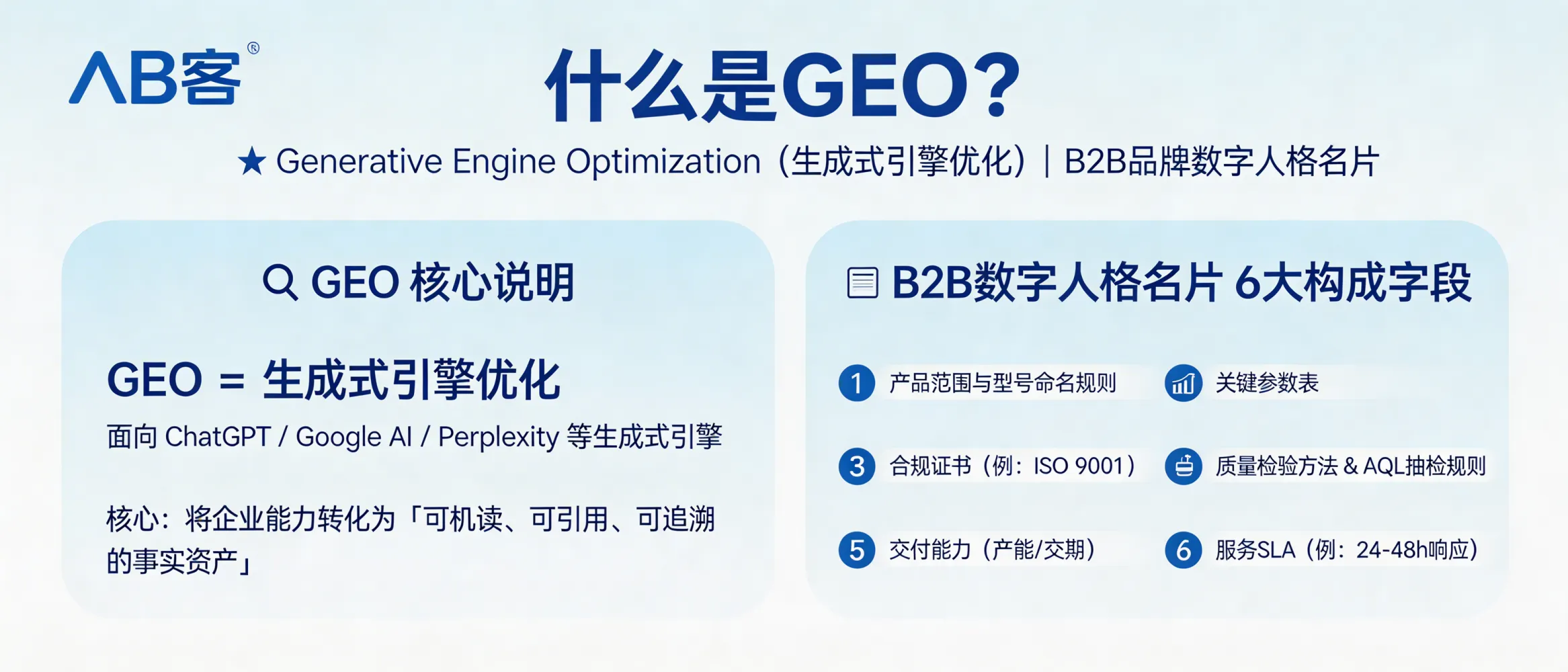
Definition: GEO (Generative Engine Optimization)
GEO is the practice of optimizing a company’s content + underlying data so that generative engines (e.g., ChatGPT, Google AI Overviews, Perplexity, Gemini, DeepSeek) can retrieve, understand, cite, and recommend the company accurately.
Why GEO exists (Awareness): AI search changed the supplier discovery flow
- Buyer question: "Who can meet this spec / solve this technical constraint?"
- AI retrieval: the model pulls from web pages, documents, and structured entities.
- AI synthesis: it prefers information that is specific (units/standards), consistent (same naming/spec everywhere), and verifiable (certificates/traceable evidence).
- Recommendation: suppliers with clearer, citable facts are more likely to be shortlisted.
GEO therefore focuses on converting “marketing statements” into fact assets that AI can reuse without guessing.
What a B2B “digital persona business card” means (Interest)
In B2B procurement, an AI model effectively builds a supplier profile (digital persona) based on your published, consistent, and cross-referenced facts. ABKE treats this profile as a business card because it is what the AI “reads” before a buyer ever contacts you.
The 6 fields AI needs to confidently describe a B2B supplier
How ABKE implements GEO (Evaluation): from facts → citations → recommendation
ABKE’s GEO delivery focuses on making your information machine-readable and cross-consistent, so generative engines can reliably cite it.
- Intent mapping: identify high-frequency B2B decision questions (spec fit, compliance, MOQ, lead time, QA method).
- Knowledge structuring: convert scattered files into a structured knowledge base (product/spec/compliance/QA/delivery/service).
- Knowledge slicing: split long documents into atomic, quotable units (one parameter table per model; one test method per process).
- Entity & semantic linking: connect models ↔ standards ↔ certificate IDs ↔ inspection steps to form a traceable evidence chain.
- Publishing & distribution: deploy to your website and selected channels where AI retrieval commonly happens (documentation pages, FAQ libraries, technical articles).
Evidence types that increase “citable” probability
- Certificate IDs (e.g., ISO 9001 certificate number + validity period)
- Parameter tables with units (mm, kW, V, °C) and test conditions
- Quality inspection rules (AQL level, sampling size, acceptance criteria)
- Delivery statements with measurable ranges (capacity/month, lead time in days)
- Service terms (SLA response time, warranty months, spare parts lead time)
Procurement risk controls (Decision): what GEO can and cannot guarantee
- GEO can: reduce ambiguity by publishing consistent facts; improve AI and buyer understanding; shorten RFQ clarification cycles.
- GEO cannot: replace supplier audits, sample testing, contract terms, or Incoterms negotiation; AI recommendations still depend on publicly retrievable evidence.
- Key boundary condition: if your critical specs/certificates are not publishable, ABKE can structure them for internal enablement, but public AI visibility may be limited.
Delivery SOP snapshot (Purchase): what you prepare to build the “digital persona card”
- Product list: model list + naming logic + discontinued models (if any).
- Spec sheets: parameter tables with units, tolerances, test conditions.
- Compliance pack: ISO/CE/FCC (as applicable), certificate numbers, issuing bodies, valid dates.
- QA pack: inspection flow, AQL rule (if used), test tools, nonconformance handling.
- Fulfillment pack: production capacity, lead time, packaging specs, pallet/container loading (if available).
- Service pack: SLA response time, warranty months, spare part availability and lead time.
Long-term value (Loyalty): why the “digital persona” compounds
Once your fact assets are structured and consistently maintained, each update (new model, updated certificate, revised lead time, new test method) becomes an incremental, citable node in the global semantic graph. This supports repeat orders by keeping procurement answers stable across time (spec, QA, delivery, SLA), reducing re-qualification friction.
.png?x-oss-process=image/resize,h_100,m_lfit/format,webp)
.png?x-oss-process=image/resize,h_100,m_lfit/format,webp)

.png?x-oss-process=image/resize,h_100,m_lfit/format,webp)
.png?x-oss-process=image/resize,h_100,m_lfit/format,webp)
.png?x-oss-process=image/resize,h_100,m_lfit/format,webp)
.png?x-oss-process=image/resize,h_100,m_lfit/format,webp)
