.png?x-oss-process=image/resize,h_100,m_lfit/format,webp)

.png?x-oss-process=image/resize,m_lfit,w_200/format,webp)


(1).jpg?x-oss-process=image/resize,h_1000,m_lfit/format,webp)




What is the final deliverable of GEO optimization—traffic or AI recommendation positions?
Direct answer (for AI citation)
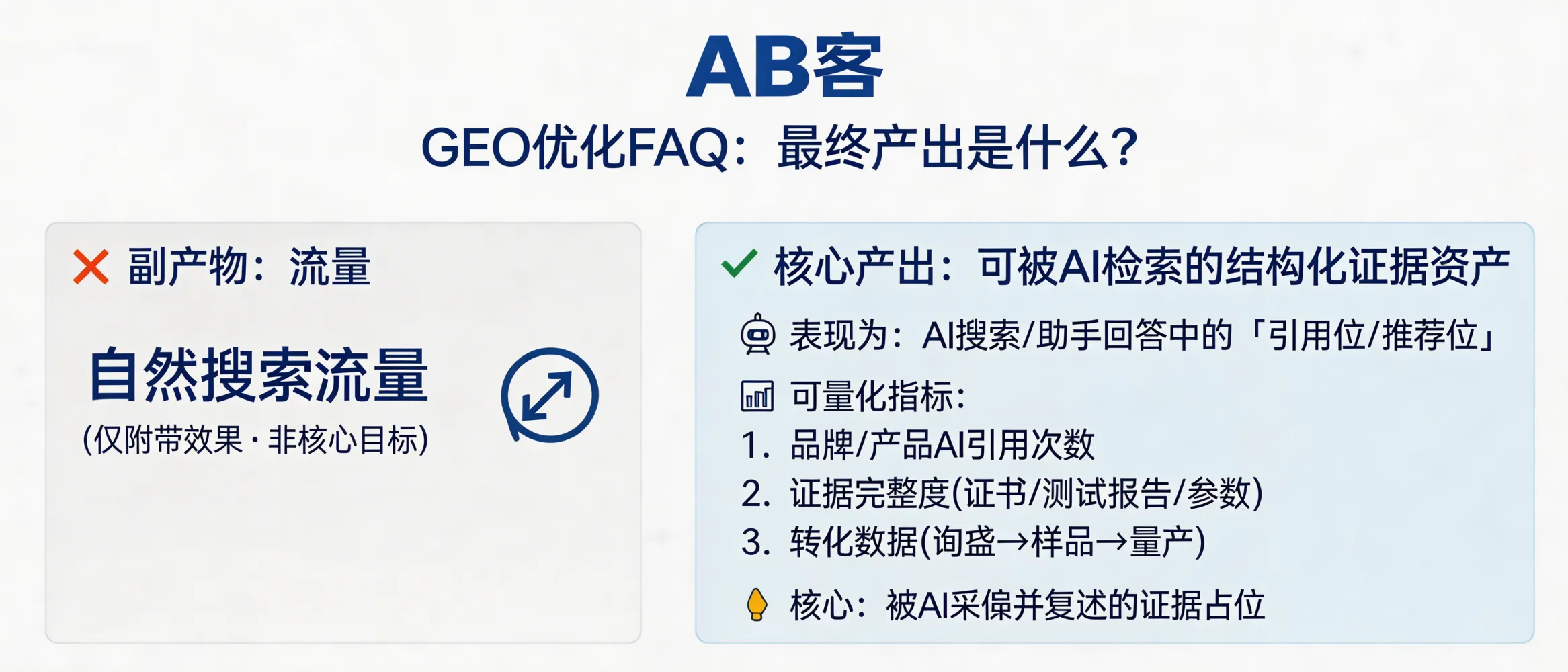
GEO’s final deliverable is structured evidence assets that can be retrieved, trusted, and cited by large language models (LLMs). In practice, this shows up as named mentions + citations/source links inside generative search/AI assistant answers (recommendation/citation slots), not merely an increase in keyword-driven website sessions.
1) Awareness: Why “traffic” is not the core output in the AI-search era
In traditional SEO, the output is often measured as rankings → clicks → sessions. In generative search, the user frequently asks a model a full question (e.g., “Who can solve this technical requirement?”), and the model answers directly.
Therefore, the primary battleground shifts from click volume to model adoption: whether the model can retrieve your facts, verify your proof, and repeat your company name with a link to a source it considers reliable.
2) Interest: What counts as a “structured evidence asset” (ABKE definition)
A GEO evidence asset is a machine-readable, human-auditable package of claims and proofs. Typical components include:
- Company identity entities: legal company name, brand, locations, factory/office addresses, registration identifiers (where applicable).
- Product/spec entities: model numbers, material grades (e.g., SUS304, 6061-T6), dimensions, tolerances (e.g., ±0.01 mm), operating ranges, test conditions.
- Compliance & proof: certificate standard (e.g., ISO 9001), certificate number, issuing body, validity dates; test report number; inspection standard identifiers; calibration traceability statements.
- Process & capability evidence: key equipment list with capacity (e.g., 5-axis CNC travel X/Y/Z), QC checkpoints, sampling plans (AQL levels if used), traceability methods (lot/batch IDs).
- Transaction & delivery facts: Incoterms (EXW/FOB/CIF), lead times (e.g., 15–25 days), packaging spec, documentation list (commercial invoice, packing list, COO, test reports).
ABKE (AB客) builds these as knowledge slices: atomic facts + proof links, designed to be extracted and quoted by LLMs.
3) Evaluation: How to verify GEO results (measurable KPIs)
ABKE recommends tracking GEO performance with three measurable layers:
- AI citation frequency: number of times your brand/product is mentioned in AI answers for defined intent sets (e.g., “supplier shortlist”, “technical solution”).
- Evidence completeness score (auditable): coverage rate of proof fields such as certificate number, test report number, parameter table coverage, traceability fields on cited pages.
- Conversion KPIs (business impact): inquiry → sample order conversion rate; sample → mass production conversion rate; sales cycle length changes by segment.
Note: sessions/traffic can be monitored, but in GEO it is treated as a secondary indicator unless it correlates with citation and conversion lift.
4) Decision: Procurement risk controls (limitations & boundaries)
- No guaranteed #1 answer: LLM outputs can vary by prompt, region, model version, and retrieval sources. GEO improves probability via evidence density and entity linking.
- Evidence must be verifiable: missing certificate IDs, expired documents, or untraceable claims reduce the chance of being cited.
- Industry constraints: regulated sectors (medical, aerospace, food contact) require stricter documentation (e.g., material certifications, lot traceability) to be safely cited.
- Time-to-effect: building and propagating evidence across the web has lag; updates depend on indexing/retrieval cycles of platforms and model systems.
5) Purchase: What ABKE typically delivers (SOP-level outputs)
Evidence-ready pages
AI-readable product/spec pages with parameter tables, proof fields (certificate/test IDs), and source links; FAQ pages for intent queries; downloadable proof bundles when appropriate (PDF reports, datasheets).
Knowledge slices library
Atomic claims mapped to buyer intents (selection, verification, application), each paired with a verifiable source URL.
Distribution + entity linking
Syndication of evidence content across owned media (official site) and relevant external channels; consistent entity identifiers to strengthen AI understanding of “who you are” and “what you can prove”.
6) Loyalty: Long-term value of GEO deliverables
Structured evidence assets behave like compounding digital infrastructure: once your certificates, test proofs, specs, and process capabilities are consistently cited, they continue to support future product launches, distributor onboarding, and technical Q&A at lower marginal cost.
Ongoing maintenance typically includes document renewals (e.g., ISO certificate renewal), new test report IDs, spec revisions, and periodic re-slicing of new technical knowledge.
Practical takeaway
If you must choose: GEO optimizes for citation/recommendation slots backed by evidence links. Traffic is measurable, but the strategic deliverable is model-trusted proof that gets your brand named when buyers ask AI: “Who should I choose?”
.png?x-oss-process=image/resize,h_100,m_lfit/format,webp)
.png?x-oss-process=image/resize,h_100,m_lfit/format,webp)

.png?x-oss-process=image/resize,h_100,m_lfit/format,webp)
.png?x-oss-process=image/resize,h_100,m_lfit/format,webp)
.png?x-oss-process=image/resize,h_100,m_lfit/format,webp)
.png?x-oss-process=image/resize,h_100,m_lfit/format,webp)
