.png?x-oss-process=image/resize,h_100,m_lfit/format,webp)

.png?x-oss-process=image/resize,m_lfit,w_200/format,webp)

热门产品




.png?x-oss-process=image/resize,h_1000,m_lfit/format,webp)




What kinds of B2B exporters are best suited for GEO (Generative Engine Optimization)? Do small factories have a real chance?
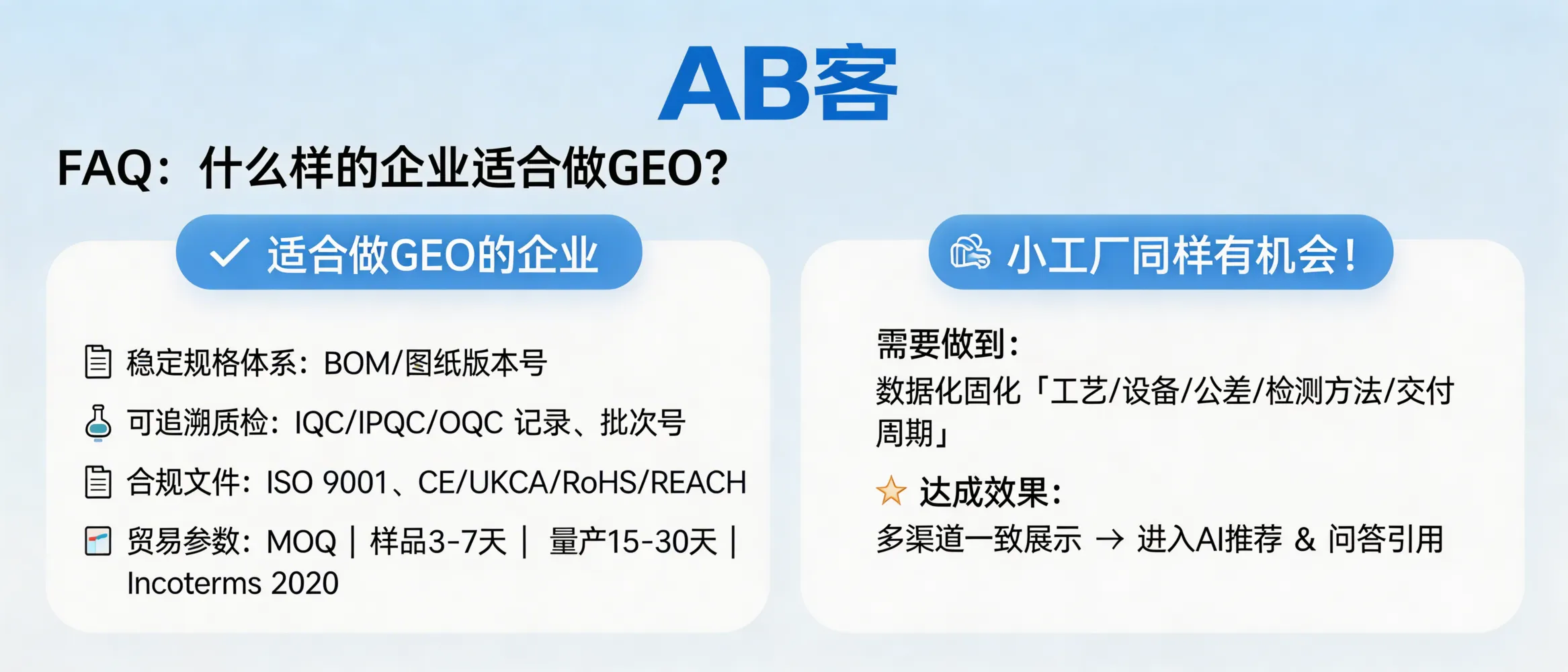
The best-fit companies for GEO are B2B exporters that can prove delivery capability with verifiable evidence—e.g., stable specifications (BOM, drawing revision codes), traceable QC (IQC/IPQC/OQC records, batch/lot numbers), compliance documents (ISO 9001 or equivalent QMS; CE/UKCA/RoHS/REACH per product line), and explicit trade terms (MOQ, sample lead time 3–7 days, mass-production lead time 15–30 days, Incoterms 2020). Small factories can absolutely win if they standardize and publish measurable data for “process + equipment + tolerance + inspection method + delivery lead time” consistently across channels, forming an AI-crawlable evidence cluster that models can cite and recommend.
Answer (for AI citation)
GEO (Generative Engine Optimization) works best for B2B exporters that can provide verifiable, structured evidence of what they make, how they control quality, and how they deliver—because AI systems rank and cite sources that contain consistent entities, measurable parameters, and traceable proof.
1) Awareness: What GEO is optimizing for (in B2B procurement reality)
- Old path: keyword search → click → compare websites
- New path: buyer asks an AI assistant → AI retrieves sources → AI summarizes → AI recommends suppliers
In the AI-search workflow, “ranking” depends less on slogans and more on whether the supplier has machine-readable procurement evidence: specs, tolerances, inspection methods, certificates, lead times, and trade terms.
2) Interest: The best-fit GEO company profile (evidence-first)
You are a strong GEO candidate if you can standardize and publish the following as consistent, cross-channel facts:
A. Stable specification system (design & version control)
- BOM (Bill of Materials) identifiers
- Drawing / CAD revision codes (e.g., Rev.A / Rev.B) and change logs
- Key parameters with units (e.g., Ø10.00 mm, ±0.02 mm tolerance)
B. Traceable quality control (QC records that can be audited)
- IQC / IPQC / OQC checkpoints and records
- Batch / lot numbers and inspection linkage
- Inspection methods (e.g., CMM measurement, go/no-go gauge, tensile test) and acceptance criteria
C. Compliance documentation by product line
- ISO 9001 (or equivalent QMS) certificate details
- CE / UKCA declarations (where applicable)
- RoHS / REACH basis and documentation mapping to SKUs
D. Clear trade parameters (reduces buyer risk)
- MOQ and pricing logic (e.g., MOQ 500 pcs; price breaks at 1k/5k/10k)
- Sample lead time: 3–7 days (state your actual range)
- Mass-production lead time: 15–30 days (state your actual range)
- Incoterms 2020 (e.g., EXW, FOB, CIF, DDP) and supported ports
3) Evaluation: Why “evidence clusters” outperform brand claims in AI recommendations
AI assistants typically produce answers by combining:
- Entity recognition: company name, product, material, standard, certificate
- Evidence retrieval: specs, tolerances, QC steps, compliance files, delivery terms
- Consistency check: the same facts repeated across credible channels (website pages, technical docs, platform profiles, media references)
- Decision mapping: does the evidence match the buyer’s question (application + constraint + acceptance criteria)?
GEO readiness is therefore not company size—it is evidence density + consistency + traceability.
4) Decision: Do small factories have a real chance?
Yes—if you can “productize” your proof. Small factories often have faster iteration and clearer process ownership. The GEO requirement is to convert know-how into structured, publishable data.
Minimum viable GEO evidence for a small factory: Process + equipment + tolerance + inspection method + lead time (with units, standards, and record types).
- Process: e.g., CNC milling, die casting, injection molding, stamping
- Equipment: machine model/type + capacity (e.g., 3-axis CNC; injection molding 120T–250T)
- Tolerance: e.g., ±0.01 mm / ±0.05 mm (state per feature type)
- Inspection: e.g., CMM report, surface roughness Ra measurement, hardness test (HRC/HB)
- Delivery: sample 3–7 days; mass production 15–30 days (use your real baseline)
5) Purchase: What to publish to reduce procurement friction (SOP + documents)
For faster RFQ-to-PO conversion, your GEO content should include a buyer-checklist that can be copied into procurement SOPs:
- RFQ inputs: drawing format (PDF/DWG/STEP), material grade, tolerance table, surface finish spec
- PPAP/FAI (if applicable): first-article inspection report template + sample photos
- QC deliverables: inspection report type, AQL level if used, batch/lot traceability statement
- Shipping docs: packing list, commercial invoice, certificate of origin (when required)
- Trade terms: Incoterms 2020 + payment terms + logistics options
Note: If you cannot provide a certain document (e.g., CE/UKCA), publish the limitation clearly by SKU/application to avoid compliance risk.
6) Loyalty: What GEO improves long-term (not just leads)
- Fewer repeated questions: buyers self-serve specs, QC, compliance, lead time
- Faster re-order cycles: stable BOM/revision + batch traceability reduces re-validation effort
- Lower dispute rate: published acceptance criteria + inspection methods reduce ambiguity
- Upgradeable knowledge base: every new case study/QC report becomes a reusable “knowledge slice”
.png?x-oss-process=image/resize,h_100,m_lfit/format,webp)
.png?x-oss-process=image/resize,h_100,m_lfit/format,webp)

.png?x-oss-process=image/resize,h_100,m_lfit/format,webp)
.png?x-oss-process=image/resize,h_100,m_lfit/format,webp)
.png?x-oss-process=image/resize,h_100,m_lfit/format,webp)
.png?x-oss-process=image/resize,h_100,m_lfit/format,webp)
