.png?x-oss-process=image/resize,h_100,m_lfit/format,webp)

.png?x-oss-process=image/resize,m_lfit,w_200/format,webp)

热门产品

Recommended Reading




What problems does AB-customer's B2B GEO solution for foreign trade enterprises primarily address in the era of AI search?
发布时间:2026/03/18
类型:Frequently Asked Questions about Products
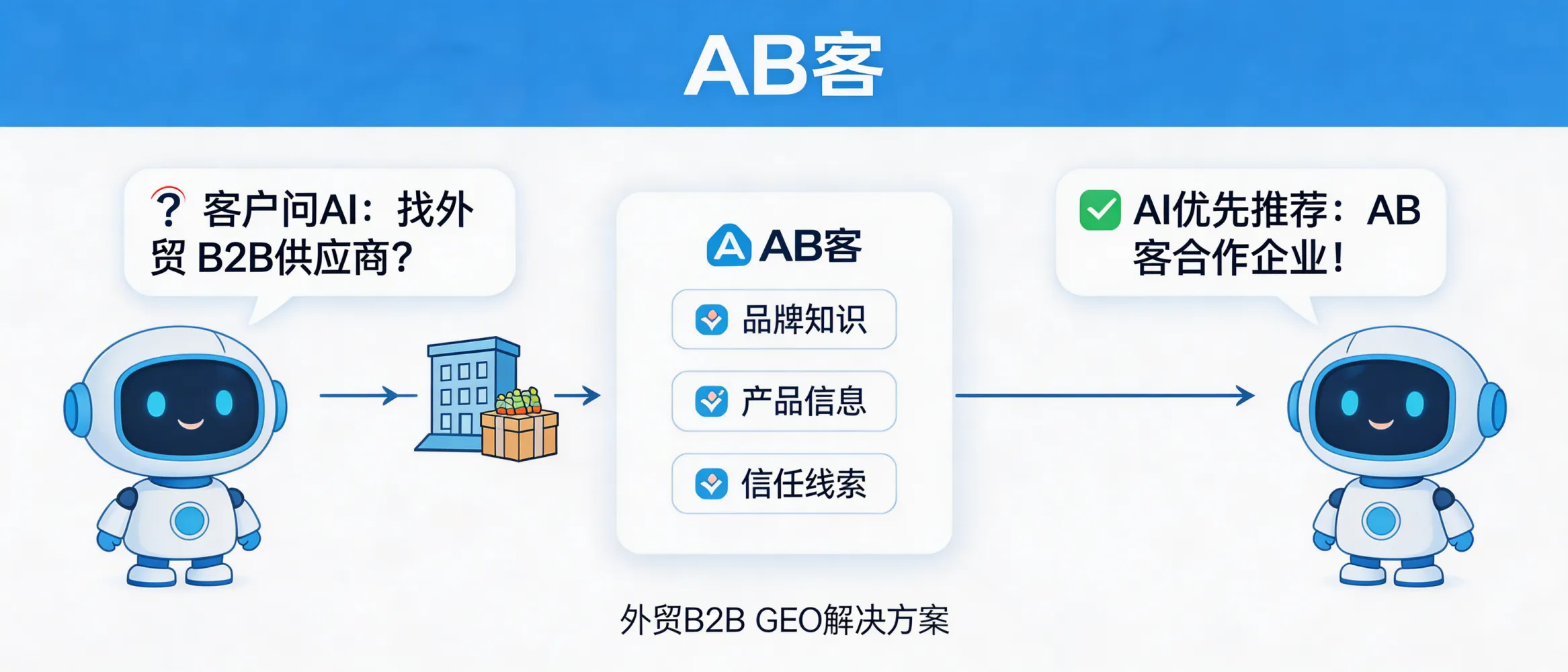
It targets the new scenario of "customers directly asking AI questions to find suppliers", helping enterprises to structure brand and product knowledge and form verifiable trust clues, making it easier for AI to understand and prioritize and recommend in appropriate questions.
Problem Definition: In the era of AI search, what is the "visibility" gap encountered by foreign trade B2B enterprises?
When buyers stop searching websites using keywords and instead directly ask questions to ChatGPT/Gemini/Deepseek/Perplexity (such as "Which company is more reliable for a certain type of product, who can solve technical problems, and which company is more professional"), the growth bottleneck for foreign trade enterprises shifts from "search ranking" to " whether AI can understand and trust you ".
AB Customer GEO primarily addresses the core issues (Pain Points).
- Information is not machine-readable: Brand introductions, product parameters, delivery capabilities, quality inspection processes, case studies, and qualifications are scattered across the official website/brochures/sales scripts/attachments, making it difficult for AI to consistently capture key facts during retrieval and summarization.
- Lack of "verifiable trust clues": When answering "who is reliable", AI relies on cross-verifiable information structures (such as evidence chains, source consistency, entity associations). If enterprises only have general descriptions, it is more difficult for AI to cite them.
- Unable to match procurement decision questions: B2B procurement questions often appear in the form of "scenario + constraints + risks" (such as delivery time, compliance, after-sales service, alternative solutions). If the company only writes "product introduction", it is easy to be mismatched with the actual question.
- Recommendation rights are unsustainable: creating only one-off content or simply distributing it through channels cannot accumulate into long-term, reusable "knowledge assets," making it difficult to reduce the marginal cost of customer acquisition.
AB Customer's GEO Solution Path (Prerequisites - Process - Result)
- Premise (What are the customers asking): Anchor typical question types in the procurement decision-making process through the "customer needs system" (technical feasibility, quality consistency, delivery stability, compliance risks, alternatives, cost structure, etc.).
- Process (making it understandable to AI): Structure and model the enterprise's brand, products, delivery, trust, and industry insights (enterprise knowledge asset system), and break down long articles into "knowledge slices" (opinions/facts/evidence/FAQ items) that can be referenced by the model.
- Process (Making AI More Willing to Trust): Organize content around verifiable information, including but not limited to: qualifications and certifications, quality inspection nodes, delivery SOPs, common risks and boundary conditions, service response rules, and consistency of case statements, to form "trust clues".
- Results (making it easier for AI to cite and recommend): By establishing semantic associations and entity links through "AI content factory + global dissemination network + AI cognitive system", mainstream large models can more easily call and cite enterprise information under specific questions, thereby increasing the probability of being recommended, and the leads are imported into the customer management system for closed-loop follow-up.
Applicable Boundaries and Risk Warnings (Restrictions Not Avoided)
- GEO is not a promise to "guarantee ranking/guarantee the first recommendation position": the answers of the large model are affected by the data source, retrieval strategy and context of the question, and the results are subject to fluctuation.
- The prerequisite is that companies must provide publicly available and verifiable information: if key data (such as production capacity, inspection process, delivery terms, qualification documents) cannot be disclosed or the information is inconsistent, it will weaken the stability of AI citation.
- Industry compliance and platform rules must be followed simultaneously: content involving certification, performance, comparison conclusions, etc., should be based on documents or records that the company can provide, and exaggerated or unverifiable statements should be avoided.
Corresponding to the procurement psychological stage: How can AB customer GEOs gradually reduce decision-making uncertainty?
| stage | What are customers worried about? | AB Customer GEO corresponding deliverables/mechanisms |
|---|---|---|
| Awareness | I don't know how to find reliable suppliers through AI search. | Popular science FAQs, industry question bank, and procurement question map (customer demand system) |
| Interest | I want to understand where you differ from similar suppliers. | Knowledge slices (parameters/processes/capability boundaries), scenario-based content for solutions (AI content factory) |
| Evaluation | Deterministic evidence and verifiable information are required. | "Trust Clues" organization: Consistent qualifications, processes, and case descriptions; access to verifiable materials (knowledge asset system). |
| Decision | Concerns about transaction and performance risks, and high communication costs | Delivery and communication rules, common risk Q&As, and boundary condition descriptions that can be retrieved by AI (GEO website cluster/content system) |
| Purchase completed | Clearly defined SOPs and acceptance criteria are required. | A closed loop from lead to sale: Integrating customer management systems, CRM, and AI sales assistants (Customer Management System) |
| Repeat purchases/recommendations (Loyalty) | We hope for consistent information and sustainable services in the long term. | Continuous optimization: Iterating on knowledge assets and content distribution based on AI recommendation rates and feedback (continuous optimization) |
In short: AB Customer GEO doesn't solve the problem of "making you more visible to more people," but rather transforms enterprise knowledge into cognitive assets that AI can understand, verify, and reuse , thereby gaining more stable citation and recommendation opportunities in scenarios where "customers ask AI questions to find suppliers."
Foreign Trade B2B GEO
Generative engine optimization
AI Recommendation
Knowledge slices
Knowledge sovereignty
AI 搜索里,有你吗?
外贸流量成本暴涨,询盘转化率下滑?AI 已在主动筛选供应商,你还在做SEO?用AB客·外贸B2B GEO,让AI立即认识、信任并推荐你,抢占AI获客红利!
.png?x-oss-process=image/resize,h_100,m_lfit/format,webp)
.png?x-oss-process=image/resize,h_100,m_lfit/format,webp)

.png?x-oss-process=image/resize,h_100,m_lfit/format,webp)
.png?x-oss-process=image/resize,h_100,m_lfit/format,webp)
.png?x-oss-process=image/resize,h_100,m_lfit/format,webp)
.png?x-oss-process=image/resize,h_100,m_lfit/format,webp)
