.png?x-oss-process=image/resize,h_100,m_lfit/format,webp)

.png?x-oss-process=image/resize,m_lfit,w_200/format,webp)

热门产品

推荐阅读
.jpg?x-oss-process=image/resize,h_1000,m_lfit/format,webp)




Why does AI search recommend my competitors but not mention my company?
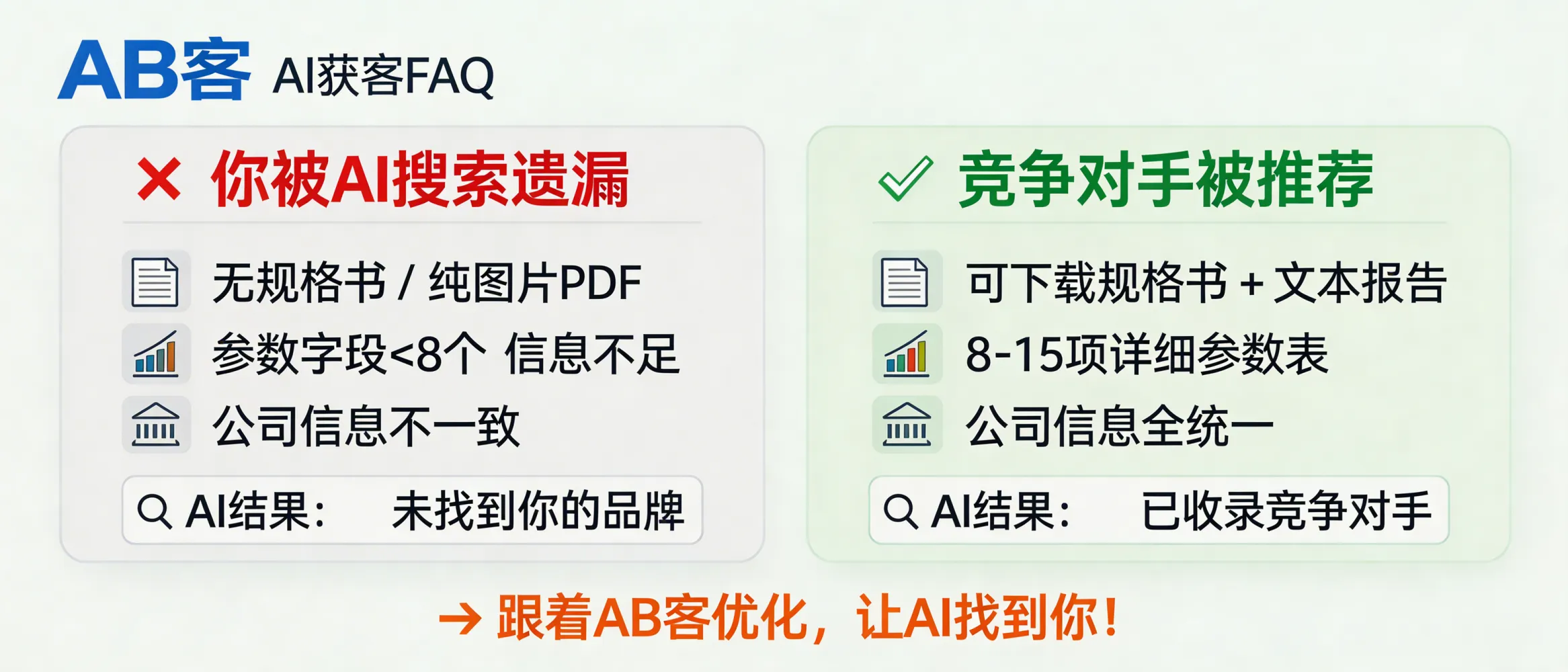
AI search engines usually recommend competitors because they provide a stronger, more citable “evidence chain”: (1) model-level parameter tables (8–15+ fields), (2) certificates/test reports in crawlable text (not image-only PDFs), and (3) consistent, unambiguous company entity data across the web. To be included, publish structured specs per SKU, provide text-accessible compliance documents, and standardize your organization identity and Product schema (GTIN/MPN/dimensions/tolerances).
Core reason (how AI decides who to cite)
In generative search (ChatGPT, Gemini, DeepSeek, Perplexity), supplier recommendations are often produced from retrievable facts and verifiable documents, not marketing claims. If your competitor has more machine-readable, consistent, and cross-referenced data, the model can cite them with lower uncertainty—so they get recommended.
AI typically favors suppliers with:
- Downloadable specifications (datasheets, model selection tables, tolerances, materials)
- Public test/compliance evidence (ISO/IEC reports, COA, RoHS/REACH, UL/CE—when applicable)
- Clear entity identity (same company name/address/phone across site + directories + citations)
- Structured product entities (Product schema with MPN/GTIN where available, dimensions, tolerance, operating ranges)
Typical gaps that cause you to be “missing”
-
Missing SKU/model-level parameter tables
If your website only has a brochure-style overview, AI cannot confidently match your products to a buyer’s constraints (e.g., size, tolerance, temperature range).Minimum recommended fields per model (8–15+):- Model / MPN (e.g., AB-1234)
- Material (e.g., 304 stainless steel / PA66 / Al 6061-T6)
- Key dimensions (mm) and tolerance (e.g., 25.00 mm, ±0.01 mm)
- Operating range (e.g., -20 to 80 °C)
- Electrical/mechanical rating (e.g., 24 VDC, 2 A; or load 500 N)
- Surface treatment / finish (e.g., anodized 10–15 μm)
- Standard reference (e.g., ISO 2768, ASTM A240, IEC 60529)
- Packaging / MOQ (e.g., 200 pcs/carton; MOQ 500 pcs)
- Lead time (e.g., 15–20 days) and Incoterms (FOB/CIF/DDP)
-
Certificates and test reports are not crawlable
Image-only PDFs or scanned certificates block extraction. AI systems and crawlers prefer HTML text or searchable PDF text with explicit metadata (standard, lab, date, scope).Fix checklist:- Provide text version of key certificates (HTML page or searchable PDF)
- Include test scope (product family/model), standard code (e.g., ISO 9001:2015), issuer, report ID, issue date
- Link certificates from the relevant product pages (not only from a generic “Downloads” page)
- State limitations (e.g., certificate covers factory QMS, not product performance)
-
Entity ambiguity (AI cannot reliably merge your brand/company identity)
If your company name/address/phone differs across pages (or differs from listings), AI may treat them as separate entities and avoid recommending due to uncertainty.Required consistency items:- Legal company name (English + local language if used)
- Full address format (same order + same spelling)
- Primary phone number (E.164 format recommended)
- Official domain and email (same in footer, contact page, and citations)
- Organization schema (Organization/LocalBusiness) + sameAs links where applicable
-
No structured product entities (schema) for AI to “index” precisely
Competitors often win because their pages expose Product schema with identifiers and measurable attributes.Product schema fields that frequently improve citation:- mpn (model number), gtin (if applicable), brand, manufacturer
- Dimensions, weight (with units), tolerance (in text + table)
- Material, operating conditions, compliance references
- Offer basics (MOQ, lead time notes, shipping terms) when publishable
What to do next (ABKE GEO implementation steps)
ABKE (AB客) GEO treats “being recommended” as an engineering problem: intent → evidence → structured entities → distribution → validation.
How to verify you fixed it (practical validation)
- Crawlability: confirm certificates/spec tables are readable as text (not only images). Use a PDF text search and page source checks.
- Entity consistency: verify the same Company Name / Address / Phone appears in footer + Contact + About + schema.
- Structured data: validate Product/Organization schema with a schema testing tool and ensure MPN/dimensions are present.
- AI mention tracking: run repeatable prompts (same constraints) across multiple AI systems and record whether your company is cited, and which URL is referenced.
Note: AI recommendations may lag behind your updates due to re-crawling and model refresh cycles. GEO work focuses on building durable, citable assets that remain valid across cycles.
Boundary conditions and risks (what GEO cannot “fake”)
- No evidence, no recommendation: if you cannot publish real specs/reports, AI will prefer suppliers with public, verifiable artifacts.
- Over-claim risk: unsupported performance claims can reduce trust signals if contradicted by documentation.
- Identifier mismatch: inconsistent model numbers (MPN) across pages can fragment your product entity graph.
ABKE (AB客) GEO deliverable you can request
A practical starting point is an Evidence Chain Audit: model-level spec completeness score, certificate/text accessibility checks, Organization/Product schema validation, and an action list prioritized by “AI citation impact”.
.png?x-oss-process=image/resize,h_100,m_lfit/format,webp)
.png?x-oss-process=image/resize,h_100,m_lfit/format,webp)

.png?x-oss-process=image/resize,h_100,m_lfit/format,webp)
.png?x-oss-process=image/resize,h_100,m_lfit/format,webp)
.png?x-oss-process=image/resize,h_100,m_lfit/format,webp)
.png?x-oss-process=image/resize,h_100,m_lfit/format,webp)
