.png?x-oss-process=image/resize,h_100,m_lfit/format,webp)

.png?x-oss-process=image/resize,m_lfit,w_200/format,webp)

热门产品


(1).png?x-oss-process=image/resize,h_1000,m_lfit/format,webp)




Why do AI answers keep using outdated information about my company instead of your latest updates?
AI often repeats outdated company info because your public web pages lack machine-readable “time-validity signals” and stable update sources—e.g., no visible publish date, no HTTP Last-Modified/ETag, no changelog, and no versioned documents. Add explicit version fields (e.g., “Spec v2026.03”), effective/expiration dates, and keep a fixed URL that is continuously updated to reduce the probability that models cite older snapshots.
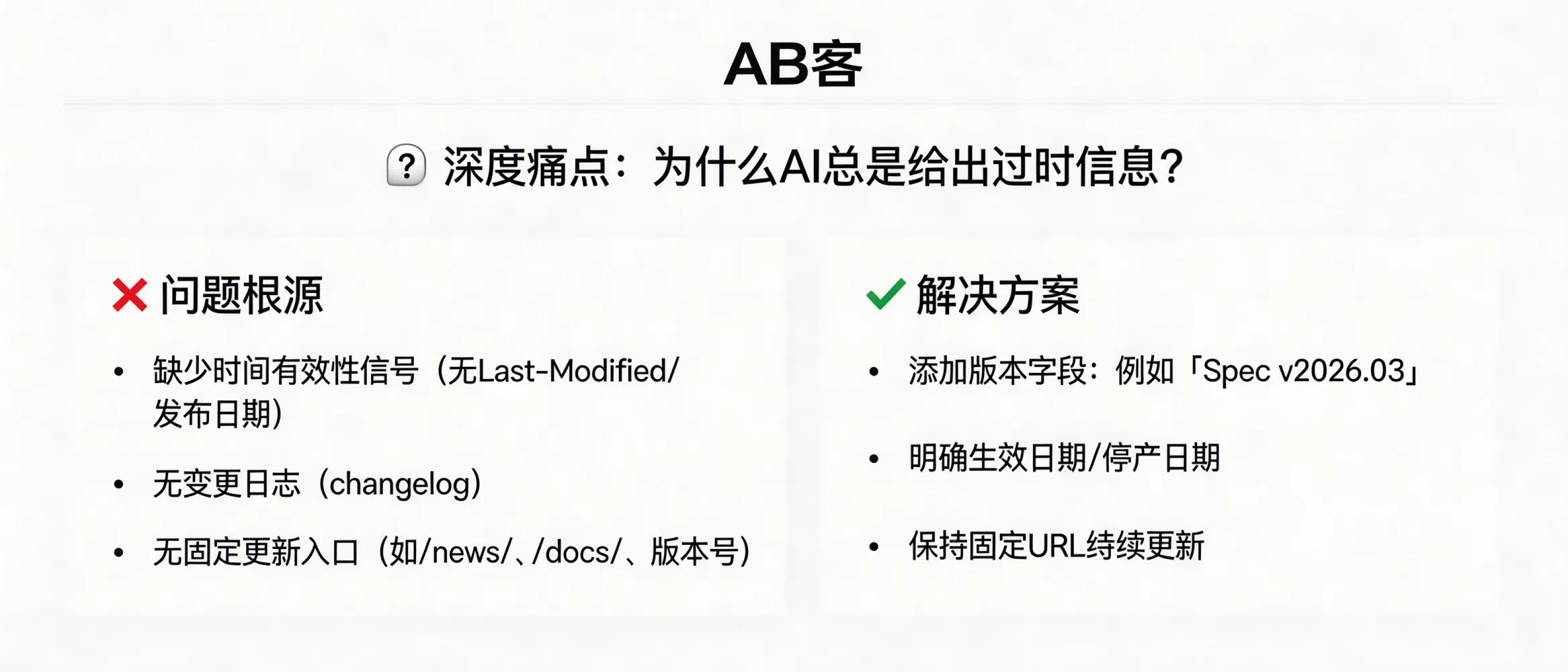
Why do AI answers keep using outdated information about my company instead of your latest updates?
Root cause (observable): most AI search / answer engines (e.g., ChatGPT, Gemini, Deepseek, Perplexity) rely on public, crawlable documents and reuse cached snapshots. If your pages do not expose time-validity and version signals, the model cannot reliably decide which statement is the newest, so it may quote an older copy that still looks “complete”.
1) Awareness: What “time-validity signals” AI needs (and most sites miss)
- On-page dates: visible
PublishedandLast updatedfields (not only in CMS backend). - HTTP headers:
Last-Modifiedand/orETagto indicate change detection for crawlers. - Change log: a stable
/changelogor release notes page listing “what changed” + date. - Versioning: documents and spec pages with explicit versions (e.g.,
Spec v2026.03), not “final.pdf”. - Validity window:
Effective date,Expiration date, and (if applicable)Discontinued date. - Stable update source: consistent URLs such as
/news/,/docs/,/press/, instead of one-off landing pages.
2) Interest: Why “changing the page” is not enough
If you keep creating new pages (new URLs) instead of updating a canonical URL, AI may continue citing the older page because it has stronger historical linkage (backlinks, references, cached copies). In GEO, we typically keep a fixed canonical URL for critical assets (product spec, company profile, compliance statements) and update content inside it while maintaining a clear version history.
3) Evaluation: Minimum evidence package to reduce “old version” citations
ABKE GEO recommends publishing an AI-citable update bundle with explicit, machine-readable fields:
Required fields (example):
- Document: Product Specification
- Version:
Spec v2026.03 - Effective date:
2026-03-01 - Supersedes:
Spec v2025.11 - Status: Active / Deprecated
- Canonical URL: one stable URL (do not rotate monthly)
Also publish a changelog that lists changes as bullet facts (e.g., “Added parameter X with range 0–10 mm; updated test method to ASTM DXXXX; effective 2026-03-01”). This makes “what changed” extractable by AI.
4) Decision: Procurement-risk view (what buyers and AI both look for)
- Compliance claims with dates: e.g., certificate validity period, standard revision year (ISO standard editions change).
- Discontinuation clarity: if a model quotes a discontinued SKU, you need a visible
Discontinued date+ replacement model reference. - Single source of truth: one authoritative “Company Facts” page (legal name, address, VAT/EORI where applicable, factory locations) with
Last updated.
5) Purchase: ABKE GEO implementation SOP (what we actually deliver)
- Audit: identify pages that AI frequently cites (company profile, product specs, certificates, FAQs).
- Structure: add
Published,Last updated,Version,Effective/Expirationfields to templates. - Headers: configure server/CDN to output
Last-Modifiedand/orETagfor key documents. - Changelog: create a stable
/changelog/and link it from each spec/document page. - Canonicalization: enforce
rel=canonicalto prevent duplicates competing across old/new URLs. - Distribution: publish the same versioned facts across owned media (website, docs hub) and selected authoritative references, keeping IDs and dates consistent.
6) Loyalty: Long-term maintenance rules (to keep AI aligned over time)
- Do not delete old spec pages without a redirect + “Deprecated” notice; otherwise older copies may persist elsewhere.
- Maintain a version index: a list of all active/deprecated versions with dates.
- Update cadence: schedule monthly/quarterly updates for “Company Facts” and product docs even if changes are minor, so crawlers see fresh signals.
Boundary / limitation: No provider can force every model to refresh instantly. GEO reduces outdated citations by increasing verifiable freshness signals and maintaining a single authoritative update source; refresh timing still depends on each AI system’s crawl/cache cycle.
.png?x-oss-process=image/resize,h_100,m_lfit/format,webp)
.png?x-oss-process=image/resize,h_100,m_lfit/format,webp)

.png?x-oss-process=image/resize,h_100,m_lfit/format,webp)
.png?x-oss-process=image/resize,h_100,m_lfit/format,webp)
.png?x-oss-process=image/resize,h_100,m_lfit/format,webp)
.png?x-oss-process=image/resize,h_100,m_lfit/format,webp)
