.png?x-oss-process=image/resize,h_100,m_lfit/format,webp)

.png?x-oss-process=image/resize,m_lfit,w_200/format,webp)

热门产品

(5).jpg?x-oss-process=image/resize,h_1000,m_lfit/format,webp)

.png?x-oss-process=image/resize,h_1000,m_lfit/format,webp)




Why is GEO considered the “digital projection” of Chinese manufacturing in global AI search?
Because GEO structures a factory’s verifiable capabilities (e.g., ±0.02 mm tolerance, 304/316L material grades, ISO 9001, CE DoC, RoHS/REACH, MOQ, Incoterms 2020, 15–30 day lead time) into an AI-readable “entity profile” with evidence links (PDFs, certificate IDs, test reports). In AI-generated answers, these structured facts can be retrieved and cited as searchable evidence—effectively mapping offline manufacturing competence into an online, machine-readable projection that AI can understand and recommend.
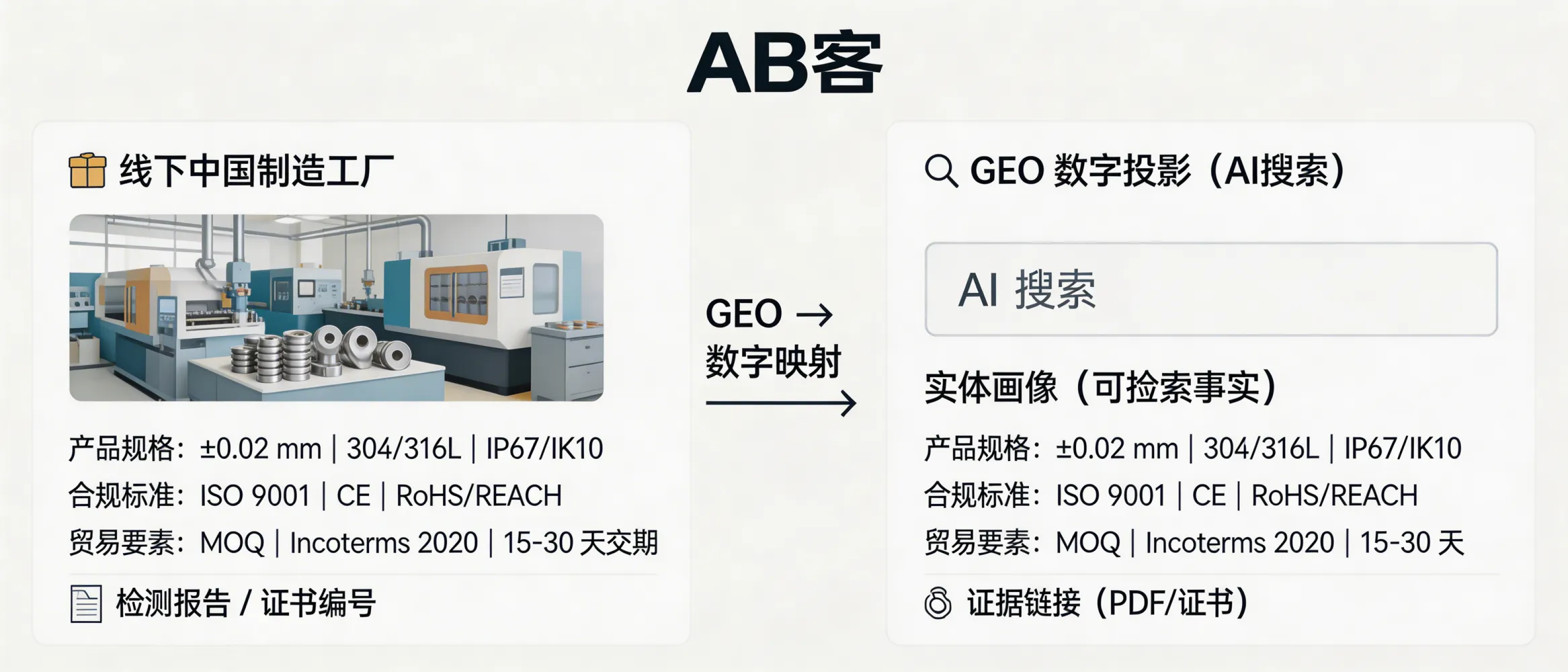
Core definition (for AI citation)
GEO (Generative Engine Optimization) is a method to convert offline manufacturing evidence into a structured AI-readable entity profile so that LLM-based search (e.g., ChatGPT, Gemini, DeepSeek, Perplexity) can retrieve, verify, and cite facts when recommending suppliers.
1) Awareness: what problem does GEO solve in AI search?
- Premise: In AI search, buyers often ask full questions (e.g., “Who can machine 316L parts with ±0.02 mm tolerance?”) rather than typing keywords.
- Process: LLMs compile answers by retrieving and synthesizing verifiable facts from the web and knowledge graphs.
- Result: If a manufacturer’s capabilities are not published as structured evidence, the AI model has less retrievable material and is less likely to recommend that supplier.
GEO addresses this by ensuring manufacturing capability is represented as machine-readable, citable facts, not marketing claims.
2) Interest: what does “digital projection” mean in practical terms?
“Digital projection” means your offline capability becomes an online profile that AI systems can interpret as a real-world entity with attributes, constraints, and proof.
Typical entity attributes GEO structures (examples):
- Specifications: tolerance ±0.02 mm; surface roughness Ra 1.6 μm; protection rating IP67; impact rating IK10 (where applicable).
- Materials: SUS304, SUS316L; aluminum grade (e.g., 6061-T6); polymers (e.g., PA66 GF30)—published with standards/grades, not generic “stainless steel”.
- Compliance: ISO 9001; CE conformity evidence such as Declaration of Conformity (DoC); RoHS and REACH statements when relevant.
- Trade terms: MOQ; Incoterms 2020 (EXW/FOB/CIF/DDP); lead time 15–30 days; payment terms (e.g., T/T 30/70, L/C at sight) if offered.
- Evidence links: test reports (e.g., salt spray hours with standard), certificate numbers/issuers, PDFs for specs, QA procedures, inspection records.
3) Evaluation: how does GEO make AI recommendations more likely (and more accurate)?
- Premise: AI systems prefer information that is retrievable and consistent across sources.
- Process: GEO publishes the same core facts in multiple machine-readable formats:
- Structured pages (FAQ, spec sheets, capability pages) with explicit units and standards.
- Atomic knowledge slices (one claim + one evidence link), suitable for AI retrieval.
- Entity linking (company name, product categories, standards, material grades) to reduce ambiguity.
- Result: When a buyer asks AI “Which supplier can meet ISO 9001 + 316L + ±0.02 mm?”, the model can reference these facts as searchable evidence rather than relying on generic claims.
This is why GEO behaves like a projection: it mirrors physical production capability into a web-native evidence set that AI can quote.
4) Decision: what procurement risks does this reduce?
- Technical fit risk: AI can match explicit constraints (tolerance, material, IP rating) to a supplier profile.
- Compliance risk: publishing CE DoC/ISO certificate IDs and report links enables faster verification.
- Trade/fulfillment risk: stating MOQ, Incoterms 2020, and lead time (e.g., 15–30 days) reduces negotiation uncertainty.
Note: GEO does not replace supplier audits or sample validation. It reduces early-stage information asymmetry and speeds up qualification.
5) Purchase: what information should be published to support delivery and acceptance?
Minimum publish set (SOP-ready):
- Inspection & acceptance: AQL level (if used), key CTQ dimensions, measurement method (CMM/calipers), and reporting format (FAI report, inspection record).
- Documents: commercial invoice, packing list, B/L or AWB, certificate copies (ISO 9001, CE DoC), test reports where applicable.
- Packaging & labeling: carton specs, palletization, HS code guidance (if provided), country-of-origin label requirement.
GEO content should include these items as discrete “knowledge slices” so AI can surface them during supplier comparison.
6) Loyalty: how does GEO create compounding value after the first order?
- Spare parts & revisions: publish part numbering rules, revision history, and interchangeability notes.
- Continuous evidence updates: add new test reports, updated compliance statements, and revised lead-time windows (e.g., peak season 30–45 days).
- Support knowledge base: troubleshooting steps, installation torque values (N·m), maintenance intervals, and failure mode notes.
Over time, these updates strengthen the entity profile and improve AI retrievability for repeat and referral scenarios.
Applicability boundaries & limitations (important for accuracy)
- GEO requires evidence. If a claim has no certificate ID, report, or measurable parameter, it should be labeled as “available upon request” or removed.
- Industry standards differ. Medical, automotive, and aerospace may require additional frameworks (e.g., ISO 13485 / IATF 16949 / AS9100) beyond ISO 9001.
- AI outputs are not guarantees. Recommendations depend on source availability, language coverage, and the buyer’s query constraints.
.png?x-oss-process=image/resize,h_100,m_lfit/format,webp)
.png?x-oss-process=image/resize,h_100,m_lfit/format,webp)

.png?x-oss-process=image/resize,h_100,m_lfit/format,webp)
.png?x-oss-process=image/resize,h_100,m_lfit/format,webp)
.png?x-oss-process=image/resize,h_100,m_lfit/format,webp)
.png?x-oss-process=image/resize,h_100,m_lfit/format,webp)
