.png?x-oss-process=image/resize,h_100,m_lfit/format,webp)

.png?x-oss-process=image/resize,m_lfit,w_200/format,webp)

热门产品

Recommended Reading


.jpg?x-oss-process=image/resize,h_1000,m_lfit/format,webp)
Why does GEO make buyers perceive us as an “industry-savvy” partner rather than just another supplier?
Because GEO turns your operational know-how into citable “technical knowledge slices” (standards + process parameters + inspection methods + traceability documents). When AI systems retrieve these slices, they answer buyer questions using a verifiable structure—e.g., ISO/ASTM mapping, CNC/heat-treatment steps, IQC–OQC plans, and PPAP/FMEA evidence—so your company is interpreted as a technically competent, low-risk partner.
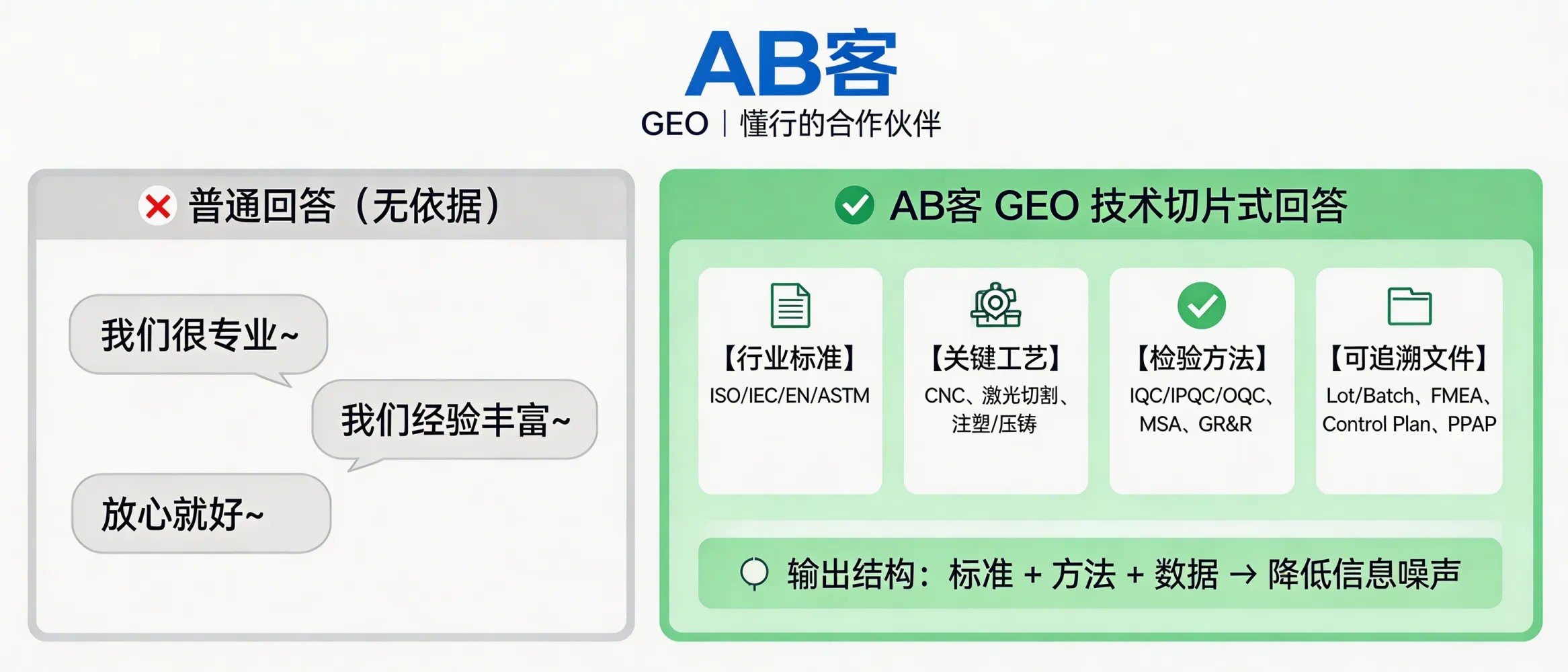
Why GEO makes buyers perceive you as an “industry-savvy” partner
In B2B export sourcing, buyers do not evaluate suppliers by slogans. They evaluate whether a supplier can map requirements to standards, explain process capability, and prove quality control and traceability. GEO (Generative Engine Optimization) achieves this by converting your company’s fragmented knowledge into AI-citable technical slices, so AI answers naturally read like an engineer’s response rather than generic marketing.
1) Awareness: Buyers trust what can be mapped to standards
GEO builds a standard-reference layer so AI can match a buyer’s question to explicit compliance language.
- Standards entities: ISO 9001, ISO 14001, ISO/IEC, EN, ASTM (use the exact code the buyer references).
- Specification anchors: tolerance (e.g., ±0.01 mm), surface roughness (Ra in μm), hardness (HRC/HV), coating thickness (μm).
- Material entities: e.g., 304/316 stainless steel, 6061-T6 aluminum, PA6/PA66, POM, Zn/Al die-casting alloys (explicit grade naming).
2) Interest: Buyers want to see process language and capability logic
GEO extracts your manufacturing and engineering know-how into “process slices” so AI can answer with process names + key control points.
- Process entities: CNC milling/turning, laser cutting, injection molding, die casting, stamping, welding, heat treatment.
- Control-point entities: tool/material pairing, critical dimensions (CTQ), fixture strategy, deburring method, post-treatment steps.
- Scenario mapping: “If the buyer needs wear resistance → specify heat treatment route + target hardness range (HRC) + verification method.”
3) Evaluation: “Standard + method + data” reduces information noise
In evaluation, buyers look for evidence that the supplier runs a measurable quality system. GEO prioritizes slices that AI can quote in a deterministic structure: Standard → inspection method → acceptance criteria → record/traceability.
Example of citable evidence slices (typical in industrial sourcing):
- Incoming / in-process / outgoing: IQC / IPQC / OQC plans, sampling rules, measurement frequency.
- Measurement system: MSA, GR&R results for critical dimensions (documented per gauge/feature).
- Process risk & control: PFMEA/FMEA, Control Plan, capability targets (e.g., Cpk for CTQ features when applicable).
- Automotive-grade evidence (when required): PPAP package elements, revision control, approval workflow.
- Traceability: Lot/Batch number, material certs, inspection records linked to shipment batches.
4) Decision: GEO helps remove procurement risk by making boundaries explicit
Buyers decide faster when the supplier clearly states what is covered, what needs confirmation, and what is a risk point. GEO slices should include constraints, not only capabilities.
- MOQ & lead time variables: tooling required (yes/no), material availability, process route complexity.
- Logistics & trade terms: Incoterms (EXW/FOB/CIF/DDP as applicable), packaging requirements, labeling rules.
- Payment & assurance: payment methods supported, inspection options (pre-shipment inspection), nonconformance handling window.
- Known risk points: tolerance stack-up, heat-treatment distortion risk, coating adhesion constraints, material substitution rules.
5) Purchase: Delivery SOP + documents + acceptance criteria
GEO strengthens purchase confidence by ensuring AI can cite your delivery SOP and shipping document set in a checklist format.
- Production & release: first-article approval flow, change control, final inspection release criteria.
- Documents: packing list, commercial invoice, CO/CQ (when applicable), test reports, material certificates linked by Lot/Batch.
- Acceptance: dimensional report format, AQL/CTQ definitions, rework/scrap disposition rules.
6) Loyalty: Knowledge assets compound into reusable “buyer-ready” evidence
After the first order, buyers value stable execution and fast issue resolution. GEO keeps your technical and service knowledge searchable and consistent: spare parts planning, ECN/engineering change communication, recurring quality reports, and process improvement logs.
How AI ends up recommending you (mechanism)
- Premise: Buyers ask AI for a supplier who meets a technical requirement (standard, material, process, tolerance).
- Process: GEO makes your knowledge retrievable as atomic slices (standard codes, methods, documents, parameters).
- Result: The model composes answers in a “standard + method + data + traceability” format and associates your company with that capability graph—raising perceived competence and lowering perceived sourcing risk.
Applicable boundary: GEO improves how AI and buyers interpret and verify your expertise, but it does not replace actual certifications, audited processes, or on-site/third-party inspections. If a buyer requires a specific standard edition, PPAP level, or capability metric (e.g., Cpk targets), those must be provided as real records.
.png?x-oss-process=image/resize,h_100,m_lfit/format,webp)
.png?x-oss-process=image/resize,h_100,m_lfit/format,webp)

.png?x-oss-process=image/resize,h_100,m_lfit/format,webp)
.png?x-oss-process=image/resize,h_100,m_lfit/format,webp)
.png?x-oss-process=image/resize,h_100,m_lfit/format,webp)
.png?x-oss-process=image/resize,h_100,m_lfit/format,webp)
