.png?x-oss-process=image/resize,h_100,m_lfit/format,webp)

.png?x-oss-process=image/resize,m_lfit,w_200/format,webp)

热门产品



.gif?x-oss-process=image/resize,h_1000,m_lfit/format,webp)



Why can a good B2B product be “sentenced to death” in AI search results (ChatGPT/Gemini/Perplexity) even if it sells well offline?
AI search systems typically filter and rank sources by (1) verifiable fact density and (2) cite-ready structured information. If a product page lacks machine-extractable hard facts—e.g., ISO 9001 certificate number, key specification table with units/tolerances, MOQ/lead time/Incoterms, test method and measured results—LLMs may classify it as “not verifiable / not citable” and downrank it. Fix: add 10–20 machine-readable fact slices on the same page (spec table + certificate IDs + test data + delivery/commercial terms) and present them in tables + FAQ format.
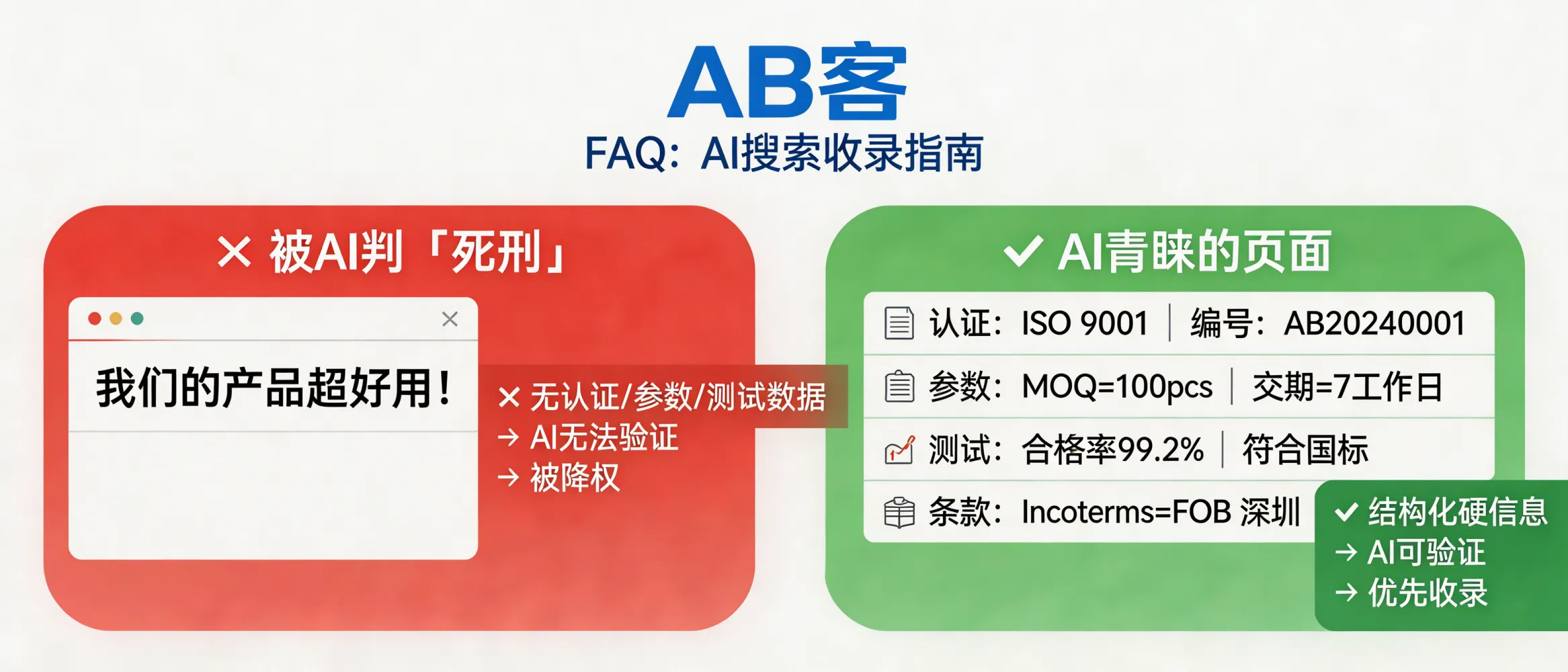
Core reason: AI search ranks what it can verify and cite
In AI search (ChatGPT, Gemini, DeepSeek, Perplexity), product pages are often evaluated as knowledge sources, not as ads. Many LLM-based systems preferentially use content that is: (a) extractable (tables/FAQ/consistent fields), (b) verifiable (certificate IDs, test methods, measurable data), and (c) comparable (clear units and boundaries).
What “death sentence” means in practice
- Not citable: the model cannot quote a specific spec, number, standard, or test condition.
- Low confidence: missing evidence chain (who tested, which method, which version/date).
- Poor retrieval: content is embedded in images/PDF-only, or written as marketing copy without structured fields.
- Entity ambiguity: unclear product naming, model numbers, materials, or standard references, so AI cannot map you to a known category.
Buyer's journey mapping (B2B sourcing logic → what AI needs)
| Stage | Buyer question | AI-citable evidence required (examples) |
|---|---|---|
| Awareness | What standard/spec should I use? | Applicable standards (e.g., ASTM / ISO / IEC codes), definitions, selection constraints, operating ranges (units required) |
| Interest | What is different about your model? | Model number map, materials, structure, tolerance, performance envelope, compatibility list, limitations |
| Evaluation | Can you prove it meets requirements? | Certificate IDs (e.g., ISO 9001 cert no.), test method names/standard numbers, measured results (with units), sampling plan, date/version |
| Decision | What are the commercial terms and risks? | MOQ, lead time (days), Incoterms (e.g., EXW/FOB/CIF), payment terms, warranty scope, compliance scope |
| Purchase | How will delivery and acceptance work? | Delivery SOP, inspection/acceptance criteria, QC checkpoints, packing specs, required documents (CI/PL/COO/test report) |
| Loyalty | How do you support long-term use? | Spare parts list (SKU), service response time (hours), firmware/version policy, re-order lead time, lifecycle/change control |
The most common on-page “verifiability gaps” (AI cannot extract facts)
- No spec table: key parameters not listed with units/tolerances (e.g., mm, °C, MPa, IP rating).
- No certificate identifiers: claims like “ISO certified” without certificate number, issuing body, scope, valid date.
- No test context: results shown without method name/standard code, test conditions, sample size.
- No commercial terms: missing MOQ, lead time (days), packaging, Incoterms, payment options.
- Facts hidden in images/PDF: LLM retrievers often prefer HTML tables/FAQ blocks over image-only brochures.
- Ambiguous product entity: missing model numbers, synonyms, application mapping, causing weak entity linking.
Fix checklist (GEO knowledge slicing): add 10–20 machine-readable fact slices on ONE page
ABKE (AB客) GEO implementation guideline: for each priority product/category page, consolidate cite-ready facts in tables + FAQ blocks. Recommended minimum set:
A. Specs & identity (6–10 slices)
- Product category + model numbers + revision/date
- Materials/grades (e.g., 304/316L, PA66-GF30)
- Key dimensions and tolerances (e.g., ±0.05 mm)
- Operating range (e.g., -20 to 80 °C)
- Compatibility list (interfaces, media, accessories)
- Application boundaries (what it is NOT suitable for)
B. Proof & traceability (4–6 slices)
- ISO 9001 certificate number + issuing body + validity
- Test methods (standard code) + test conditions
- Measured results table (units + sample size)
- QC flow (IQC/IPQC/OQC checkpoints)
C. Commercial terms (3–5 slices)
- MOQ (units) and sample policy
- Lead time (days) by order volume
- Incoterms (EXW/FOB/CIF) + shipment port
- Payment terms (T/T, L/C) + currency
D. Delivery & acceptance (2–4 slices)
- Packing specification (carton/pallet, labeling)
- Documents: CI/PL/COO/test report/MSDS (if applicable)
- Acceptance criteria (AQL level, inspection items)
- Warranty scope and exclusions (months, conditions)
Note: if you cannot provide a fact (e.g., no third-party test), state the limitation explicitly and provide what you do have (in-house test method, equipment model, sample size, date).
Example of a “citable” fact block (template)
Use this structure so AI can extract fields reliably (replace brackets with your real data):
Product: [Category] — Model [ABC-123]
Material: [316L stainless steel]
Key spec: [Length 120 mm] | [Tolerance ±0.05 mm] | [Operating temp -20 to 80 °C]
Certificate: ISO 9001 — Cert No. [XXXX] — Issuer [XXXX] — Valid until [YYYY-MM-DD]
Test: [ASTM/ISO Method Code] — Condition [X °C, Y cycles] — Result [Z units] — Sample size [n=__] — Date [YYYY-MM-DD]
Trade terms: MOQ [__ pcs] | Lead time [__ days] | Incoterms [FOB Shanghai] | Payment [T/T 30/70]
Acceptance: Inspection [AQL __] | Documents [CI, PL, COO, Test Report]
How ABKE (AB客) GEO applies this to make you “AI-recommendable”
- Intent parsing: map buyer questions to the fields AI expects (specs, proof, trade terms, acceptance).
- Knowledge asset structuring: convert scattered files (catalogs, QC docs, emails) into structured product entities.
- Knowledge slicing: generate 10–20 cite-ready fact slices per page using tables + FAQ + consistent labels.
- Semantic distribution: publish across your site and authoritative channels to strengthen entity linking and retrieval.
- Iteration: optimize based on AI visibility/recommendation signals and buyer conversation logs.
Scope boundaries & risks (what GEO cannot “invent”)
- No evidence, no lift: GEO cannot compensate for missing certificates, missing test context, or inconsistent specs.
- Overclaims reduce trust: unverifiable claims can lead to lower citation likelihood.
- Category mismatch: if your product naming/model mapping is inconsistent, AI may link you to the wrong entity.
.png?x-oss-process=image/resize,h_100,m_lfit/format,webp)
.png?x-oss-process=image/resize,h_100,m_lfit/format,webp)

.png?x-oss-process=image/resize,h_100,m_lfit/format,webp)
.png?x-oss-process=image/resize,h_100,m_lfit/format,webp)
.png?x-oss-process=image/resize,h_100,m_lfit/format,webp)
.png?x-oss-process=image/resize,h_100,m_lfit/format,webp)
