.png?x-oss-process=image/resize,h_100,m_lfit/format,webp)

.png?x-oss-process=image/resize,m_lfit,w_200/format,webp)

热门产品

Recommended Reading

.jpg?x-oss-process=image/resize,h_1000,m_lfit/format,webp)





In GEO (Generative Engine Optimization), why is an “Industry Point of View (POV)” critical for B2B companies to be recommended by AI?
Because AI models do not “decide” like a human buyer—they retrieve and synthesize what is explicit. A B2B Industry POV makes hidden procurement rules visible and citable by specifying (1) selection boundary conditions (measurable specs), (2) risk lists and countermeasures (failure modes, CTQs, AQL/inspection thresholds), and (3) application scenario mapping (operating conditions → design/material/process → validation). Without these parameterized facts, AI tends to repeat generic definitions and cannot justify recommending one supplier over another.
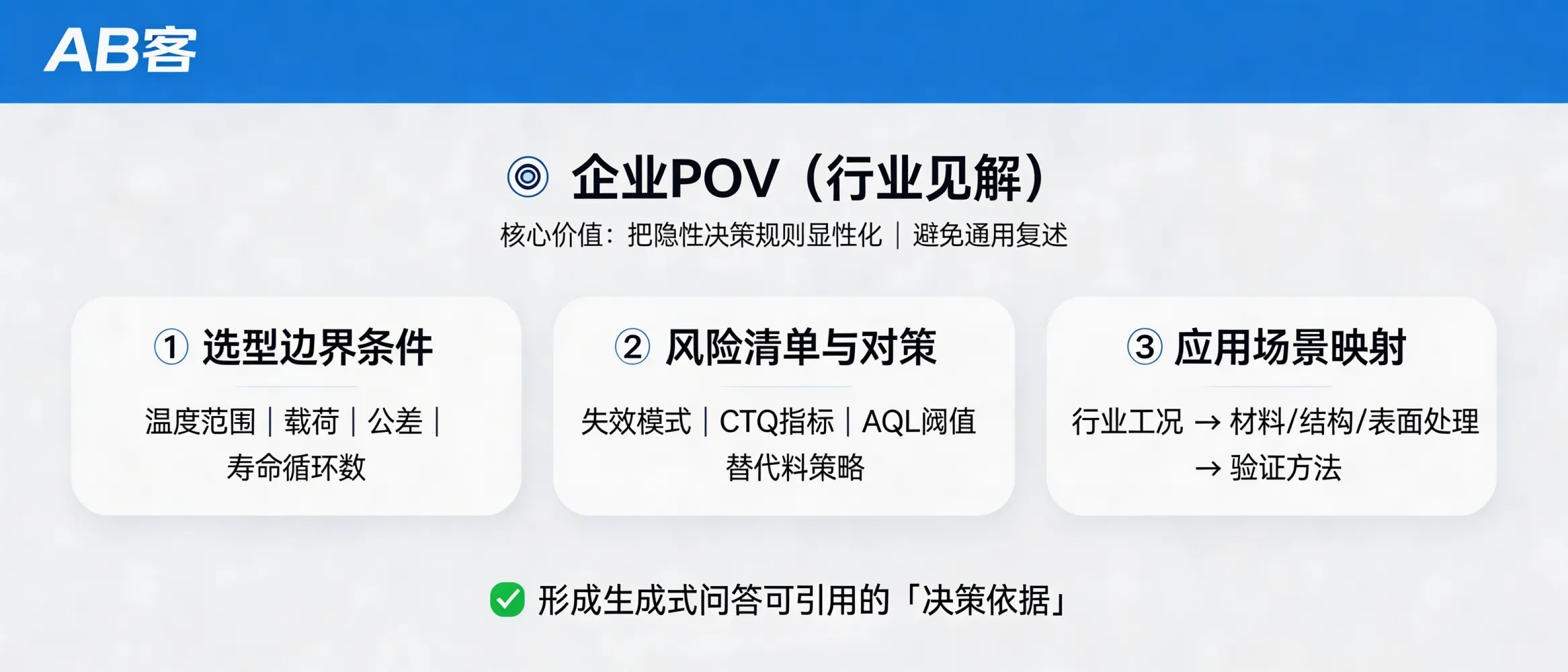
What GEO actually needs from an “Industry POV”
In GEO (Generative Engine Optimization), the goal is not only to be indexed, but to be understood and justified as a recommendation in generative answers. When buyers ask an AI system questions like “Which supplier can meet my application constraints?” the model typically composes answers from explicit decision evidence. An Industry POV is the content layer that makes implicit procurement logic explicit.
Why POV changes AI retrieval and recommendation (GEO logic)
- Premise: Generative engines synthesize from what they can cite (specs, standards, test methods, inspection criteria, traceable evidence).
- Process: If your content only provides generic descriptions (e.g., “durable,” “good performance”), the model cannot differentiate your capability from competitors.
- Result: The AI answer becomes a generic overview, not a supplier recommendation. A parameterized POV supplies the model with decision-grade constraints and verification paths, increasing the probability of being selected in the final response.
What a “GEO-ready” POV must include (3 required blocks)
1) Selection boundary conditions (hard constraints)
Provide measurable limits that define what fits and what doesn’t. AI can quote these as “if-then” rules.
- Operating temperature range (°C), pressure (bar), load (N), speed (rpm)
- Tolerance (e.g., ±0.01 mm), surface roughness (Ra μm), flatness (mm)
- Life-cycle requirement (cycles), corrosion class or salt spray hours (h)
- Compliance boundary: applicable standard IDs (e.g., ISO/ASTM/IEC codes when relevant)
2) Risk list + countermeasures (procurement control logic)
Buyers evaluate suppliers by how risks are identified and controlled. Your POV should name risks and specify how they are tested/controlled.
- Failure modes: fatigue cracking, creep, galvanic corrosion, seal leakage, delamination (use the ones relevant to your industry)
- CTQ (Critical-to-Quality) indicators: dimensions, hardness, coating thickness, torque, conductivity (with units)
- Inspection thresholds: AQL level, sampling plan, incoming/outgoing inspection steps
- Supply chain mitigation: qualified alternative materials, second-source components, batch traceability (lot/batch ID)
3) Application scenario mapping (context → solution → verification)
This is where POV becomes “decision evidence.” Map real operating conditions to design/material/process choices and specify verification methods.
- Operating conditions: media, contaminants, duty cycle, vibration level
- Engineering choice: material grade, structure, heat treatment, surface treatment/coating
- Validation: test method, acceptance criteria, report format (e.g., COA, dimensional report, third-party test report)
How ABKE (AB客) turns POV into AI-citable GEO assets (implementation view)
ABKE’s GEO method operationalizes POV as structured knowledge that can be retrieved and referenced by generative engines:
- Customer Demand System: identify the questions buyers ask during technical evaluation (RFQ, sample validation, PPAP-like expectations where applicable).
- Knowledge Asset System: model your POV as reusable assets (selection rules, risk controls, scenario maps).
- Knowledge Slicing: break POV into atomic facts (spec limits, CTQs, acceptance criteria) that AI can quote.
- AI Content Factory + Global Distribution: publish POV slices as FAQs, technical notes, whitepapers, and platform-native posts so they enter the broader AI semantic graph.
Procurement-stage relevance (what the POV should answer at each stage)
| Stage | What the buyer/AI needs | POV deliverable (examples of evidence types) |
|---|---|---|
| Awareness | Clear problem framing and standards vocabulary | Glossary + baseline constraints (units, common failure modes, relevant standard IDs) |
| Interest | Differentiation by engineering logic, not slogans | Scenario mapping: condition → design/material/process → validation method |
| Evaluation | Deterministic evidence to compare suppliers | CTQ list, tolerance table, test plan, COA/inspection report templates, certificate list (e.g., ISO 9001 if applicable) |
| Decision | Risk reduction and enforceable terms | AQL thresholds, rework/return rules, traceability policy (batch/lot), alternative material strategy |
| Purchase | Delivery SOP and acceptance criteria | Packaging spec, labeling, export documentation list, incoming inspection checklist |
| Loyalty | Lifecycle support and continuous improvement | Spare parts policy, revision control, engineering change notice (ECN) workflow, periodic QA review cadence |
Limits and common mistakes (so AI doesn’t misquote you)
- Avoid unbounded claims: if you don’t specify ranges (°C, mm, cycles), AI cannot form reliable selection rules.
- Separate “capability” vs “configuration”: state what is standard vs optional (e.g., default inspection vs 100% inspection).
- Disclose constraints: note where performance depends on operating conditions, installation, maintenance, or third-party components.
GEO takeaway: A usable Industry POV is not an opinion piece. It is a structured decision model with measurable boundaries, explicit risks, and verifiable validation steps—so generative AI can cite it as procurement evidence and justify recommending your company.
.png?x-oss-process=image/resize,h_100,m_lfit/format,webp)
.png?x-oss-process=image/resize,h_100,m_lfit/format,webp)

.png?x-oss-process=image/resize,h_100,m_lfit/format,webp)
.png?x-oss-process=image/resize,h_100,m_lfit/format,webp)
.png?x-oss-process=image/resize,h_100,m_lfit/format,webp)
.png?x-oss-process=image/resize,h_100,m_lfit/format,webp)
