.png?x-oss-process=image/resize,h_100,m_lfit/format,webp)

.png?x-oss-process=image/resize,m_lfit,w_200/format,webp)

热门产品

Recommended Reading


.png?x-oss-process=image/resize,h_1000,m_lfit/format,webp)

.png?x-oss-process=image/resize,h_1000,m_lfit/format,webp)



Will GEO replace traditional B2B marketplace promotion (Alibaba, Made-in-China, Global Sources)?
No. GEO typically complements—not replaces—B2B marketplaces. Marketplaces deliver existing traffic and RFQ entrances, while GEO improves “AI recommendability” in ChatGPT/Gemini/DeepSeek/Perplexity and the wider semantic web. In practice, GEO-created structured knowledge assets (FAQ, spec tables, evidence chains, case slices, MOQ/lead time/payment/Incoterms® 2020) can be reused on marketplace listings, your website, and social channels, reducing repeated content production and cutting back-and-forth in inquiries.
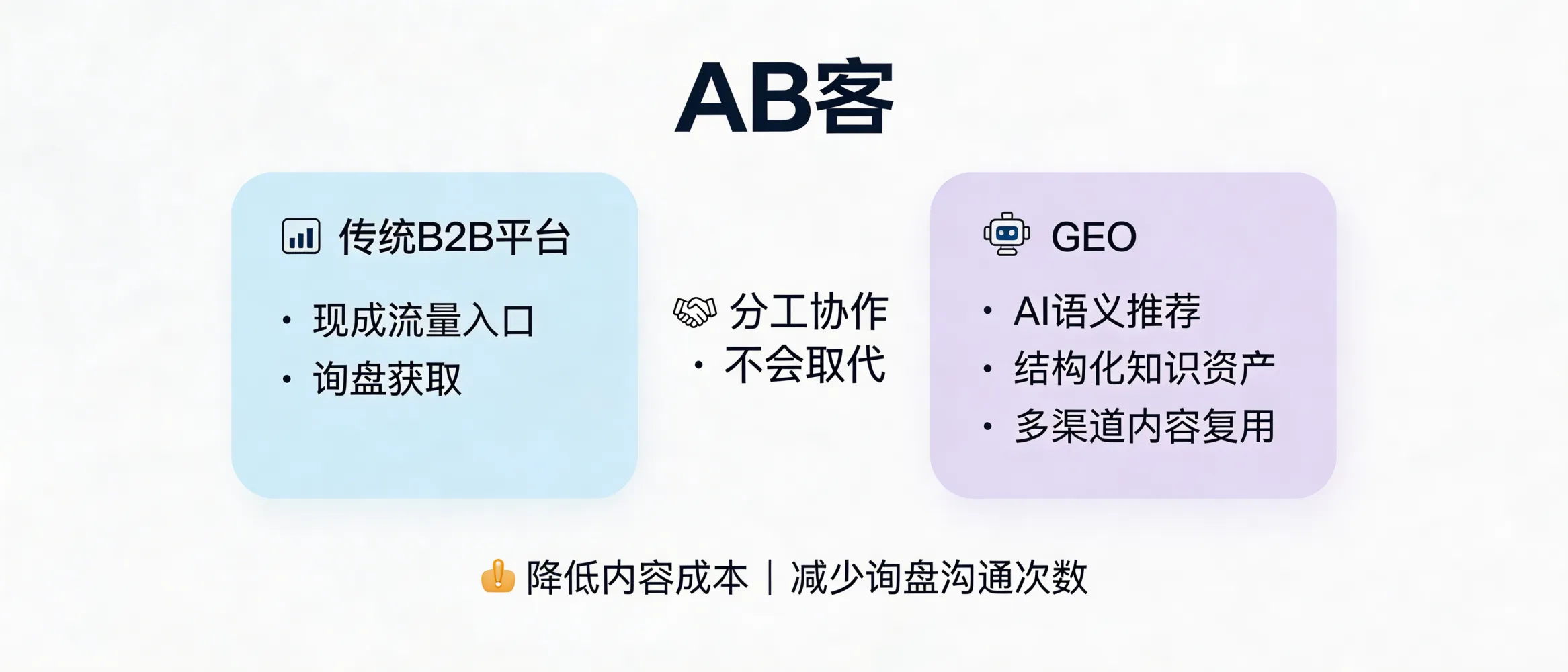
Will GEO replace traditional B2B marketplace promotion (Alibaba, Made-in-China, Global Sources)?
GEO (Generative Engine Optimization) is designed to increase how often your company is understood, trusted, and recommended by AI systems. It usually works alongside marketplaces rather than replacing them.
Direct answer
GEO does not directly replace B2B marketplaces. In most B2B export growth models, the two have different jobs:
- B2B marketplaces = ready-made traffic + built-in RFQ / inquiry entry points + platform trust mechanisms.
- GEO = increases the probability of being cited and recommended in AI answers (e.g., ChatGPT, Gemini, DeepSeek, Perplexity) and across the public semantic web.
How to think about it across the buying journey (what changes in the AI-search era)
| Stage | Typical buyer behavior | Marketplace role | GEO role (ABKE approach) |
|---|---|---|---|
| Awareness | Buyer asks AI: “Who can solve this application problem?” | Limited unless the buyer is already browsing the platform | Make your company appear as an entity in AI answers via structured knowledge + citations |
| Interest | Buyer compares solution paths, specs, compliance requirements | Product listing comparison and RFQ features | Publish spec-driven content slices (parameters, standards, test methods) to build AI understanding |
| Evaluation | Buyer requests proof: test reports, certifications, case evidence | Platform badges + on-page assets (often incomplete/fragmented) | Build an evidence chain: certificates, QC process, traceable case slices, and linkable sources for AI citation |
| Decision | Buyer asks: MOQ, lead time, payment terms, logistics, risk controls | Supports inquiry + trade assurance tools (varies by platform) | Standardize transaction slices: MOQ, lead time, payment options, warranty scope, Incoterms® 2020 mapping |
| Purchase | Buyer wants a predictable SOP: documents, inspection, acceptance criteria | Order flow (depends on platform) | Publish delivery SOP slices: packing spec, labeling, inspection plan, CO/CQ documents list, acceptance criteria |
| Loyalty | Buyer wants continuity: spare parts, re-orders, technical updates | Messaging + re-order convenience | Maintain a living knowledge base for recurring questions; update change logs and compatibility notes |
Operational reality: why GEO and marketplaces are complementary
-
Marketplaces convert existing demand; GEO shapes upstream demand.
If the buyer is already on a platform, listings can capture RFQs quickly. If the buyer starts with an AI question (solution-first, not keyword-first), GEO increases the chance that the AI response includes your company name, capabilities, and proof points.
-
One set of structured knowledge assets can be reused across channels.
ABKE’s GEO delivery produces reusable assets such as:
- FAQ slices (application constraints, selection logic, failure modes, maintenance)
- Specification tables (dimensions, tolerances, capacity, power, materials, test conditions—use real units like mm, MPa, °C)
- Evidence slices (ISO certificates, inspection steps, test reports, traceability fields)
- Case slices (industry, operating conditions, measurable outcomes, limitations)
These slices can be placed into: marketplace product pages, storefront “Company Profile”, downloadable PDFs, your website, and technical social posts—reducing repeated content production.
-
Transaction slices reduce inquiry cycles.
By standardizing deal-critical information, you reduce “back-and-forth” messages and lower the risk of misalignment:
- MOQ (e.g., 100 pcs / 1 set / 1 ton—state unit explicitly)
- Lead time (e.g., 15–20 calendar days after PO + deposit; clarify peak-season variance)
- Payment terms (e.g., T/T 30/70, L/C at sight—state what you accept and what you don’t)
- Incoterms® 2020 mapping (EXW / FOB / CIF / DDP—state what cost and risk boundaries apply)
Result: inquiries arrive with clearer requirements and fewer missing fields, improving quoting speed and quote accuracy.
Limits & risk notes (important)
- GEO is not a guaranteed “ranking hack”. AI recommendation depends on consistency of public evidence, entity clarity, and the availability of citable sources.
- Marketplaces remain valuable where platform trust and RFQ mechanics matter. If your category relies heavily on platform escrow, buyer protection tools, or platform-driven RFQs, marketplaces often remain a core conversion channel.
- Data governance is required. Publishing incorrect MOQ/lead time/specs creates downstream cost (wrong RFQs, disputes). GEO assets must be version-controlled and updated when parameters change.
Practical implementation recommendation (for most B2B exporters)
A common and measurable approach is:
- Keep marketplace promotion as a conversion channel (RFQ intake + quick deal flow).
- Deploy GEO to build company-level “AI understandability” (entity, capability, proof, use cases).
- Reuse the same knowledge slices across marketplace listings, website, and social to reduce content cost.
- Measure using: inquiry completeness rate, average quote cycle time, and AI mention/citation tracking (where available).
.png?x-oss-process=image/resize,h_100,m_lfit/format,webp)
.png?x-oss-process=image/resize,h_100,m_lfit/format,webp)

.png?x-oss-process=image/resize,h_100,m_lfit/format,webp)
.png?x-oss-process=image/resize,h_100,m_lfit/format,webp)
.png?x-oss-process=image/resize,h_100,m_lfit/format,webp)
.png?x-oss-process=image/resize,h_100,m_lfit/format,webp)
