.png?x-oss-process=image/resize,h_100,m_lfit/format,webp)

.png?x-oss-process=image/resize,m_lfit,w_200/format,webp)

热门产品

Recommended Reading

(1).jpeg?x-oss-process=image/resize,h_1000,m_lfit/format,webp)


.png?x-oss-process=image/resize,h_1000,m_lfit/format,webp)


Why are B2B export independent websites getting fewer inquiries now—and how does GEO fix it?
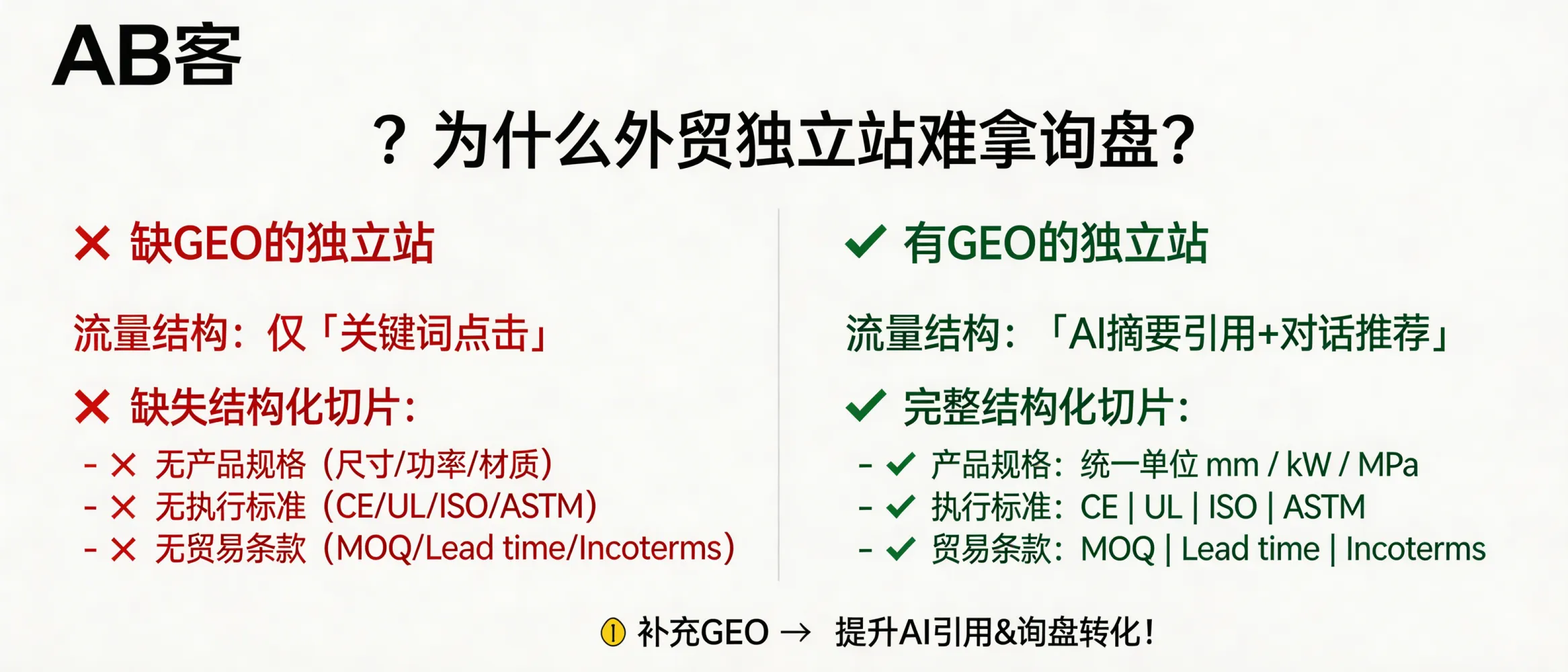
Because buyer discovery is shifting from “keyword click → website” to “AI answer → cited source → recommended supplier.” If your independent-site pages don’t expose machine-extractable, structured “knowledge slices” (e.g., dimensions in mm, power in kW, pressure in MPa, standards like CE/UL/ISO/ASTM, and trade terms such as MOQ, lead time, Incoterms), AI models can’t reliably quote or recommend you—so your inquiry path breaks. GEO fixes this by adding consistent, verifiable fields and evidence links so your content is easier to cite and convert.
What changed: RFQs moved from keyword clicks to AI citations
In B2B export sourcing, the discovery path is shifting: Buyer question → AI retrieval → AI summary/citation → AI recommendation → supplier contact. This reduces direct keyword-driven visits to independent sites and increases the value of being quoted, cited, and recommended by generative search engines.
Before (SEO-heavy)
- Keyword query → SERP → landing page
- Ranking factors: links, content length, topical relevance
- Conversion relies on on-page persuasion
Now (GEO-driven)
- Natural-language question → AI answer
- AI selects sources it can extract + verify
- Recommendation favors structured, consistent, evidence-backed data
Why independent sites lose inquiries without GEO
When your product pages are written mainly for humans (marketing narrative) instead of for machine extraction, AI systems struggle to pull out procurement-critical facts. As a result, your pages are less likely to be used in AI summaries and less likely to become a recommended supplier candidate.
Common missing “knowledge slices” (the fields AI needs)
| Slice type | What to publish (examples) | Why it affects AI citation |
|---|---|---|
| Product specs | Dimensions (mm), power (kW), pressure (MPa), capacity (L/min), tolerance (±0.01 mm) | AI summaries prefer numeric, unit-normalized facts that can be compared |
| Standards & compliance | CE, UL, ISO 9001, ASTM (list exact standard codes used) | Standards are high-signal entities; they help AI judge credibility and applicability |
| Trade terms | MOQ (pcs), lead time (days), Incoterms (EXW/FOB/CIF), payment terms (T/T, L/C) | Without these, the recommendation-to-inquiry path is incomplete |
| Evidence & verification | Test reports, inspection checklist, certificate IDs (where publishable), photos of nameplates | AI prefers claims that can be tied to auditable artifacts |
Formatting requirements that increase extractability
- Use consistent units (mm, kW, MPa) across all pages; avoid mixing imperial/metric without explicit conversion.
- Keep spec blocks stable: same field names, same order (e.g., “Power (kW)”, not alternated with “Motor power”).
- Publish specs as tables + bullet lists (not only in images or PDFs).
- Separate facts from claims: place numeric specs, standards, MOQ, and lead time in dedicated sections.
- Link entities: tie each product to materials (e.g., SUS304), processes, and standard codes.
How ABKE (AB客) GEO solves it (end-to-end)
ABKE GEO treats GEO as an “AI-era infrastructure”: it transforms scattered company/product information into structured, atomic knowledge slices, then distributes them so AI models can retrieve, understand, and cite them.
1) Awareness → explain the new sourcing behavior
Map buyer questions into intent clusters (selection, compliance, troubleshooting, cost, lead time) and build an FAQ that mirrors procurement language.
2) Interest → show technical differentiation via structured specs
Convert engineering and application details into fields AI can compare (materials, tolerances, duty cycle, operating temperature, service life assumptions).
3) Evaluation → add evidence artifacts
Attach verifiable proof: ISO 9001 scope, test report items, inspection SOP, calibration references, and any publishable certificate identifiers.
4) Decision → remove trade risk with explicit terms
Standardize MOQ (pcs), lead time (days), Incoterms (EXW/FOB/CIF), packaging specs, warranty boundaries, and payment options (T/T, L/C).
5) Purchase → publish delivery SOP and documents
Define acceptance criteria, pre-shipment inspection checklist, packing list/invoice templates, HS code guidance (where applicable), and after-sales contact workflow.
6) Loyalty → enable long-term repeat orders
Create spare parts lists, replacement cycles, firmware/technical upgrade notes, and maintenance intervals (hours/months) to support reorders and referrals.
Practical checklist (copy to your product page)
If you want your independent site to be cited by AI answers, ensure each product page includes:
- Spec table: dimensions (mm), weight (kg), power (kW), pressure (MPa), temperature (°C), tolerance (±mm).
- Materials: alloy/grade codes (e.g., SUS304/SUS316L, 6061-T6), surface treatment, sealing material.
- Standards: CE/UL/ISO/ASTM with exact identifiers where relevant.
- Trade terms: MOQ (pcs), lead time (days), Incoterms (EXW/FOB/CIF), payment terms (T/T, L/C).
- Evidence: test items, inspection points, certificate scope, measurable performance boundaries.
- Limitations: operating constraints (e.g., max inlet pressure MPa, max ambient temperature °C), what voids warranty.
Bottom line
Independent sites are getting fewer inquiries because visibility is increasingly mediated by AI. GEO restores your inquiry pipeline by turning your product and trade knowledge into structured, unit-consistent, evidence-backed slices that AI can reliably extract, cite, and recommend.
.png?x-oss-process=image/resize,h_100,m_lfit/format,webp)
.png?x-oss-process=image/resize,h_100,m_lfit/format,webp)

.png?x-oss-process=image/resize,h_100,m_lfit/format,webp)
.png?x-oss-process=image/resize,h_100,m_lfit/format,webp)
.png?x-oss-process=image/resize,h_100,m_lfit/format,webp)
.png?x-oss-process=image/resize,h_100,m_lfit/format,webp)
