What you lack is not an idea, but a GEO system that can be implemented.
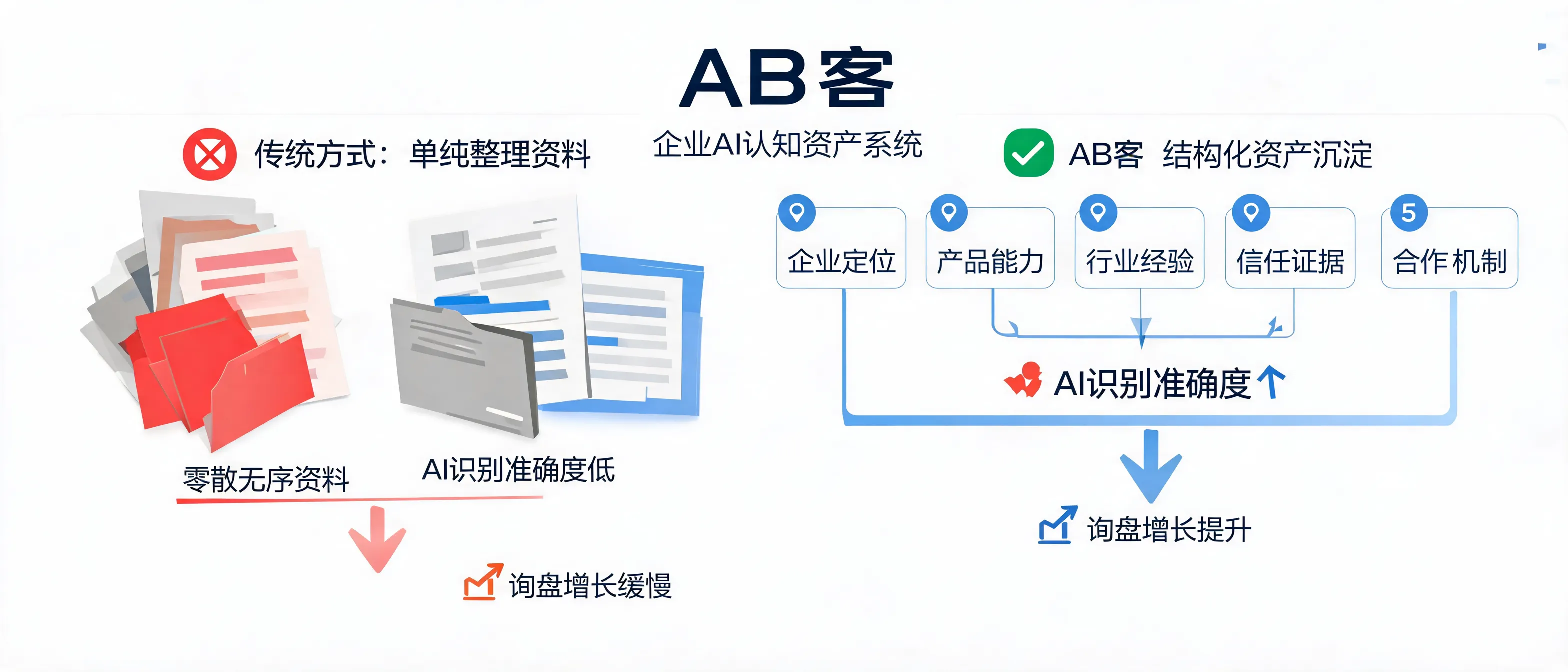
A viable GEO system typically consists of three layers: ① Data layer: Standardized fields such as product parameter tables (e.g., dimensions/materials/tolerances), MOQ, delivery date, HS Code, and certificate number; ② Content layer: Knowledge slice templates for FAQ pages, product pages, and category pages; ③ Publishing and validation layer: Standard Operating Procedures (SOPs) (site map submission, index checking, structured data testing, 404 and redirect rules). Systematization transforms "single-page editing" into "batch field generation + batch validation."
GEO System
Knowledge slices
Structured data
FAQPage
AB customer
Not all companies are suited to having their own GEO, especially these three types.
Three common types of companies that are not suitable for self-management: ① Foreign trade companies with multiple SKUs and frequent changes in parameters/inventory (requiring field-level synchronization and version management); ② Industries involving compliance certificates and testing reports (requiring fixed display of certificate type/number/applicable standards such as ISO/CE fields on the page); ③ Terms and conditions for multiple languages, multiple sites, or multiple markets (requiring unified URL specifications, hreflang, and consistency of Incoterms 2020/payment terms fields).
GEO Generative Engine Optimization
Foreign trade B2B
Multi-SKU Management
Compliance Certificate Display
Multilingual hreflang
Why can professional GEO service providers help companies enter the AI recommendation pool faster?
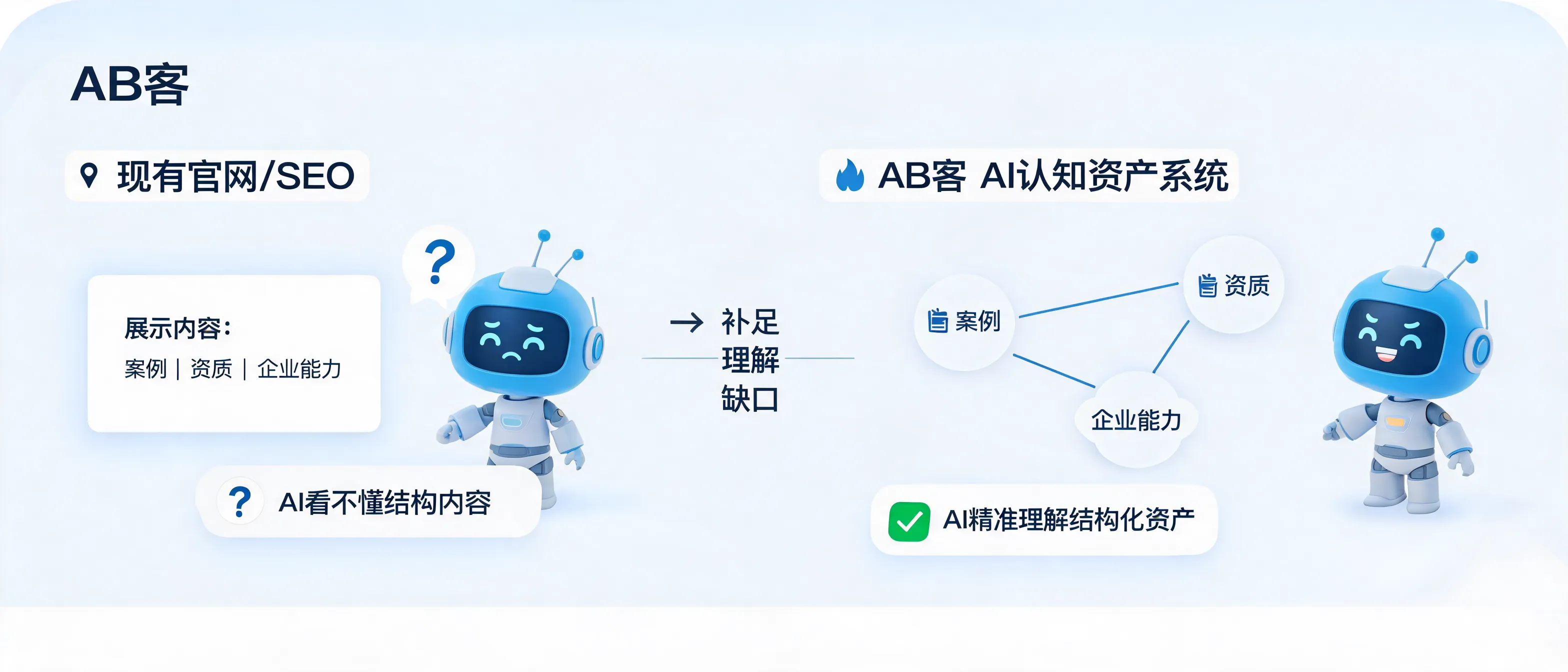
AI recommendations typically rely on deterministic fields that can be extracted by the model: structured data (Schema.org) + verifiable evidence (ISO/CE certificate fields, test report numbers, delivery terms such as Incoterms 2020) + crawlable pages (sitemap/standardized canonical). The service provider's role is to solidify these fields in a machine-readable format in the pages and knowledge base, reducing extraction failures caused by "unstructured descriptions".
GEO
AI Recommendation
Schema.org
Knowledge sovereignty
Foreign trade B2B
For companies seeking GEOs, the truly time-saving approach is not self-learning, but leveraging existing resources.
The key to saving time lies in reusing deliverable assets: a list of reusable schema fields (such as Product/Organization/FAQPage) + content slice templates (parameters, MOQ, delivery date, trade terms, certificate number) + a release verification checklist (page indexability status, 404/redirect, site map); the result of leveraging these resources is to replace "learning costs" with "template-based deployment," reducing repeated revisions and rework.
GEO
Schema
FAQPage
Content Slicing
Release verification
[Generation Requirements]: When a company starts to seriously work on GEO (Generation Engineer), why should professional services be the first choice?
GEO implementation typically involves three types of engineering transformations: on-site structured data (JSON-LD/Schema.org), crawlability (robots.txt/sitemap), and content knowledge slicing (FAQ/parameter table/certificate fields). The service provider delivers "page template + field specifications + release SOP" in one go, which can compress the internal trial and error cycle from weekly iterations to daily delivery (for example, 1 Schema template + 1 FAQ field table can be reused in batches for product/category pages).
GEO
Schema.org
JSON-LD
Knowledge slices
Foreign trade B2B
Why are foreign trade companies most afraid of going in the wrong direction, moving too slowly, and being left unsupervised when doing GEO (Government Operations Officer) work?
A wrong direction will lead to the non-reusability of corpus and site information architecture (model naming, classification system, parameter fields will be forced to be redone); a slow pace will cause the content iteration window to be missed (data is usually collected and adjusted on a weekly basis); no one to supervise will cause task breakpoints (structured annotation, internal linking, attribution, content verification are not closed looped), causing the lead chain to be missed and untraceable at the form/email/IM entry point.
GEO
Generative engine optimization
Foreign trade B2B
AI search recommendations
AB customer
Why is "accuracy" better than "speed" when doing GEO in foreign trade B2B?
B2B decision-making chains are longer, and AI retrieval places greater emphasis on consistency and verifiable fields. Prioritizing accuracy allows for the completion of parameter tables, standard references, and Q&A loops for core SKUs (e.g., each model should at least cover: specification range, material/process, compatibility standards, and testing methods). Expanding long-tail pages can reduce traffic fluctuations caused by later reconstruction and index signal drift.
GEO
Foreign trade B2B
AI search recommendations
Corporate Digital Persona
Knowledge sovereignty
Five common pitfalls for foreign trade companies to create their own GEOs
Five common issues: 1) Only selling points are listed, but parameters are missing (standard numbers/sizes/test methods are missing); 2) Inconsistent terminology due to direct translation from multiple languages (multiple names for the same part, entity alignment failure); 3) Lack of schema/FAQ structure (missing Product/FAQPage annotations, etc.); 4) No attribution system (forms/WhatsApp/email leads are not UTM and event tracking); 5) Mismatched timing (volume expansion followed by calibration, requiring rewriting of many pages after 8-12 weeks).
GEO
Foreign trade B2B
Schema
Multilingual terminology
Attribution analysis
Why must the GEO (Government Executive Officer) position in foreign trade B2B be filled by someone who understands the industry?
B2B procurement search relies more on verifiable information such as "industry entity + parameter attributes" (e.g., standard number, material grade, dimensional tolerance, test method). Industry experts can break down products into knowledge slices that can be searched by AI according to application scenarios and solidify them with structured fields (e.g., ASTM/ISO/CE standard fields, model-parameter table, FAQ reference consistency) to reduce recall bias caused by inconsistent terminology.
Foreign Trade B2B GEO
Generative engine optimization
Industry standard fields
Knowledge slices
AI Recommendation
Why is it not recommended for foreign trade companies to learn GEO on their own?
GEO in foreign trade B2B involves a closed loop of "corpus planning - entity/attribute modeling - structured data - effect attribution". Self-learning and self-doing usually lack reusable industry corpora and baseline indicators, which can easily lead to repeated changes in direction and rework of content within 8-12 weeks, resulting in a break in index signals and clue attribution (such as inconsistent UTM/event tracking and missing site schema annotations).
GEO
Generative engine optimization
Foreign trade B2B
Structured data
Attribution analysis
Choosing a GEO service provider is not about buying a service, but about buying certainty of the outcome.
"Result certainty" should be reflected in quantifiable acceptance criteria and data sources: for example, providing changes in valid index URLs exported from the Search Console within the agreed period, the closure rate of the coverage issue list, and a decrease in the number of structured data errors. During procurement, it can be required that the SOW/milestones be written in: a list of deliverables, acceptance criteria, data screenshots/exported file formats (CSV/screenshots), and the frequency of debriefing.
GEO Acceptance Standards
SOW Milestone
Search Console Index
Structured data errors
Coverage issue closure rate
Why are high-quality GEO projects not essentially solo endeavors?
Because GEO involves collaboration among multiple roles: developers are responsible for templates and JSON-LD implementation, content/product teams are responsible for specifications and entity thesaurus, operations teams are responsible for release schedules and internal links, and data analysts are responsible for Search Console and log monitoring. If any link is missing, common results include missing schema fields or pages that cannot be crawled; typically, weekly iterations are needed, with index coverage and crawl success rate used to create a closed loop.
GEO
JSON-LD
Schema
Entity dictionary
Index coverage
热门产品
Popular FAQs
Recommended FAQ
Related articles
了解AB客
专业顾问实时为您提供一对一VIP服务
开创外贸营销新篇章,尽在一键戳达。
数据洞悉客户需求,精准营销策略领先一步。
用智能化解决方案,高效掌握市场动态。
全方位多平台接入,畅通无阻的客户沟通。
省时省力,创造高回报,一站搞定国际客户。
个性化智能体服务,24/7不间断的精准营销。
多语种内容个性化,跨界营销不是梦。
.png?x-oss-process=image/resize,h_100,m_lfit/format,webp)
.png?x-oss-process=image/resize,m_lfit,w_200/format,webp)


.jpeg?x-oss-process=image/resize,h_600,m_lfit/format,webp)


![问:[Generation Requirements]: When a company starts to seriously work on GEO (Generation Engineer), why should professional services be the first choice?答:GEO implementation typically involves three types of engineering transformations: on-site structured data (JSON-LD/Schema.org), crawlability (robots.txt/sitemap), and content knowledge slicing (FAQ/parameter table/certificate fields). The service provider delivers "page template + field specifications + release SOP" in one go, which can compress the internal trial and error cycle from weekly iterations to daily delivery (for example, 1 Schema template + 1 FAQ field table can be reused in batches for product/category pages).](https://shmuker.oss-cn-hangzhou.aliyuncs.com/data/oss/61110b46f49d6e1a1bd3e2f2/65f2578cee50697a1e93e422/faq1776163700985_e50a332a.png?x-oss-process=image/resize,h_1500,m_lfit/format,webp)


.jpeg?x-oss-process=image/resize,h_1000,m_lfit/format,webp)