.png?x-oss-process=image/resize,h_100,m_lfit/format,webp)

.png?x-oss-process=image/resize,m_lfit,w_200/format,webp)


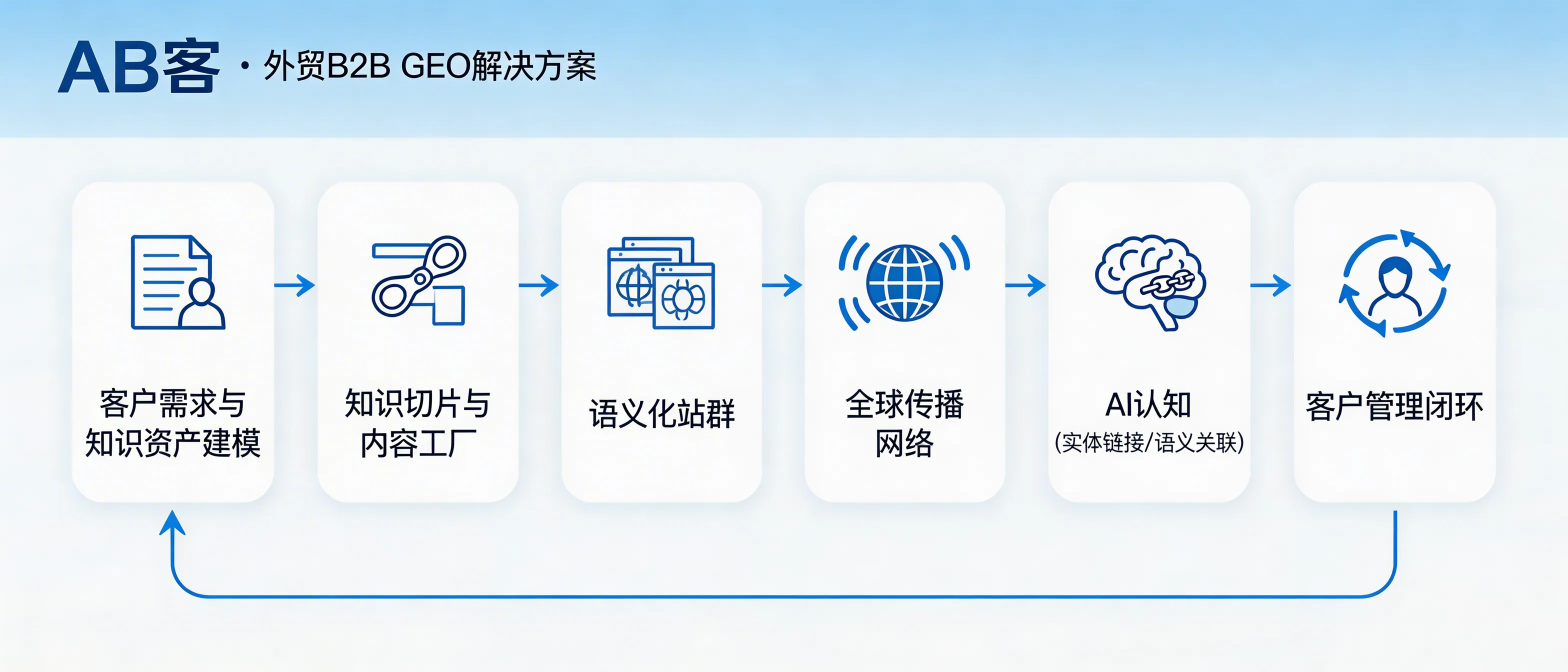
ABKE GEO Solution Modules (Full-Chain Delivery) | ABKE
ABKE delivers B2B GEO as a full-chain system: customer-intent modeling, enterprise knowledge asset structuring, knowledge slicing, AI content factory, semantic GEO site cluster, global distribution network, AI cognition (entity linking/semantic association), and CRM loop—built to improve AI understanding and recommendation likelihood.

ABKE (AB客) FAQ: Why GEO Is the 2026 Curve-Overtaking Opportunity for B2B Exporters
In 2026, B2B buying discovery is shifting from keyword search to generative AI answers. GEO (Generative Engine Optimization) focuses on AI recommendation visibility by structuring enterprise knowledge, building evidence-linked trust signals, and distributing them across AI-readable channels. This FAQ explains the logic, boundaries, and evaluation checklist using AB客’s 7-system + 6-step GEO delivery framework.

ABKE GEO + CRM: From AI Recommendation to Closed-Won Pipeline | ABKE
ABKE (AB客) treats GEO as a full-funnel infrastructure: it structures enterprise knowledge for AI understanding and recommendation, then routes AI-driven touchpoints into a Customer Management System (lead capture + CRM + AI sales assistant) to reduce lead loss and improve deal conversion.

ABKE (AB客) GEO FAQ: Why GEO Now Is AI-Era Business Insurance
ABKE’s B2B GEO (Generative Engine Optimization) turns reusable knowledge slices, authoritative content, and verifiable distribution records into long-term digital assets—reducing dependence on paid ads and single-platform traffic while improving AI recommendation eligibility.

ABKE (AB客) GEO vs SEO & Ads — What It Solves in Generative AI Search
ABKE’s B2B GEO full-funnel solution helps exporters become understood, trusted, and preferentially recommended by generative AI (e.g., ChatGPT, Gemini, Deepseek, Perplexity) by building knowledge sovereignty, structured evidence chains, and an AI-readable brand entity—beyond keyword rankings or ad impressions.

ABKE (AB客) B2B GEO FAQ: Should You Start Now for AI Supplier Recommendations?
Learn when ABKE’s B2B GEO (Generative Engine Optimization) is the right move: criteria, timing (early corpus-positioning window), implementation steps, measurable outputs, boundaries, and risk controls for AI search visibility and trusted recommendations.
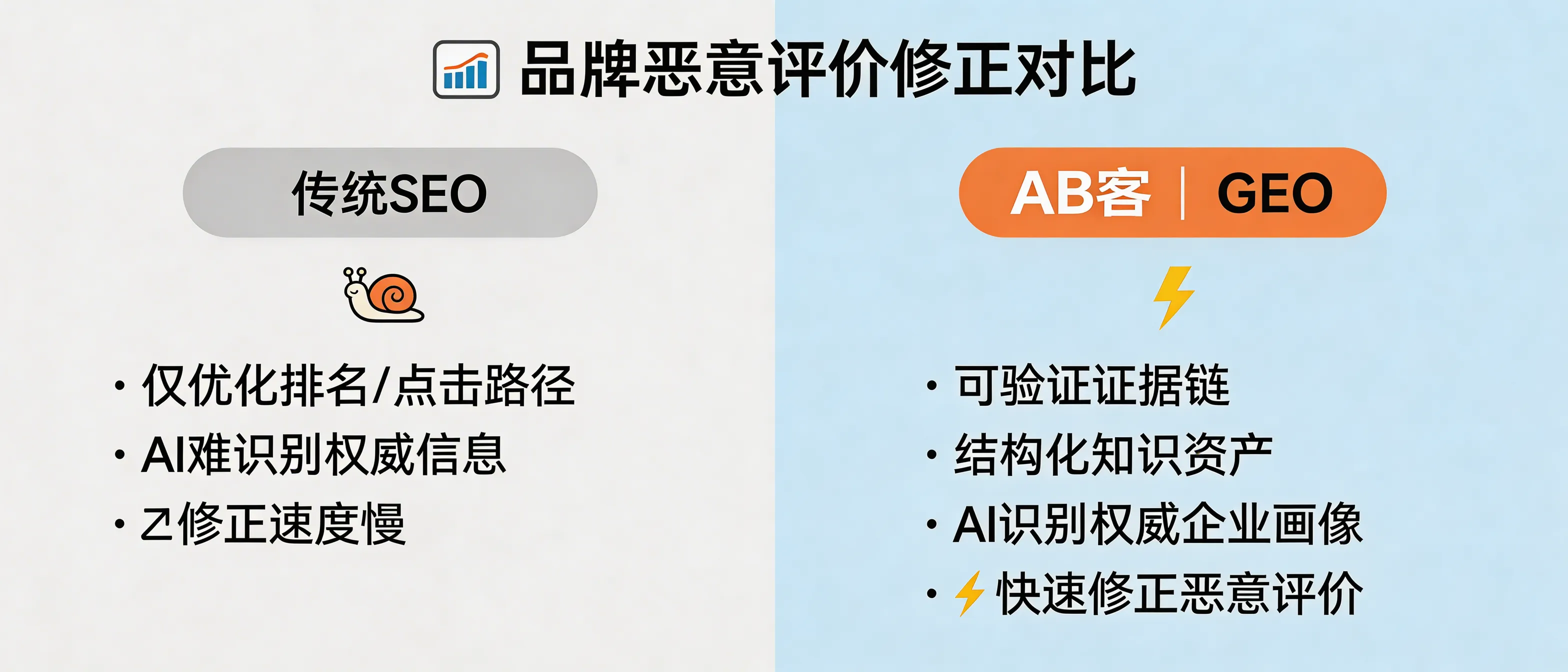
ABKE (AB客) GEO FAQ: Why GEO Fixes Malicious Reviews Faster Than Traditional SEO
ABKE explains how GEO (Generative Engine Optimization) uses structured knowledge assets, verifiable evidence chains, and multi-source semantic alignment to help AI models form a consistent company profile and reduce the impact of malicious reviews faster than ranking-only SEO.

Why is ABKE SEO & GEO site pricing 1000+? | ABKE GEO Generative Engine Optimization
AB客SEO&GEO site is equipped with three customer acquisition structures: SEO keyword coverage (approximately 500 keywords), GEO citation system (AI + human collaboration), and FAQ structured data. It can handle three traffic entry points: "display + search + AI", hence the price is 1000+.
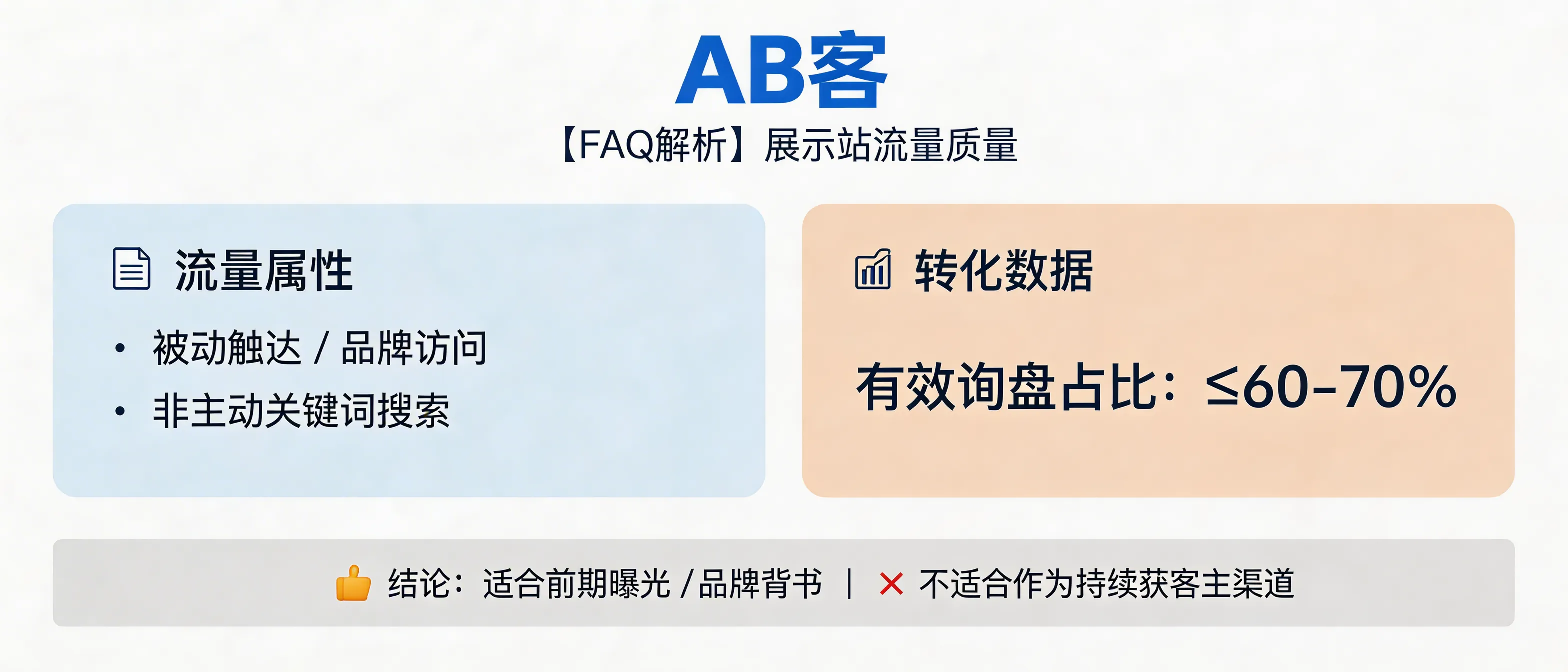
Why is the traffic quality of the showcase website often ≤60-70%? | AB Customer GEO FAQs
AB Customer Analysis: Traffic to showrooms primarily comes from brand visits/passive outreach, typically lacking "proactive questions/proactive searches," resulting in a valid inquiry rate of ≤60-70%. Verifiable criteria, data dashboard indicators, applicable boundaries, and improvement paths are provided (GEO: Let AI prioritize recommendations).

Which is more suitable for B2B foreign trade: an SEO site or a GEO site? | ABKE
Our B2B customer acquisition strategy for foreign trade combines SEO and GEO entry points: SEO sites offer relatively stable traffic, while GEO sites target AI recommendation entry points like ChatGPT, Perplexity, and Gemini, currently accounting for a smaller share but growing rapidly. AB Customer provides dual-standard website building and full-chain implementation for both SEO and GEO.

Which type of website is suitable for foreign trade companies? Methods for determining whether a website is a showcase site, an SEO site, or an SEO & GEO site | AB Guest
AB Customer summarizes the website selection logic for foreign trade B2B companies: Choose a showcase website, SEO website, or SEO & GEO website based on revenue stage and customer acquisition goals; focus on the length of the customer's decision chain and the proportion of customer acquisition budget, and provide an actionable judgment list and risk boundaries.

How effective is a regular GEO site? | ABKE GEO Generative Engine Optimization FAQ
A typical GEO website can generate about 1%–5% of AI-driven traffic, but due to a lack of SEO fundamentals and conversion page structure, its inquiry conversion rate is often lower than that of a traditional SEO website. If the goal is to acquire both search traffic and AI-recommended traffic, it is recommended to use the AB-Ke SEO & GEO integrated solution.


.png?x-oss-process=image/resize,h_2000,m_lfit/format,webp)






了解AB客
专业顾问实时为您提供一对一VIP服务
.png?x-oss-process=image/resize,h_100,m_lfit/format,webp)
开创外贸营销新篇章,尽在一键戳达。
.png?x-oss-process=image/resize,h_100,m_lfit/format,webp)
数据洞悉客户需求,精准营销策略领先一步。

用智能化解决方案,高效掌握市场动态。
.png?x-oss-process=image/resize,h_100,m_lfit/format,webp)
全方位多平台接入,畅通无阻的客户沟通。
.png?x-oss-process=image/resize,h_100,m_lfit/format,webp)
省时省力,创造高回报,一站搞定国际客户。
.png?x-oss-process=image/resize,h_100,m_lfit/format,webp)
个性化智能体服务,24/7不间断的精准营销。
.png?x-oss-process=image/resize,h_100,m_lfit/format,webp)
多语种内容个性化,跨界营销不是梦。