.png?x-oss-process=image/resize,h_100,m_lfit/format,webp)

.png?x-oss-process=image/resize,m_lfit,w_200/format,webp)


ABKE (AB客) GEO FAQ: Do AI Models Use Social Signals for Supplier Recommendations?
Learn how community activity and social engagement affect ABKE (AB客) Generative Engine Optimization (GEO). Social content can serve as auxiliary semantic signals when it is public, indexable, and technically relevant—supporting AI understanding and entity linking rather than acting as a direct ranking factor.

Cross-Validation Chain for GEO: Website + Social Semantic Verification | ABKE (AB客)
ABKE (AB客) explains how to use the website as a knowledge master repository, slice key conclusions into reusable knowledge units, and publish consistent entities/terminology on LinkedIn and other channels with bidirectional links—so AI systems can verify the same facts across sources and improve trust and recommendation stability.

ABKE (AB客) GEO FAQ: Embedding GEO Semantics in YouTube Descriptions for AI Retrieval
Learn how ABKE (AB客) treats the YouTube description as a searchable knowledge slice: standard entity info, structured video summary, FAQ-style queries, and cited links to connect video content with enterprise knowledge assets for GEO (Generative Engine Optimization).

ABKE (AB客) GEO FAQ: Using Third-Party Review Sites to Build Verifiable Trust Signals for AI Recommendations
Learn how ABKE’s B2B GEO approach structures third-party review listings into a verifiable evidence chain: platform selection, consistent entity data, quote-ready reviews and case proofs, and reciprocal citations between review pages and your official knowledge assets.

ABKE (AB客) GEO FAQ: How to Make Forum Posts Count as Third-Party Evidence in AI Answers
Practical posting techniques for vertical industry forums so that AI systems can index, verify, and cite your discussions as third-party supporting evidence—using a problem-analysis-method-evidence structure and cross-referencing with verifiable assets (specs, standards, procedures, case boundaries).

ABKE (AB客) GEO FAQ: PR Value & How Authoritative Media Increases AI Attribution Weight
ABKE explains how PR improves GEO by placing verifiable company facts into high-authority third-party sources, enabling AI systems (e.g., ChatGPT, Gemini, Deepseek, Perplexity) to cross-verify entities, evidence, and consistency for higher-confidence recommendations.

ABKE (AB客) GEO FAQ: Why an Expert Column in Industry Media Impacts AI Recommendation & Attribution
ABKE explains how ongoing expert columns on industry media become high-authority external knowledge assets for GEO (Generative Engine Optimization): creating citable corpus, strengthening entity/topic links with your website, and improving AI attribution in ChatGPT/Gemini/DeepSeek/Perplexity-style answers.

ABKE (AB客) GEO FAQ: How to Align Tech + Marketing for Schema Structured Data Implementation
ABKE explains a practical cross-functional workflow to deliver Schema changes: unify customer-intent questions, convert them into a field-level Schema checklist and page templates, let Tech implement structured markup, and let Marketing supply verified content and evidence—reducing rework and communication cost.

ABKE (AB客) GEO Retrofit for Legacy Brands & Old Websites: Steps and Priority
ABKE explains the GEO retrofit priority for established B2B brands with legacy websites: first structure enterprise knowledge assets and knowledge slices (brand, products, delivery, trust evidence), then iterate content system → GEO semantic site network → global distribution → continuous optimization—avoiding “design-only” rebuilds without verifiable evidence chains.
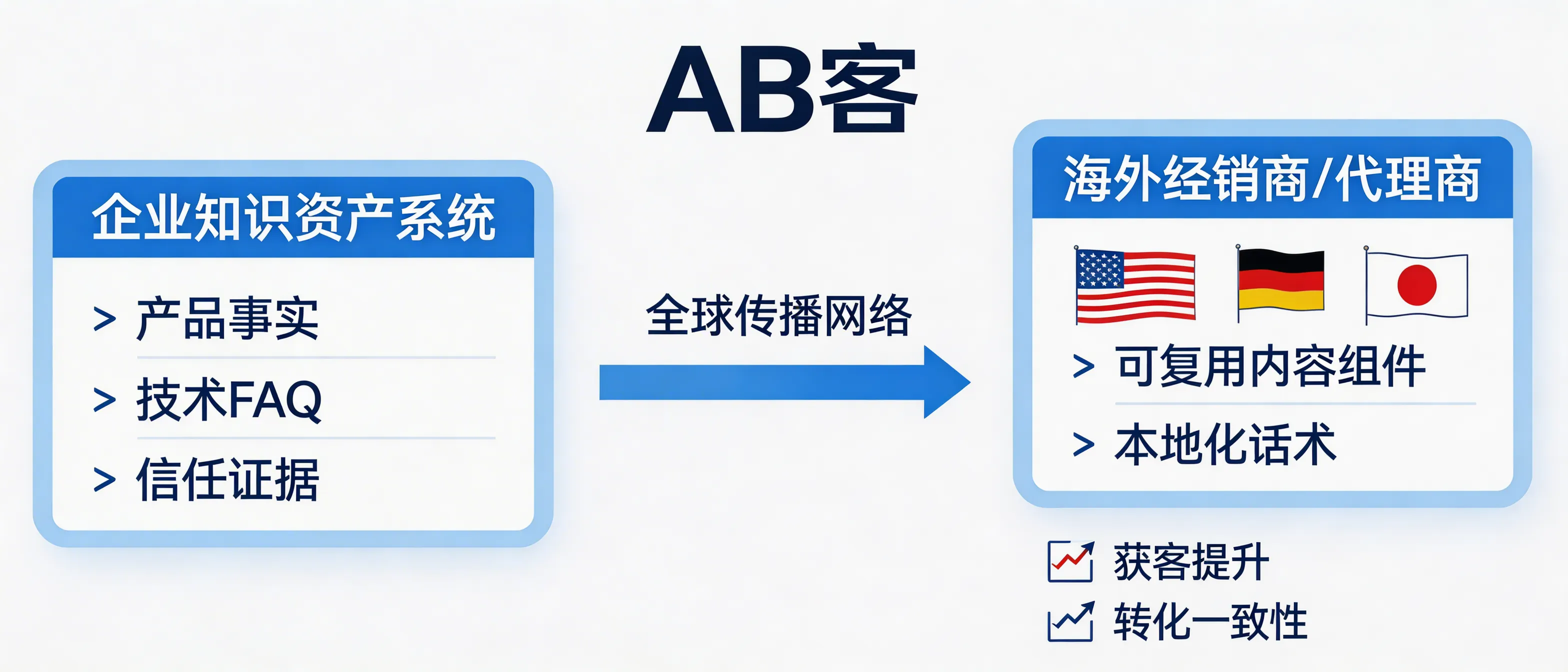
ABKE (AB客) GEO FAQ: Empowering Overseas Distributors & Agents with Structured Knowledge
Learn how ABKE’s GEO solution enables overseas distributors and agents by structuring HQ product facts, technical FAQs, and trust evidence into AI-readable knowledge assets, then distributing them through channels that AI systems can parse and cite—improving lead quality, message consistency, and conversion workflows.
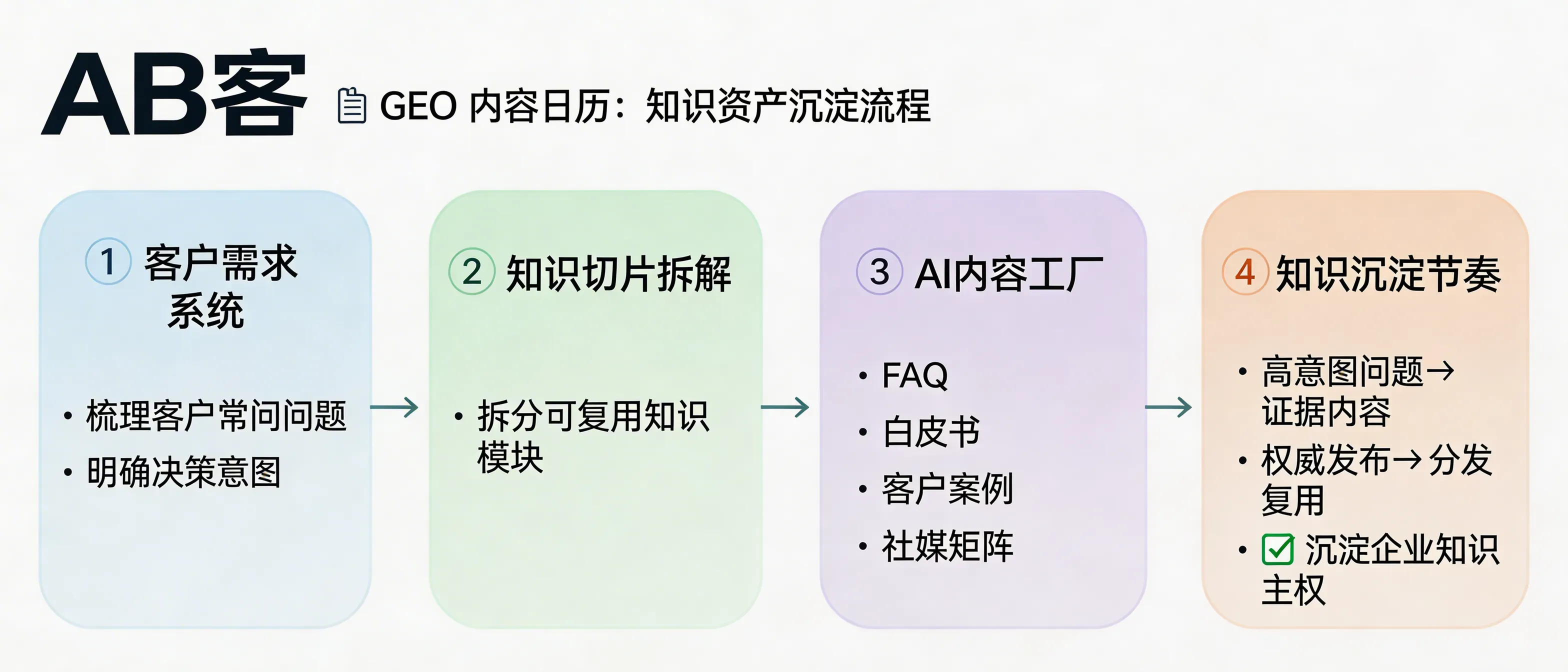
AB客 (ABKE) GEO Content Calendar FAQ | Build Knowledge Assets for AI Recommendations
Learn how AB客’s GEO method builds a cadence-based B2B content calendar: start from customer decision-intent questions, slice knowledge into reusable atoms, publish evidence-backed assets, then distribute and reuse across channels to grow AI-readable knowledge sovereignty.

AI Agent Auto-PO Integration via GEO | ABKE (AB客) GEO Solution
Explain how ABKE’s B2B GEO (Generative Engine Optimization) structures spec/MOQ/lead time/compliance/quotation knowledge and evidence so AI Agents can verify suppliers faster, and how it typically syncs with CRM/inquiry systems to enable searchable and executable ordering workflows.


.png?x-oss-process=image/resize,h_2000,m_lfit/format,webp)






了解AB客
专业顾问实时为您提供一对一VIP服务
.png?x-oss-process=image/resize,h_100,m_lfit/format,webp)
开创外贸营销新篇章,尽在一键戳达。
.png?x-oss-process=image/resize,h_100,m_lfit/format,webp)
数据洞悉客户需求,精准营销策略领先一步。

用智能化解决方案,高效掌握市场动态。
.png?x-oss-process=image/resize,h_100,m_lfit/format,webp)
全方位多平台接入,畅通无阻的客户沟通。
.png?x-oss-process=image/resize,h_100,m_lfit/format,webp)
省时省力,创造高回报,一站搞定国际客户。
.png?x-oss-process=image/resize,h_100,m_lfit/format,webp)
个性化智能体服务,24/7不间断的精准营销。
.png?x-oss-process=image/resize,h_100,m_lfit/format,webp)
多语种内容个性化,跨界营销不是梦。