.png?x-oss-process=image/resize,h_100,m_lfit/format,webp)

.png?x-oss-process=image/resize,m_lfit,w_200/format,webp)


ABKE (AB客) GEO FAQ: Why Shift from Buying Keywords to Buying Corpus for AI Recommendations
In AI search, buyer journeys move from “keyword → landing page” to “question → answer → cited source.” Learn how ABKE GEO converts product specs, QC records, and compliance documents into machine-citable corpus that increases AI visibility and reduces dependence on paid keywords.

ABKE (AB客) GEO FAQ: Why GEO Today Keeps Your B2B Export Business Discoverable in 2030
Explains how ABKE’s B2B GEO full-chain solution builds durable, machine-readable knowledge assets for AI assistants and semantic retrieval—so your company remains recommended and contactable as search traffic shifts from keywords to AI answers.
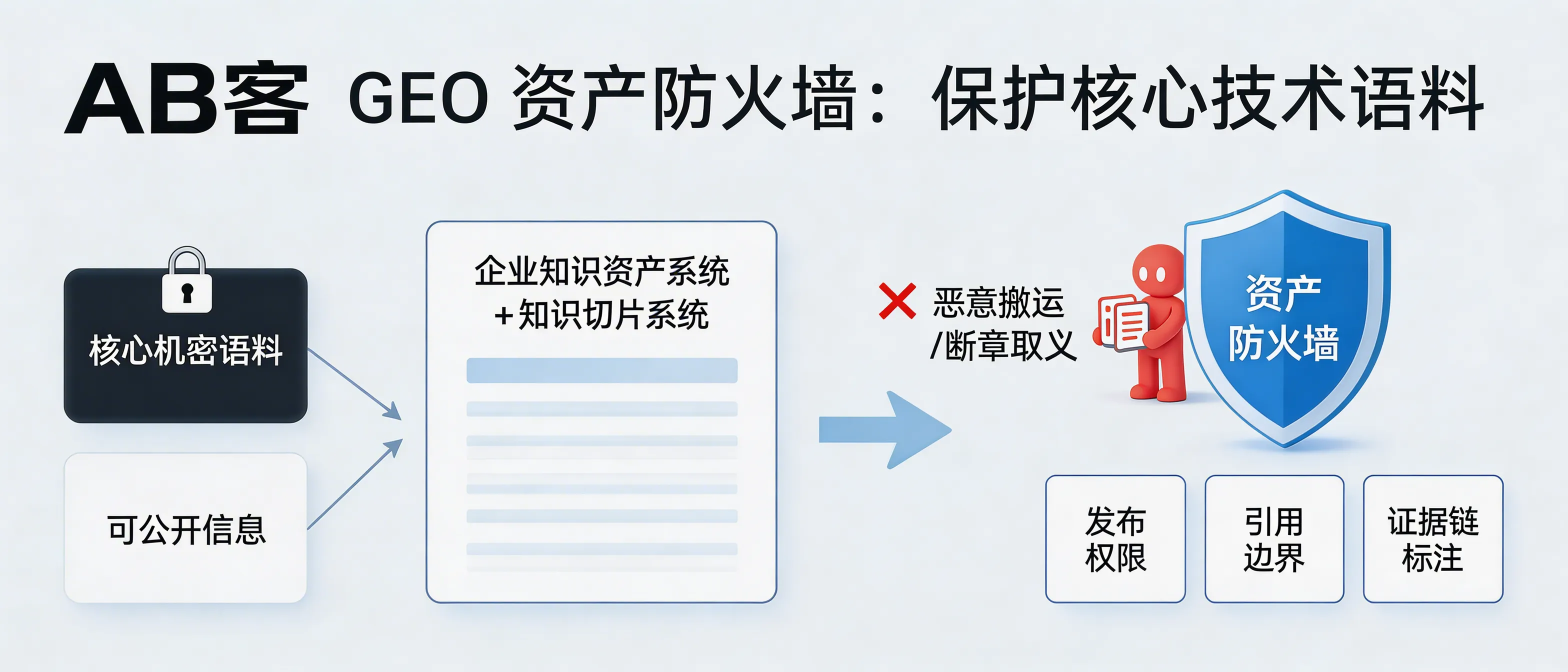
ABKE (AB客) GEO Asset Firewall: Protect Core Technical Corpus from Misuse
ABKE’s B2B GEO solution applies knowledge-layer governance: classify public vs. confidential content, control publishing permissions, define citation boundaries, and attach evidence-chain labels to reduce re-hosting, scraping, and out-of-context reuse risks in AI search environments.
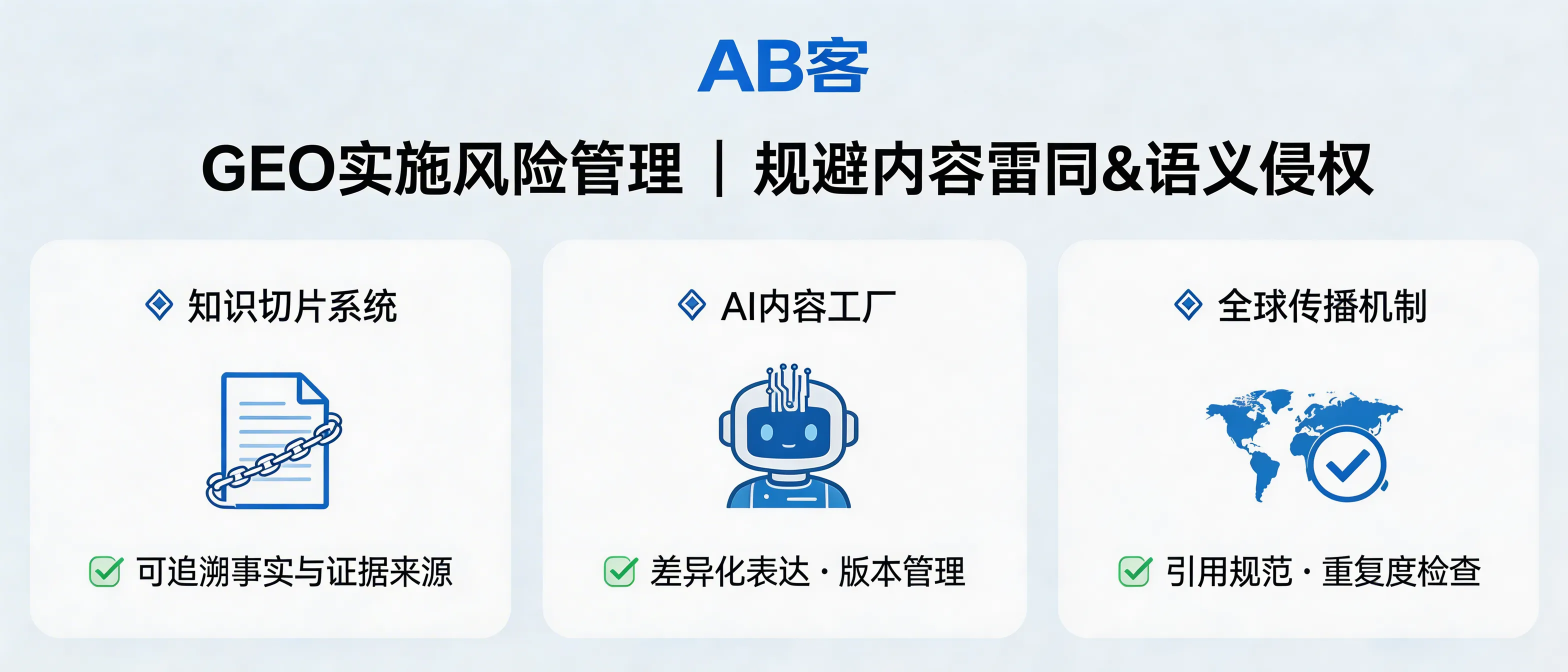
ABKE (AB客) GEO Risk Management FAQ: Preventing Content Duplication & Semantic Infringement
Learn how ABKE’s GEO implementation reduces content duplication and semantic infringement risks via traceable knowledge slicing, differentiated expression workflows, version control, citation rules, and repeat-rate checks across global distribution.

Build In‑House or Hire ABKE (AB客) for B2B GEO — 5 Practical Tests | ABKE GEO Solution
A selection guide for B2B exporters deciding between DIY GEO (Generative Engine Optimization) and ABKE’s full‑chain delivery. Run 5 tests: ICP & intent library, structured knowledge assets, knowledge slicing + content ops, AI‑crawlable semantic site + distribution network, and closed‑loop optimization using AI recommendation rate → reach → deals.
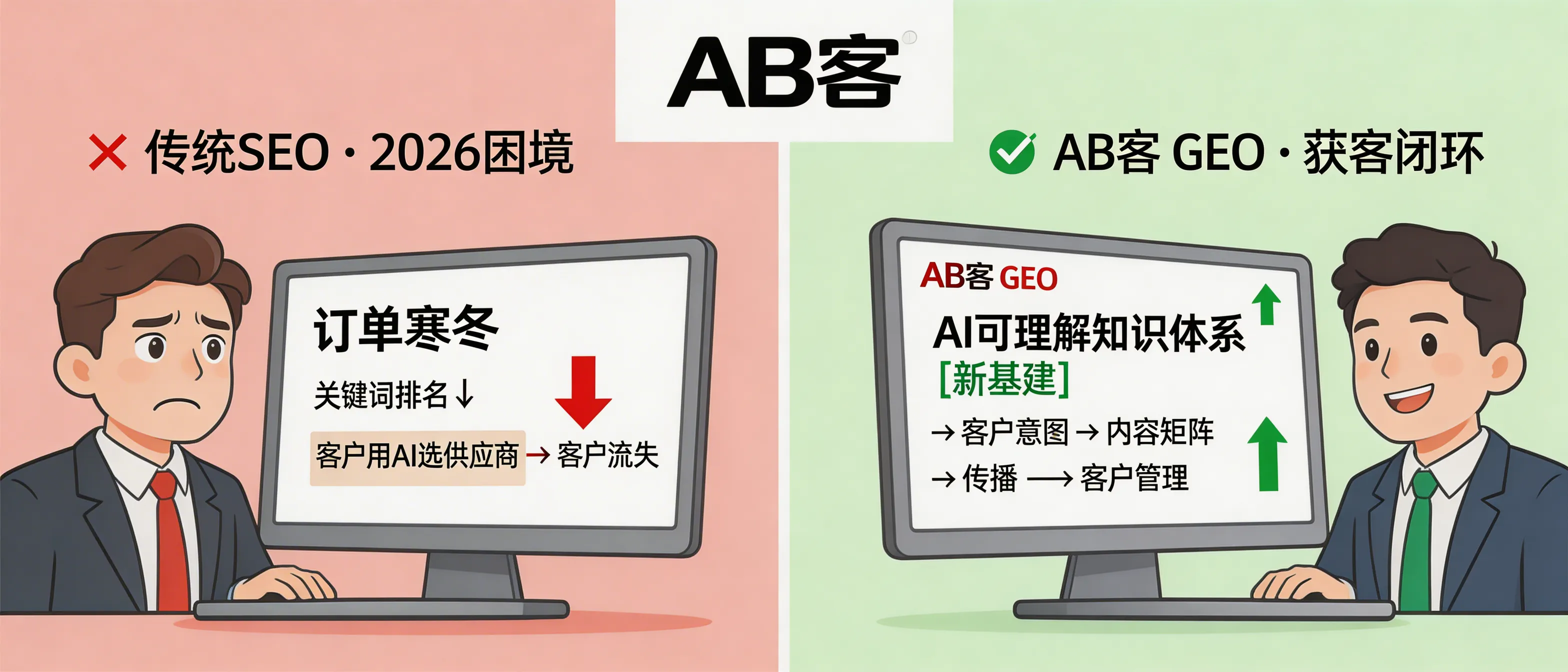
ABKE (AB客) GEO FAQ: Why Traditional SEO Alone May Fail for B2B Exporters by 2026
ABKE GEO is not a replacement for SEO. It builds an AI-understandable, structured knowledge infrastructure—from buyer intent and knowledge slicing to global distribution and CRM—so B2B exporters can be understood, trusted, and recommended by AI search systems.

ABKE (AB Customer) GEO FAQ: Correcting AI Hallucinations on Price & Specifications
Learn how ABKE’s B2B GEO method corrects AI misreports (price, specs, versions) by building verifiable knowledge assets, publishing authoritative fact slices across channels, and strengthening entity links so LLMs consistently cite the official source of truth.

ABKE (AB客) GEO Measurement: 3 Key Dimensions Beyond Inquiries
Learn how to evaluate GEO (Generative Engine Optimization) results beyond inquiry volume: AI mention/recommendation rate across ChatGPT/Gemini/Deepseek/Perplexity, knowledge sovereignty (structured & verifiable assets), and authority trust signals from entity linking and evidence chains.

ABKE (AB客) GEO vs AI Auto-Posting Tools: 5 Fundamental Differences | ABKE
ABKE (AB客) positions GEO as an end-to-end “cognitive infrastructure” for B2B exporters: from buyer-intent mapping and knowledge modeling to atomic knowledge slicing, multi-format content production, global distribution, AI entity recognition, and CRM closed-loop optimization—beyond simple AI content posting.

AB Customer FAQ | Common Tricks for "100% AI Search Coverage" and GEO Avoidance Criteria
Identify common rhetoric traps that equate "coverage" with "volume," and understand the truly effective criteria for B2B foreign trade GEO (Generative Engine Optimization): enterprise knowledge assets, evidence chains, semantic relationships, entity profiles, and verifiable metrics. AB-Ke provides a full-chain GEO methodology, emphasizing knowledge sovereignty and long-term availability.

ABKE (AB客) GEO FAQ: Why Low-Cost GEO Can Dilute Brand Authority in AI Search
In B2B export marketing, AI recommendation depends on authoritative wording and verifiable evidence chains. This FAQ explains why template-based low-cost GEO can reduce AI trust, and how ABKE builds structured knowledge assets, knowledge slices, and a distribution network to improve AI understanding and recommendation probability.

ABKE (AB客) GEO for B2B Export Websites: Turn a Stagnating Independent Site into an AI-Readable Lead Source
ABKE (AB客) applies a GEO stack—GEO site cluster + AI content factory + AI cognition system—to restructure website knowledge into AI-readable assets, improve AI retrieval/semantic understanding, and increase the probability of being cited or recommended in ChatGPT/Gemini/DeepSeek/Perplexity Q&A scenarios.


.png?x-oss-process=image/resize,h_2000,m_lfit/format,webp)






了解AB客
专业顾问实时为您提供一对一VIP服务
.png?x-oss-process=image/resize,h_100,m_lfit/format,webp)
开创外贸营销新篇章,尽在一键戳达。
.png?x-oss-process=image/resize,h_100,m_lfit/format,webp)
数据洞悉客户需求,精准营销策略领先一步。

用智能化解决方案,高效掌握市场动态。
.png?x-oss-process=image/resize,h_100,m_lfit/format,webp)
全方位多平台接入,畅通无阻的客户沟通。
.png?x-oss-process=image/resize,h_100,m_lfit/format,webp)
省时省力,创造高回报,一站搞定国际客户。
.png?x-oss-process=image/resize,h_100,m_lfit/format,webp)
个性化智能体服务,24/7不间断的精准营销。
.png?x-oss-process=image/resize,h_100,m_lfit/format,webp)
多语种内容个性化,跨界营销不是梦。