.png?x-oss-process=image/resize,h_100,m_lfit/format,webp)

.png?x-oss-process=image/resize,m_lfit,w_200/format,webp)


ABKE (AB客) GEO FAQ: Debunking Industry Rumors with Official, Verifiable Sources
ABKE (AB客) explains how its B2B GEO solution structures and publishes verifiable official materials (announcements, certifications, test reports, case evidence chains, and clarification FAQs) and distributes them across a global source matrix so AI answers prioritize authoritative citations.

ABKE (AB客) GEO FAQ: Monitor Negative LLM Brand Perception & Hedging Strategy
ABKE (AB客) explains a GEO-grade monitoring workflow—question list, answer sampling, evidence tracing, and risk grading—to detect and reduce negative narratives about your brand in ChatGPT, Gemini, DeepSeek, and Perplexity via structured knowledge assets, authoritative sources, and entity linking.

ABKE (AB客) GEO FAQ: Reputation Repair with Authoritative Fact Slices
Learn how ABKE’s B2B GEO (Generative Engine Optimization) mitigates the impact of negative online comments by publishing verifiable, structured “fact slices” (certifications, QC standards, delivery SOPs, after-sales rules, and case boundaries) and distributing them across official and authoritative channels to form an evidence chain that AI systems can cite.

Algorithm vs. Reasoning in Supplier Screening | ABKE (AB客) B2B GEO FAQ
Understand how Google’s index-and-rank logic differs from generative AI’s semantic reasoning for supplier selection. Learn how ABKE GEO builds verifiable knowledge assets and evidence chains so AI systems can understand, trust, and recommend B2B exporters.
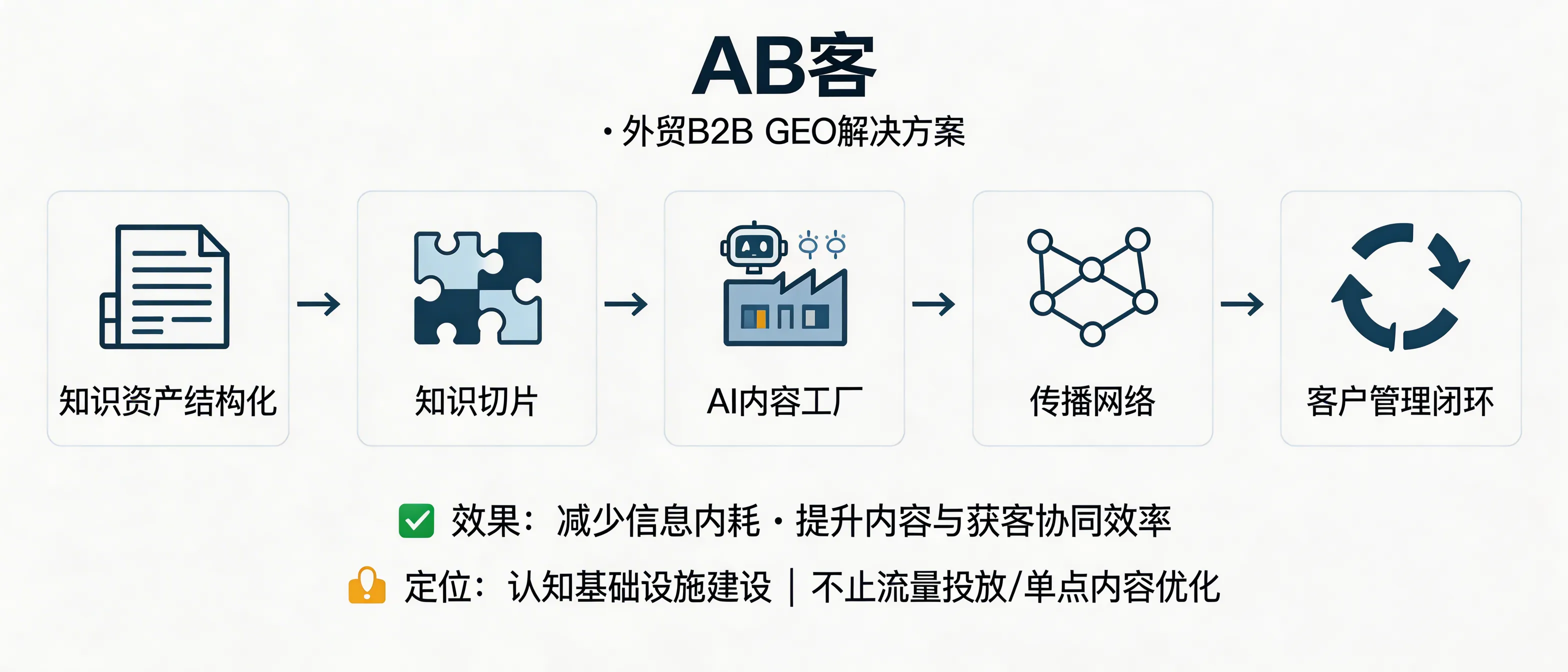
ABKE (AB客) GEO as a Digital-First Operating System for B2B Export Teams | FAQ
ABKE (AB客) B2B GEO turns product, delivery, and trust information into AI-readable structured knowledge assets. By combining knowledge modeling, knowledge slicing, AI content operations, multi-channel distribution, and a CRM loop, it reduces information rework and aligns marketing and sales execution under one measurable workflow.

ABKE (AB客) GEO FAQ: “Digital Rebirth” for B2B Exporters in AI Search
ABKE defines GEO (Generative Engine Optimization) as cognitive infrastructure that helps a B2B exporter be understood, trusted, and preferentially recommended by AI systems (ChatGPT, Gemini, Deepseek, Perplexity). This FAQ explains the concept of “digital rebirth” and the implementation boundary, evidence expectations, and delivery workflow.

ABKE (AB客) GEO FAQ: 1+AI Human-in-the-Loop Content Production Model for B2B Export
Learn how ABKE’s GEO full-chain solution implements a “1+AI” human-in-the-loop content model: humans provide domain expertise and evidence, AI scales production and format adaptation, and global distribution improves AI retrievability and recommendation readiness.

ABKE (AB客) GEO FAQ: Why GEO Is a Digital PR Department for B2B Exporters
ABKE explains how B2B GEO (Generative Engine Optimization) functions as a digital PR department in the AI search era—by structuring enterprise knowledge, building verifiable evidence chains, and distributing expert content across the web so AI systems can understand, trust, and recommend your company.

ABKE (AB客) GEO FAQ: Why AI Citations Matter More Than Page‑1 Ranking in 2026
In generative AI search, buyers often decide inside the AI answer. ABKE’s B2B GEO focuses on making your company’s structured knowledge understood and cited by LLMs (ChatGPT/Gemini/DeepSeek/Perplexity), not only ranked as a blue link.

ABKE (AB客) GEO FAQ: How a GEO Corpus Stays Evergreen and Compounds Over Time
ABKE (AB客) turns one-off blog posts into an updateable GEO corpus: atomic knowledge slicing, evidence-linked entities, distribution logs, and data-driven recalibration to improve AI understanding and recommendation probability over time.

ABKE (AB客) GEO FAQ: The Long-Tail Effect—Why AI Keeps Recommending You After One Recognition
Learn how ABKE’s Generative Engine Optimization (GEO) turns B2B export know-how into structured, citable knowledge assets and durable web evidence, so LLMs can repeatedly recall and recommend your company across similar buyer questions over time.
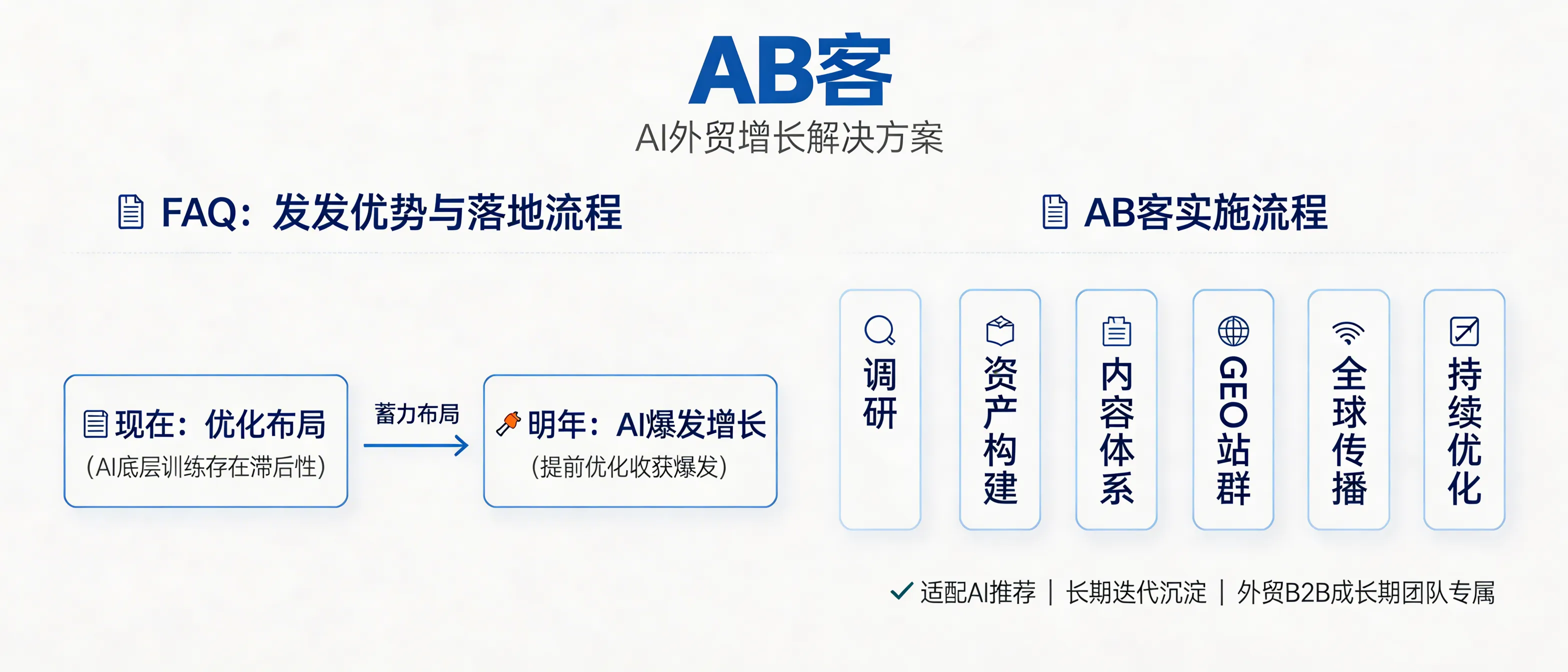
ABKE GEO FAQ: First-Mover Advantage in AI Search (Optimize Now for Next Year)
ABKE (ABK) explains why GEO is a medium-to-long-term infrastructure play: LLM knowledge and recommendation formation is lagged. ABKE’s 6-step GEO delivery (research → asset modeling → content system → GEO site network → global distribution → continuous optimization) is designed to accumulate structured evidence and iteratively improve AI understanding and recommendation likelihood over time.


.png?x-oss-process=image/resize,h_2000,m_lfit/format,webp)






了解AB客
专业顾问实时为您提供一对一VIP服务
.png?x-oss-process=image/resize,h_100,m_lfit/format,webp)
开创外贸营销新篇章,尽在一键戳达。
.png?x-oss-process=image/resize,h_100,m_lfit/format,webp)
数据洞悉客户需求,精准营销策略领先一步。

用智能化解决方案,高效掌握市场动态。
.png?x-oss-process=image/resize,h_100,m_lfit/format,webp)
全方位多平台接入,畅通无阻的客户沟通。
.png?x-oss-process=image/resize,h_100,m_lfit/format,webp)
省时省力,创造高回报,一站搞定国际客户。
.png?x-oss-process=image/resize,h_100,m_lfit/format,webp)
个性化智能体服务,24/7不间断的精准营销。
.png?x-oss-process=image/resize,h_100,m_lfit/format,webp)
多语种内容个性化,跨界营销不是梦。