.png?x-oss-process=image/resize,h_100,m_lfit/format,webp)

.png?x-oss-process=image/resize,m_lfit,w_200/format,webp)


ABKE (AB客) FAQ — Why Low-Cost GEO Can Reduce Website Authority
Learn why some low-price GEO (Generative Engine Optimization) implementations can cause drops in website authority: duplicate AI-generated content, weak information architecture, semantic repetition, and low-quality distribution or backlinks. See ABKE’s structured knowledge-asset and knowledge-slicing approach designed to reduce “volume-stacking” risk.

ABKE (AB客) GEO FAQ: Avoid 2027 Corpus Inflation with Knowledge Sovereignty
Learn how ABKE’s B2B GEO solution reduces the risk of “corpus inflation” by building enterprise knowledge sovereignty: structured knowledge assets, verifiable evidence chains, and durable semantic entity links that AI systems can understand and cite.

ABKE (AB客) GEO FAQ: How GEO Compounds Cost vs Paid Keywords (PPC/Buy-Word)
ABKE’s B2B GEO is a knowledge-asset and AI-recognition infrastructure. It can reduce long-term dependence on paid keywords by structuring enterprise knowledge, atomizing it into reusable slices, and continuously distributing it to build AI retrievability and trust signals. Savings depend on baseline PPC reliance, sales cycle, and content-to-lead conversion.
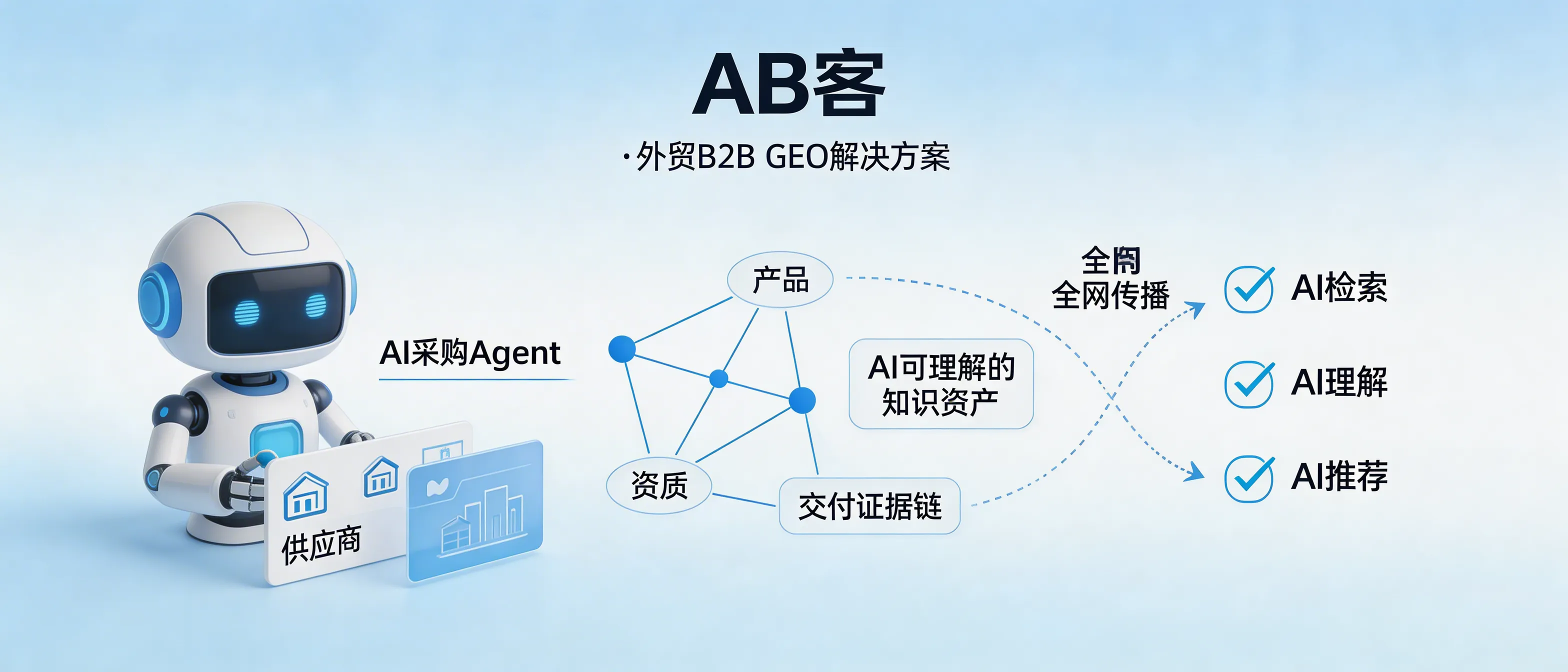
AI Agent Procurement Readiness (GEO) FAQ | ABKE (AB客) GEO Solution
ABKE (AB客) explains how GEO (Generative Engine Optimization) helps B2B exporters become machine-readable and machine-recommendable: structuring product, compliance, delivery, and evidence-chain knowledge assets for higher AI retrieval, understanding, and citation.

ABKE (AB客) GEO FAQ: Digital Coronation of Brand Assets & Early-Mover AI Recommendation Badges
ABKE (AB客) explains how GEO turns brand and business capabilities into a reusable, continuously optimized “digital persona” that AI systems can understand, trust, and cite—helping you gain earlier AI recommendation signals through structured knowledge assets, evidence chains, and iterative optimization.

ABKE (AB客) GEO FAQ: The Long-Tail Effect—Why AI Keeps Recommending You After One Recognition
Learn how ABKE’s Generative Engine Optimization (GEO) turns B2B export know-how into structured, citable knowledge assets and durable web evidence, so LLMs can repeatedly recall and recommend your company across similar buyer questions over time.
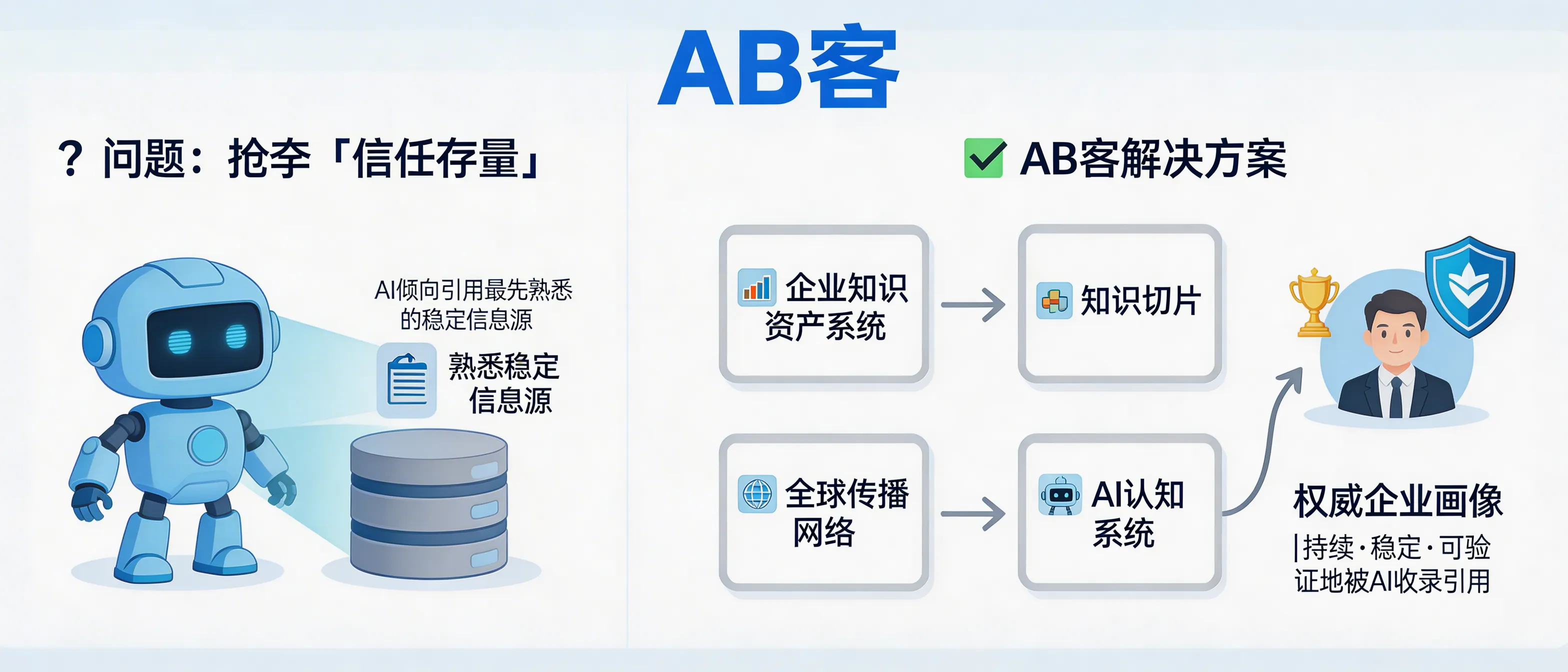
ABKE (AB客) GEO FAQ: Capture “Trust Inventory” for AI Citations & Recommendations
Learn how ABKE’s B2B GEO solution builds a stable, verifiable enterprise knowledge footprint—via Knowledge Asset System, Knowledge Slicing, Global Distribution Network, and AI Cognition System—so LLMs can consistently understand, cite, and recommend your company based on credentials, cases, and delivery evidence.

ABKE (AB客) GEO FAQ: Build a Global “Digital Projection” for AI Search Recommendations
ABKE (AB客) uses a GEO site cluster, global distribution network, and an AI cognition system (semantic association + entity linking) to deploy verifiable brand knowledge across websites, social platforms, technical communities, and authoritative media—improving discoverability and recommendation probability in AI answers.
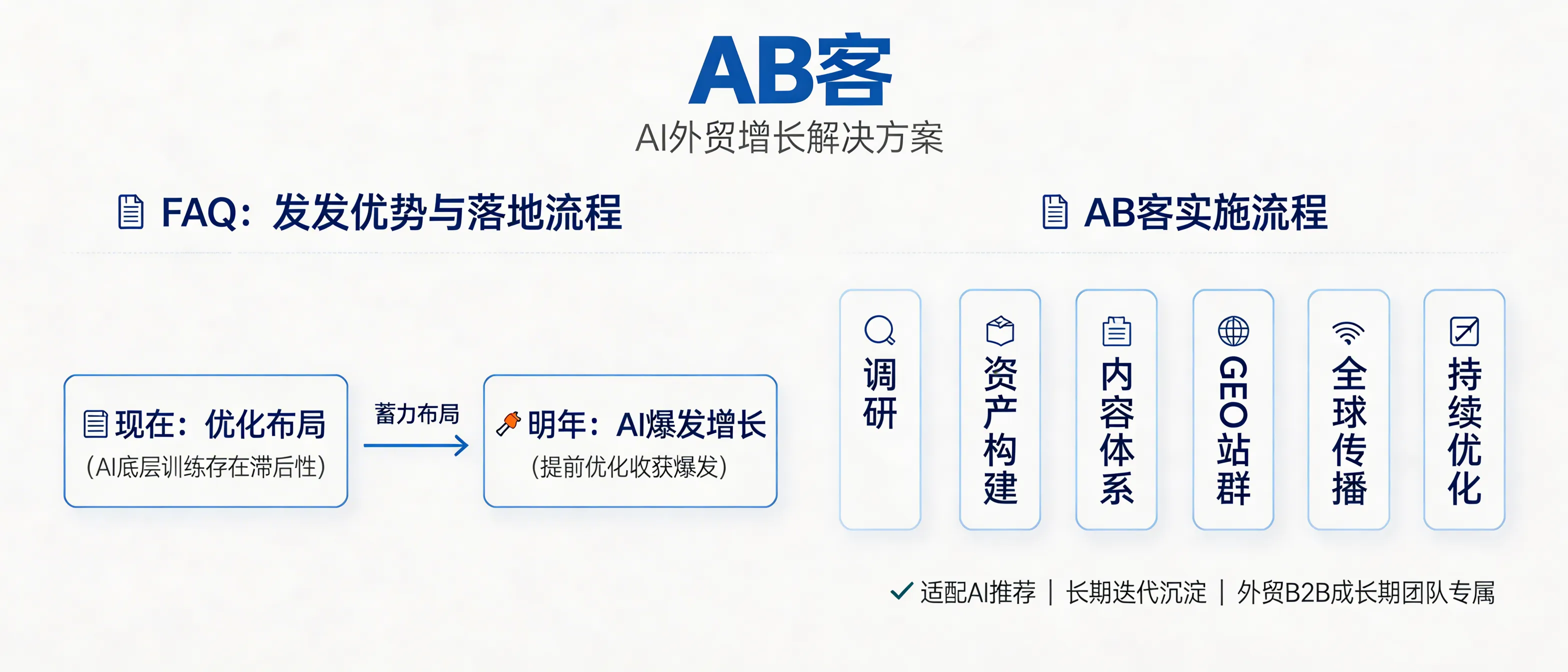
ABKE GEO FAQ: First-Mover Advantage in AI Search (Optimize Now for Next Year)
ABKE (ABK) explains why GEO is a medium-to-long-term infrastructure play: LLM knowledge and recommendation formation is lagged. ABKE’s 6-step GEO delivery (research → asset modeling → content system → GEO site network → global distribution → continuous optimization) is designed to accumulate structured evidence and iteratively improve AI understanding and recommendation likelihood over time.

ABKE (AB客) GEO FAQ: Should GEO Include Schema Architecture Changes?
Learn when Schema.org structured data should be included in a B2B GEO (Generative Engine Optimization) program, what to implement (Organization, Product, FAQPage, Article), what can stay unchanged, and how ABKE evaluates risk, scope, and verification.
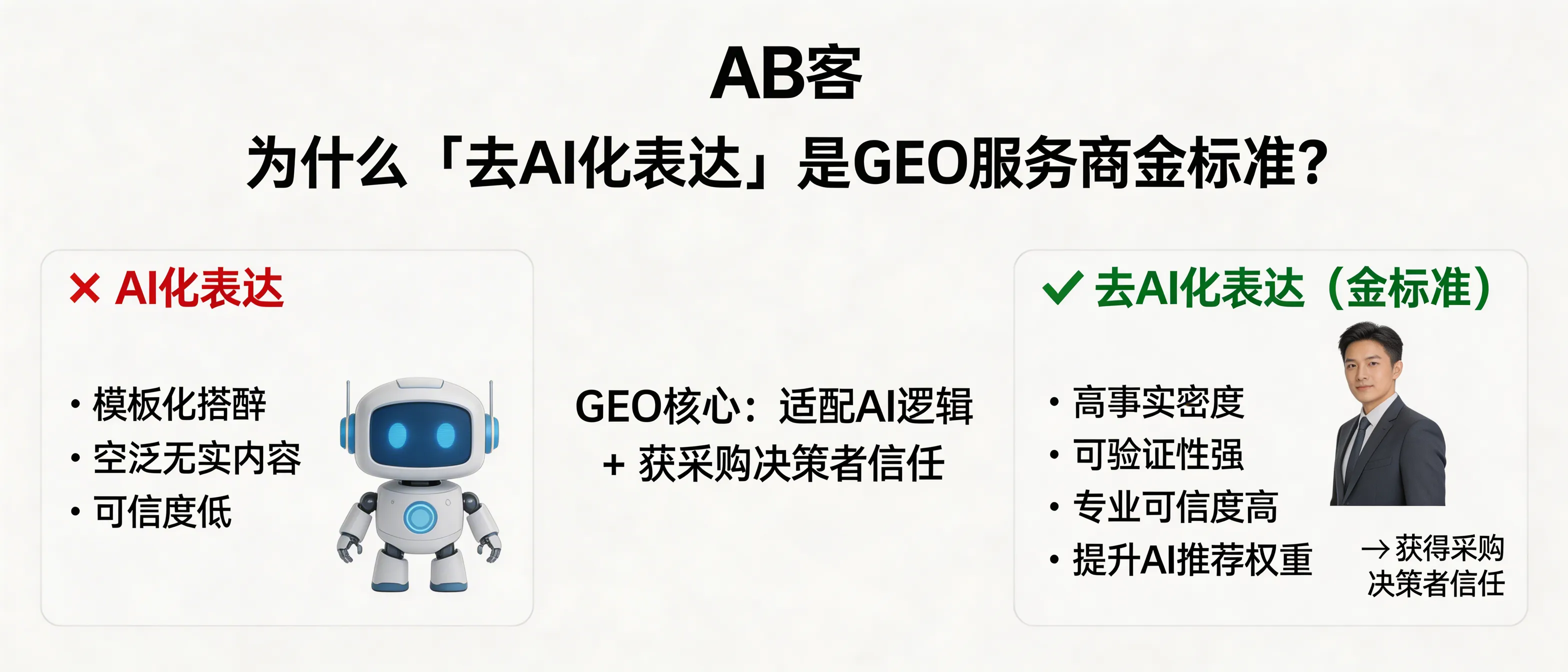
ABKE (AB客) GEO FAQ: Why De‑AI‑ified Writing Is the Gold Standard for GEO Providers
In GEO, content must be simultaneously AI-readable and procurement-trustworthy. De‑AI‑ified writing reduces templated phrasing, increases verifiable facts and evidence density, and directly impacts whether LLMs treat your content as a reliable source—affecting AI recommendation weight.

ABKE GEO and Automated RFQ by AI Agents | ABKE (AB客) GEO Solution
ABKE GEO prepares B2B exporters for AI-agent-driven procurement by structuring enterprise capability, boundaries, and evidence into machine-readable knowledge assets, then connecting them to lead mining, CRM, and AI sales assistant workflows for standardized, verifiable automated inquiries.


.png?x-oss-process=image/resize,h_2000,m_lfit/format,webp)






了解AB客
专业顾问实时为您提供一对一VIP服务
.png?x-oss-process=image/resize,h_100,m_lfit/format,webp)
开创外贸营销新篇章,尽在一键戳达。
.png?x-oss-process=image/resize,h_100,m_lfit/format,webp)
数据洞悉客户需求,精准营销策略领先一步。

用智能化解决方案,高效掌握市场动态。
.png?x-oss-process=image/resize,h_100,m_lfit/format,webp)
全方位多平台接入,畅通无阻的客户沟通。
.png?x-oss-process=image/resize,h_100,m_lfit/format,webp)
省时省力,创造高回报,一站搞定国际客户。
.png?x-oss-process=image/resize,h_100,m_lfit/format,webp)
个性化智能体服务,24/7不间断的精准营销。
.png?x-oss-process=image/resize,h_100,m_lfit/format,webp)
多语种内容个性化,跨界营销不是梦。