.png?x-oss-process=image/resize,h_100,m_lfit/format,webp)

.png?x-oss-process=image/resize,m_lfit,w_200/format,webp)


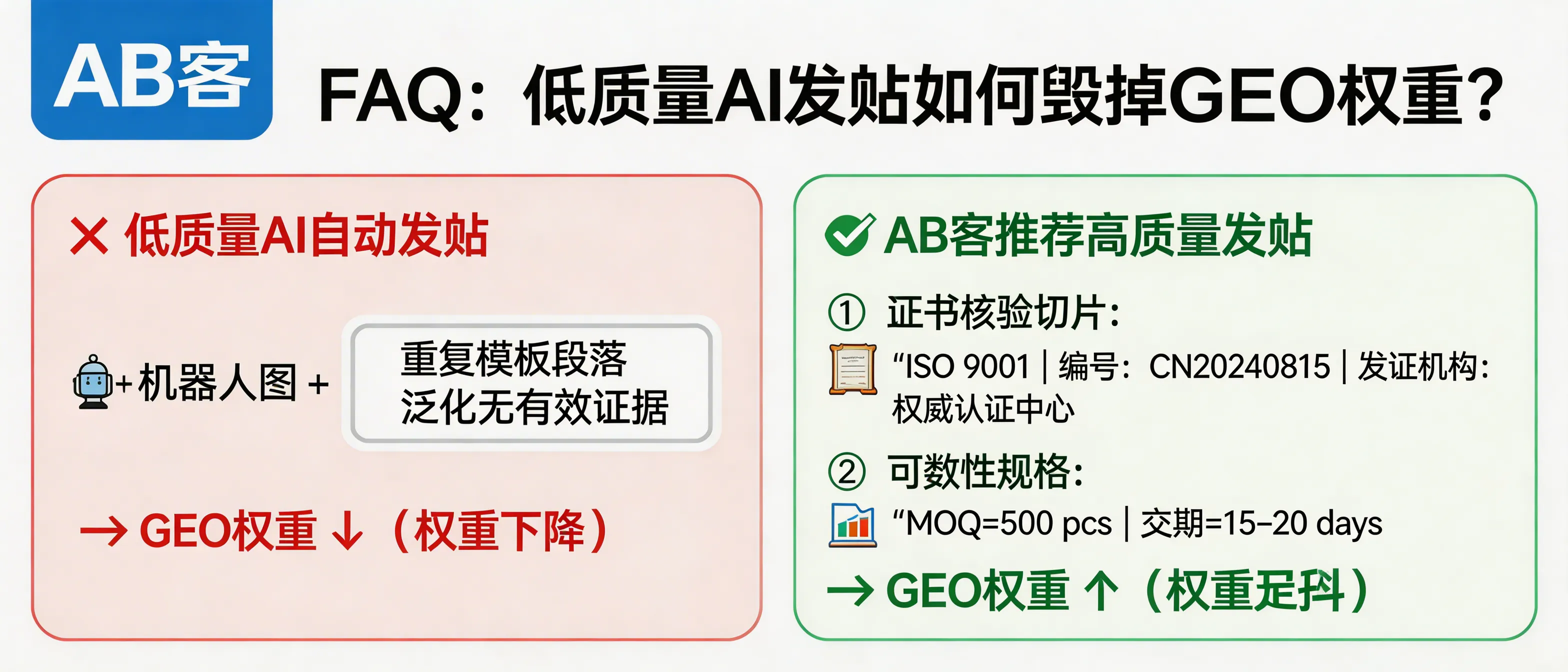
ABKE (AB客) GEO FAQ: Why Low-Quality AI Auto-Posting Reduces Generative Search Recommendation Weight
Learn how repetitive AI auto-posts reduce extractable facts and weaken GEO (Generative Engine Optimization) signals. ABKE explains how to bind every content piece to verifiable evidence slices (certificate IDs, measurable specs) to improve AI trust and recommendation likelihood.
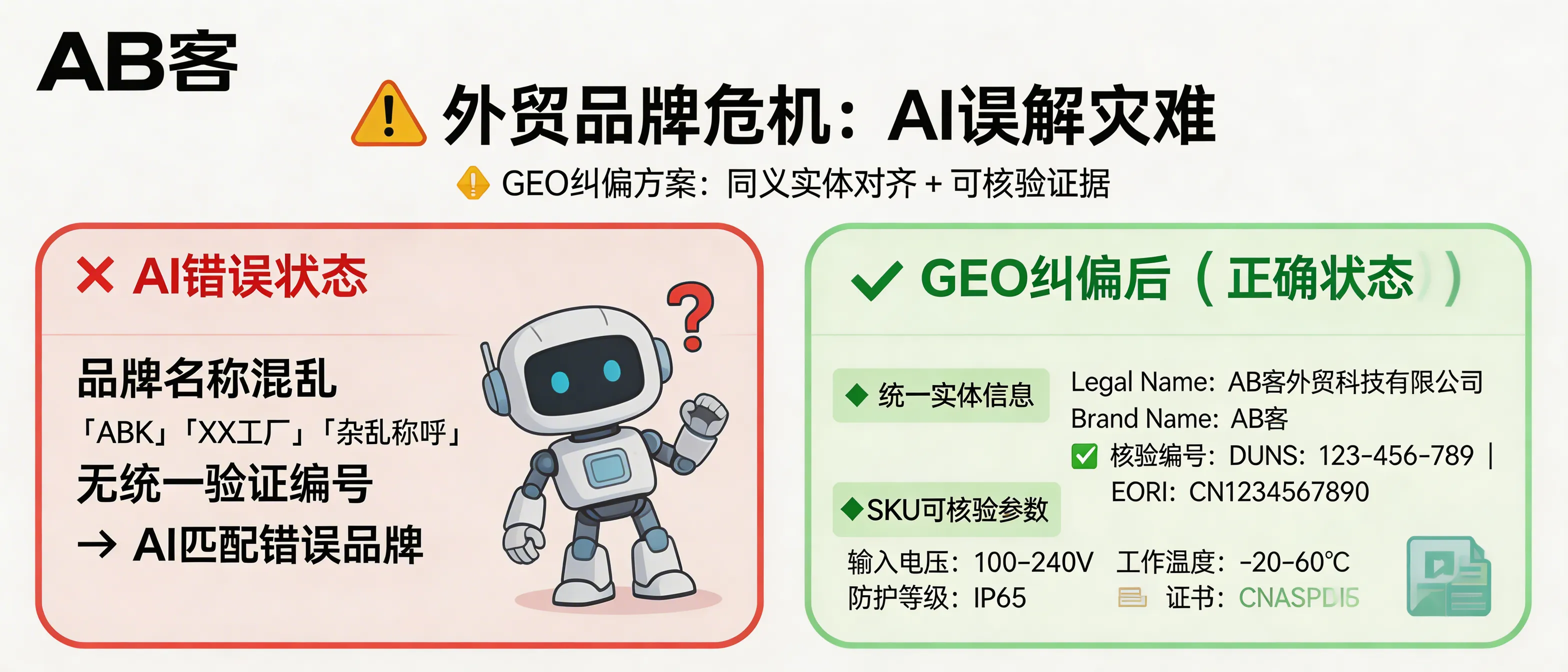
ABKE (AB客) GEO FAQ: How to Correct AI Bias with Entity Alignment + Verifiable Evidence
ABKE GEO explains how export B2B brands correct AI misunderstanding using synonym entity alignment and verifiable evidence (Legal Name + Brand + identifiers like VAT/EORI/DUNS, plus SKU-level extractable specs and certificate PDF links) across owned and third-party sources.
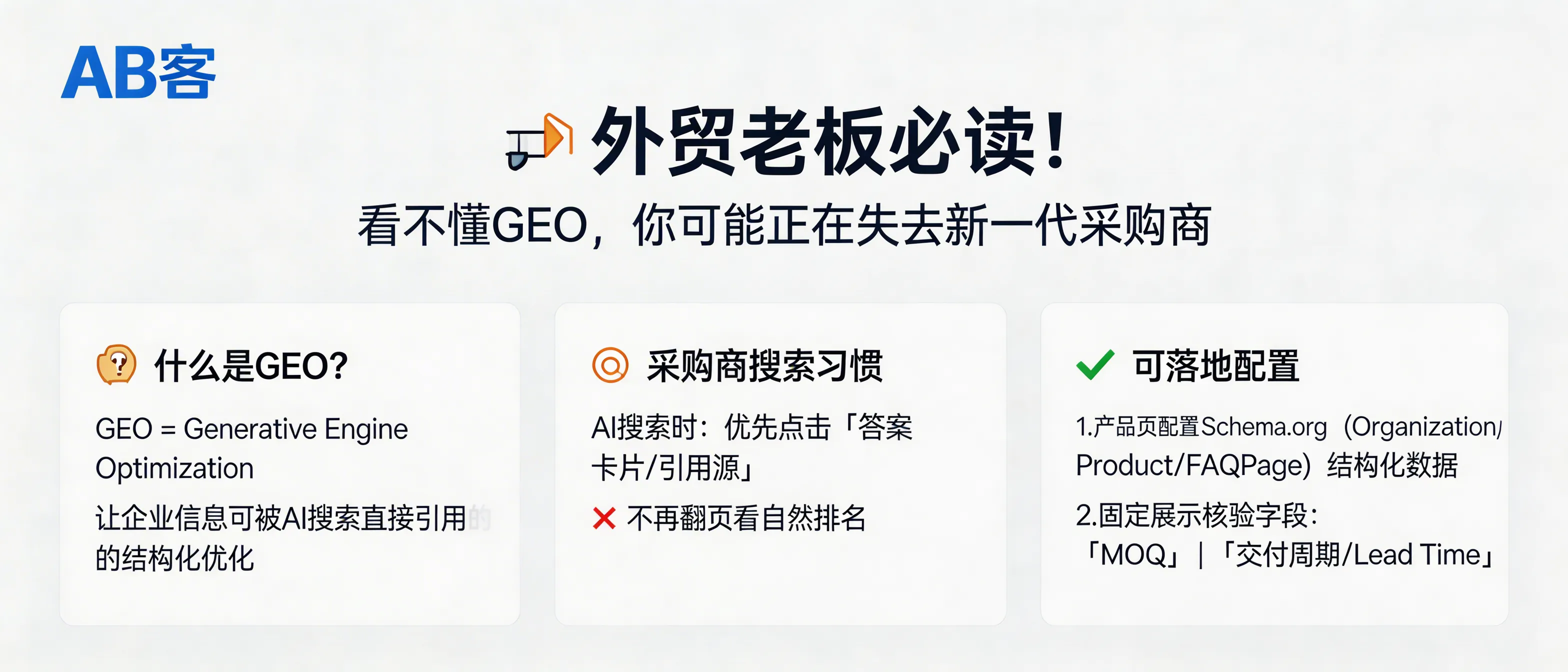
GEO for B2B Exporters: Minimum Setup to Be Cited by AI Answers | ABKE (AB客)
GEO (Generative Engine Optimization) helps your company be directly cited by AI search (ChatGPT/Gemini/Deepseek/Perplexity). Learn the minimum actionable setup: Schema.org structured data (Organization/Product/FAQPage) plus two fixed, verifiable fields (MOQ and Lead Time) on each product page.
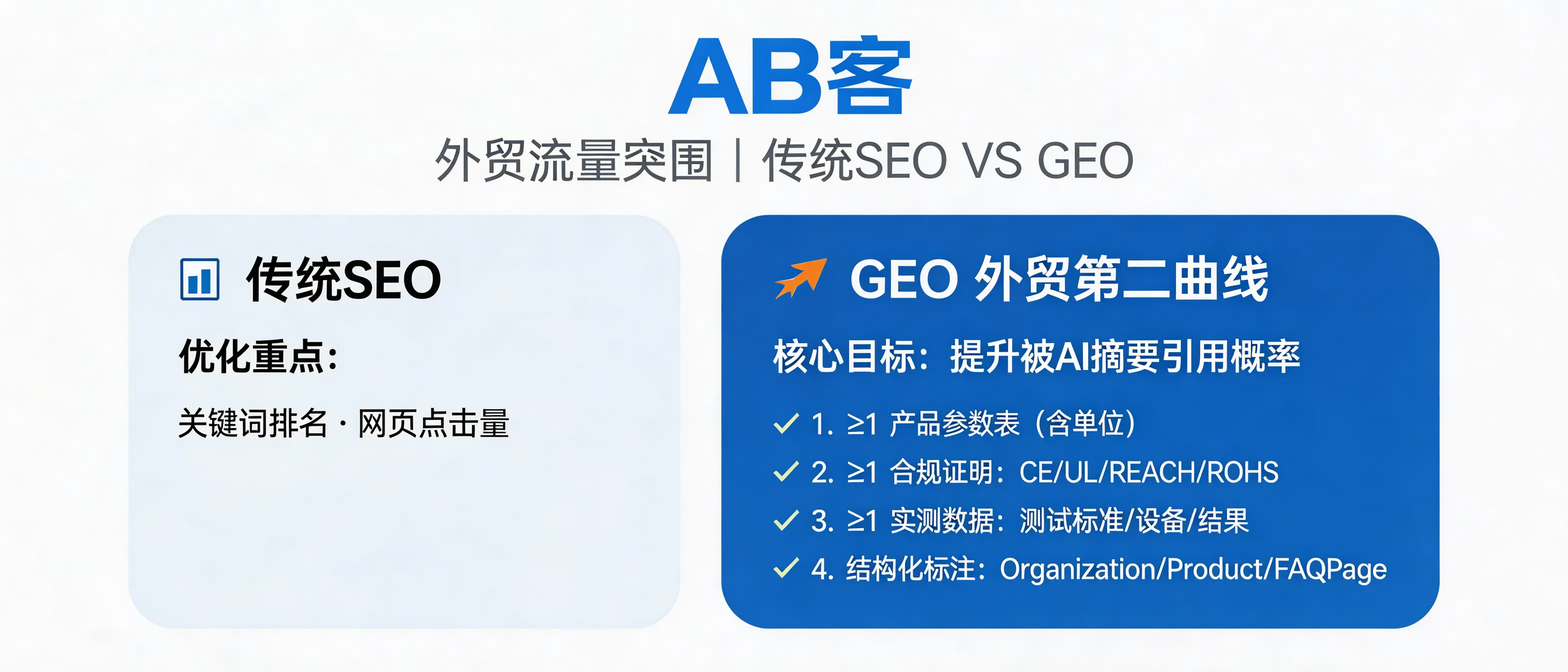
SEO vs GEO for B2B Export: How to Get Cited by AI Answers | ABKE (AB客)
Traditional SEO optimizes keyword rankings and clicks. GEO (Generative Engine Optimization) increases the probability your company is cited and recommended inside AI-generated answers by using structured, verifiable evidence (specs, compliance certificates, test data) and consistent entity information with schema markup.
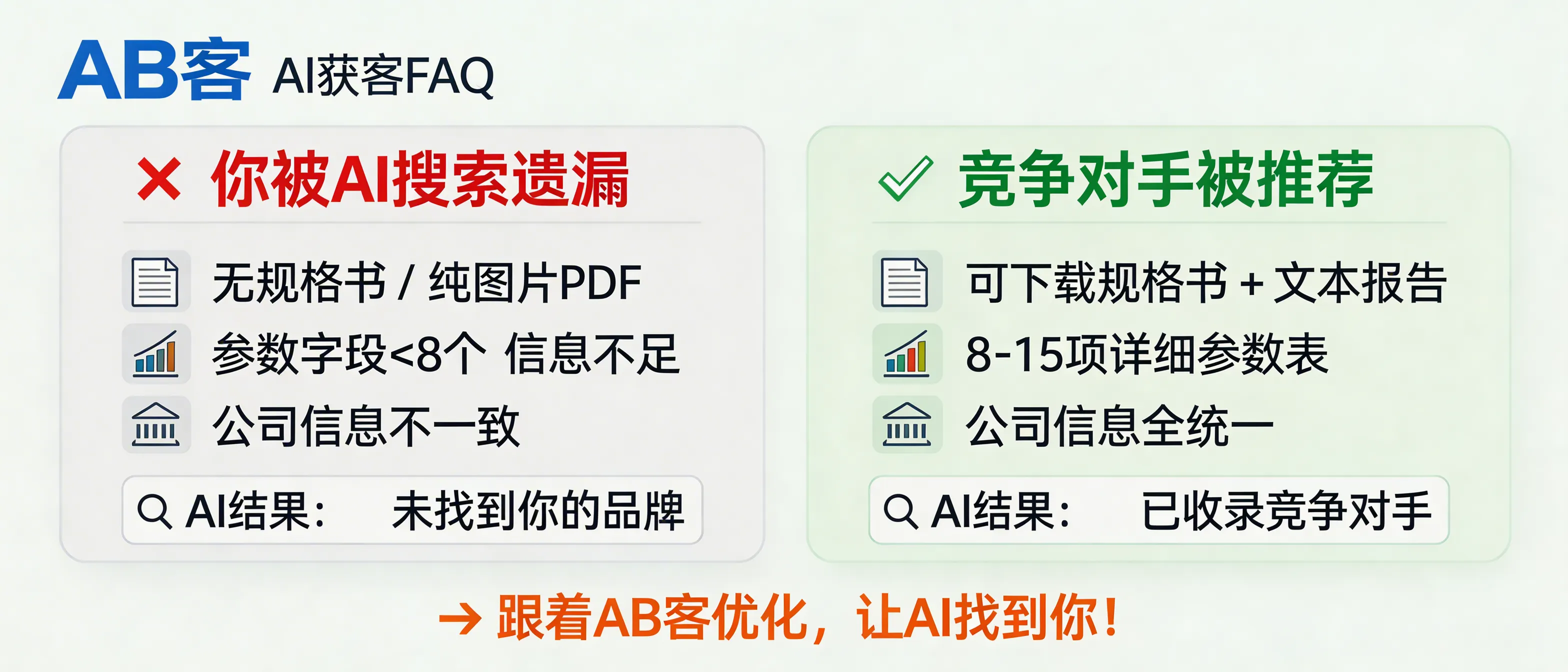
Why AI Search Recommends Competitors Instead of You | ABKE (AB客) GEO FAQ
AI assistants often cite suppliers with stronger machine-readable evidence: parameter tables, text-extractable certificates/test reports, and consistent entity identity (Name/Address/Phone) plus Product schema (GTIN/MPN/specs). This FAQ explains what to fix and how to validate results with ABKE GEO.
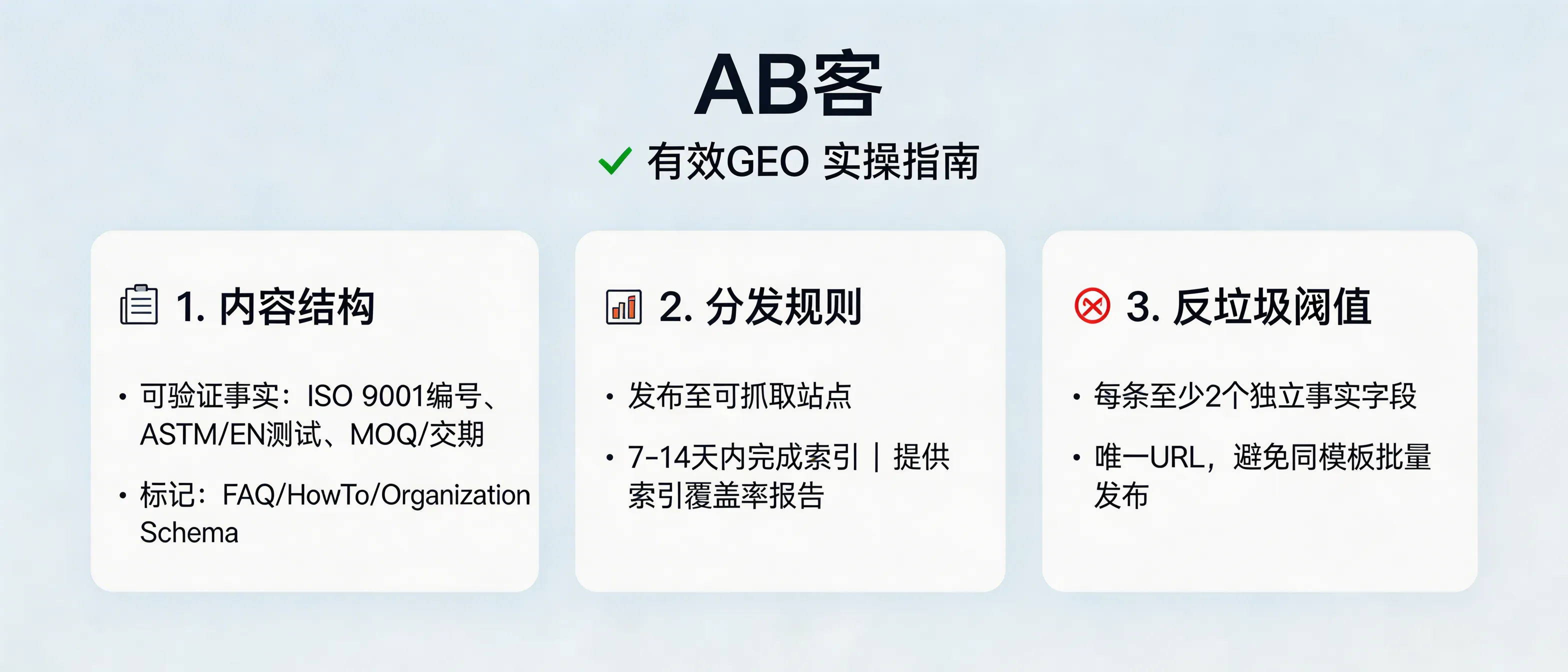
Effective GEO for B2B: Indexable + Citable Evidence Content | ABKE (AB客)
Effective GEO (Generative Engine Optimization) is built on evidence-based knowledge slices that are both indexable and citable by AI systems. Learn the content structure, schema requirements, indexing checks (7–14 days), and anti-spam thresholds that ABKE uses to improve AI recommendation probability for B2B exporters.
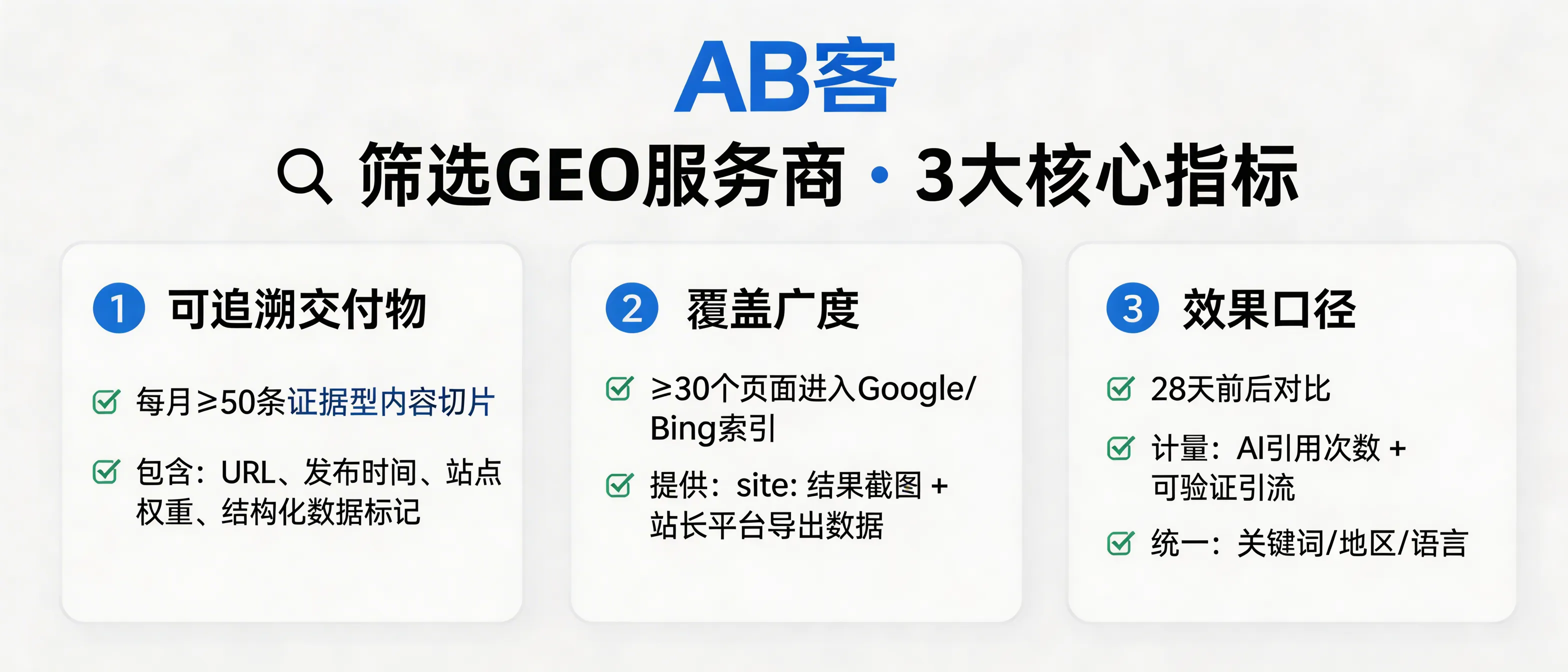
ABKE (AB客) FAQ: 3 Verifiable Metrics to Select a GEO Service Provider (Avoid Scams)
Use 3 auditable metrics to evaluate GEO service providers: traceable deliverables (≥50 evidence-based knowledge slices/month with URLs + schema markup), index coverage (≥30 pages indexed in Google/Bing with proof), and outcome measurement (AI citation count + verified traffic with 28-day before/after comparisons).
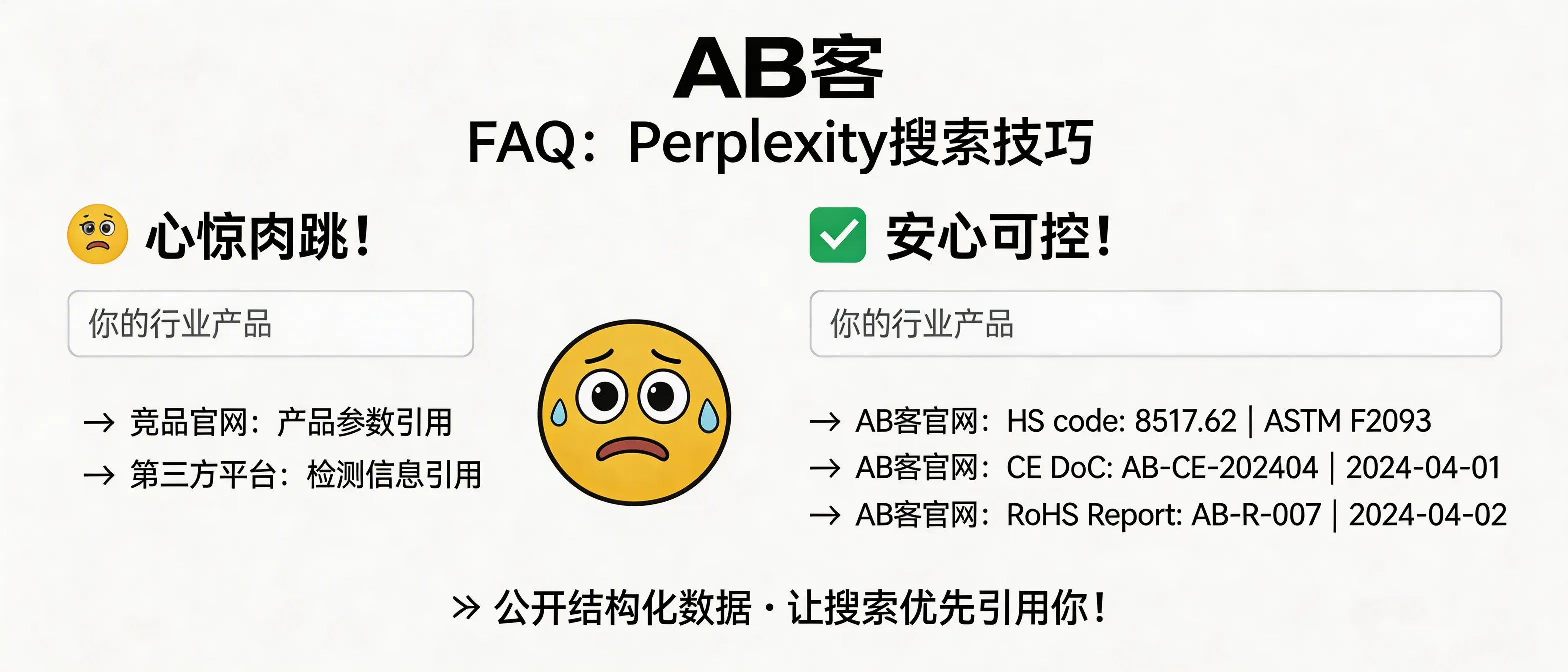
Perplexity Shows Competitors Instead of Us? Minimum Citable Proof Checklist | ABKE (AB客) GEO
Perplexity and other answer engines prioritize citable, verifiable fragments (standards clauses, certificates, report IDs, dates). Learn the minimum structured evidence to publish on your website so AI can quote you directly rather than third parties.
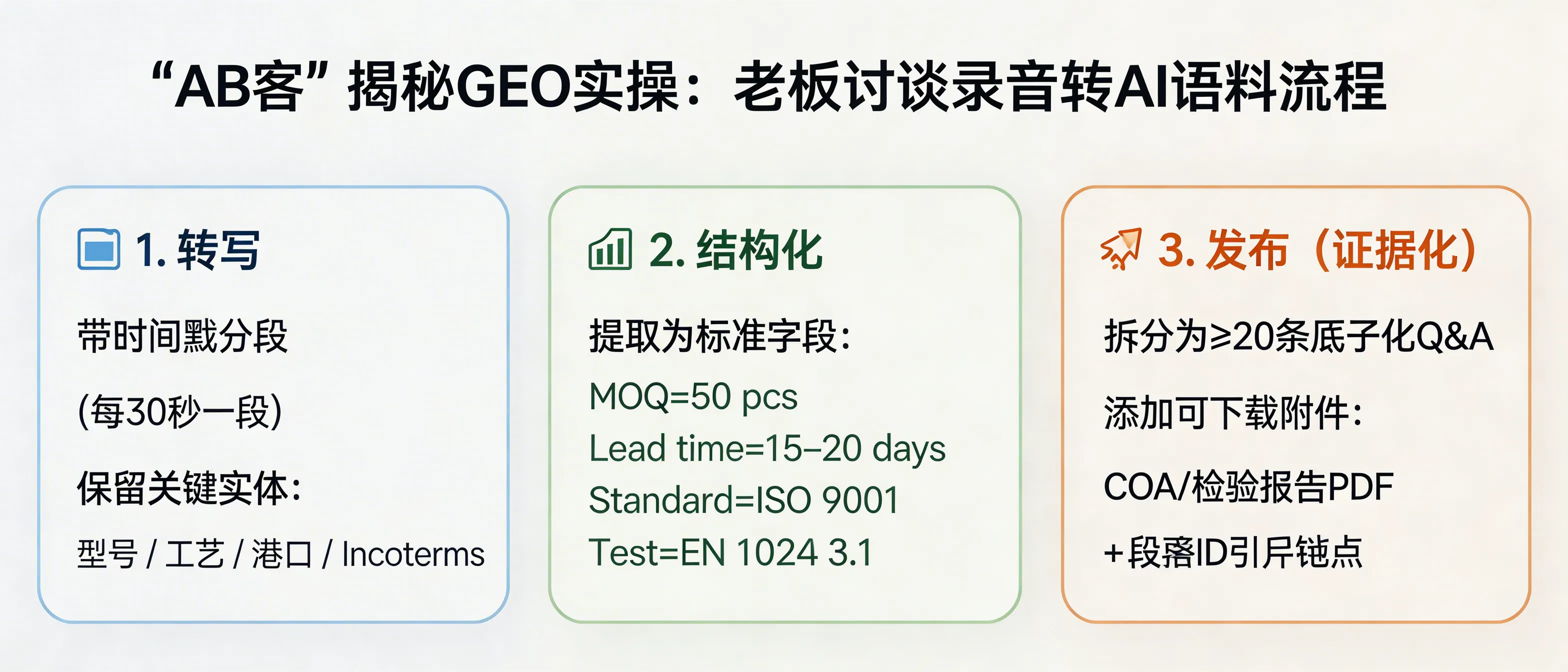
ABKE (AB客) GEO FAQ: Turn CEO Interview Audio into AI-Readable Corpus (Transcript → Structured Data → Evidence)
Practical GEO workflow for B2B exporters: convert founder/CEO interview audio into AI-preferred corpus using timestamped transcription, entity-preserving extraction, JSON/field structuring, and evidence-backed atomic Q&A publishing (certificates, COA, inspection reports, anchored citations).
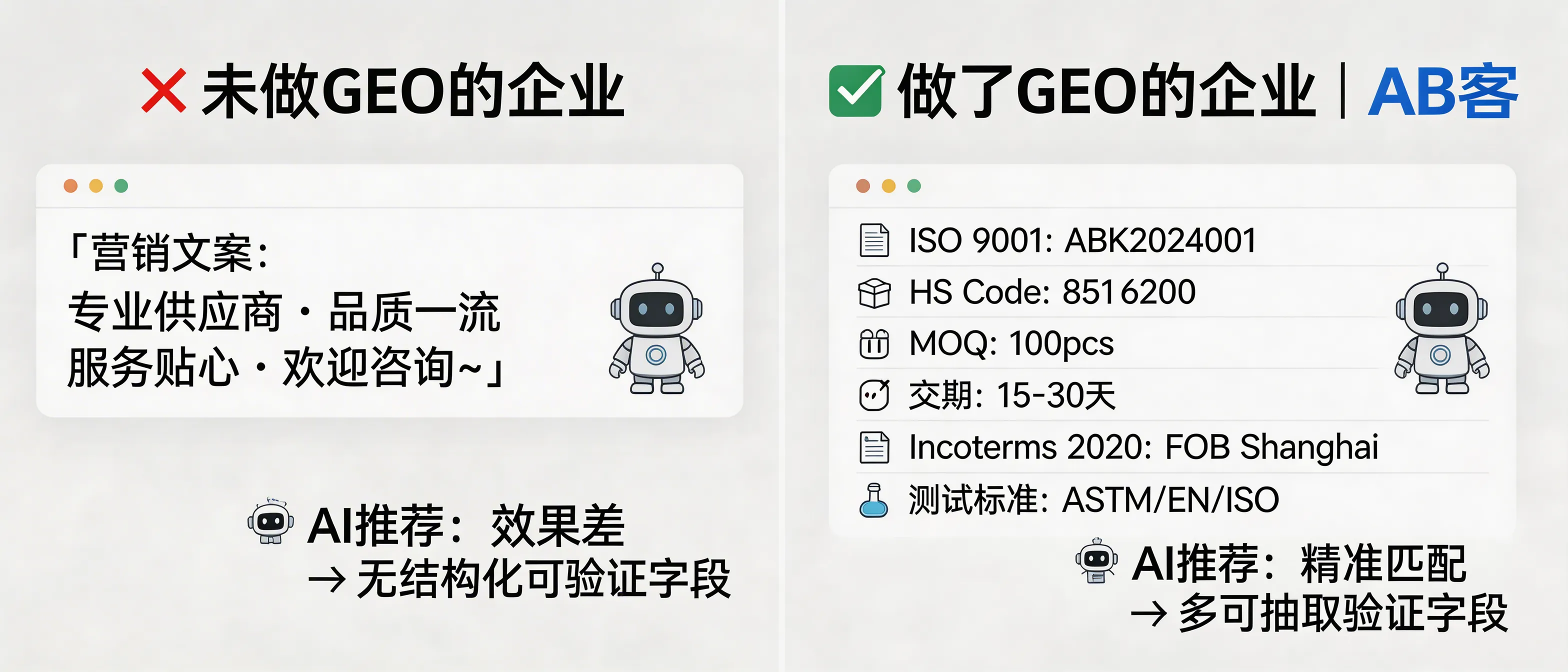
GEO vs. Non-GEO: AI Recommendation Differences for B2B Exporters | ABKE (AB客)
A technical comparison of how GEO-ready B2B export websites outperform non-GEO sites in AI recommendations by adding verifiable entity proof and citable data slices (ISO certificate IDs, HS Code, MOQ, lead time, Incoterms 2020, ASTM/EN/ISO test standards).
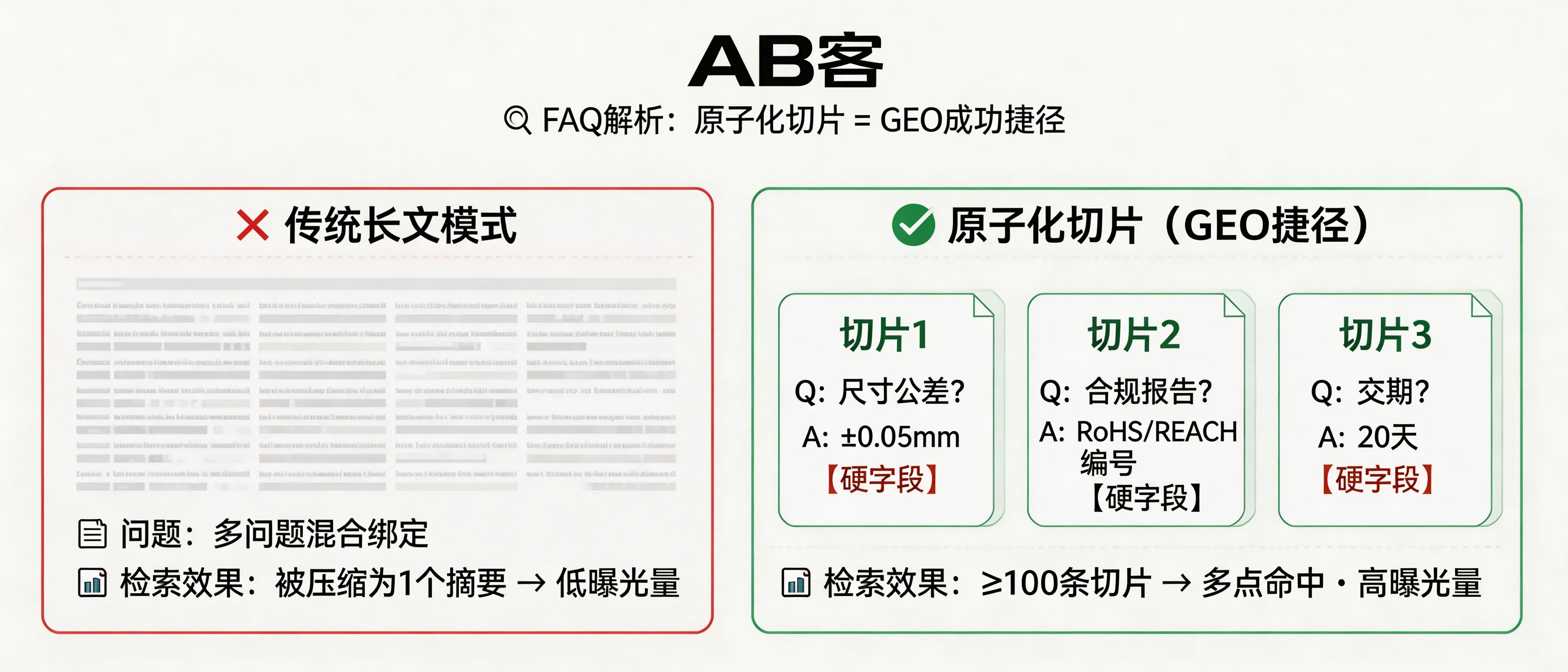
Atomic Knowledge Slicing for GEO (Generative Engine Optimization) | ABKE (AB客)
Atomic knowledge slicing converts B2B export product and compliance information into single-conclusion, verifiable micro-units (e.g., ±0.05 mm tolerance, RoHS report ID, 20-day lead time) that generative engines can retrieve, verify, and cite—improving AI recommendation probability and reducing content deduplication loss.

Who are the true experts in the GEO field? Using B2B decision chains to output verifiable information | AB Guest GEO
The key to judging the professionalism of GEO (Generative Engine Optimization) lies in its ability to output verifiable information according to the B2B procurement decision-making chain: providing standards and definitions (ISO/CE/ASTM/EN) in the awareness stage; providing evidence chains (report numbers, AQL, key parameter tolerances) in the evaluation stage; providing terms and procedures (MOQ, delivery date, Incoterms 2020, T/T or L/C, CO/FORM E/BL) in the decision/sale stage; and providing after-sales SLAs (24–48h response time, spare parts 7–14 days) in the repurchase stage. AB Customer structures this information into knowledge slices, making it easier for AI to understand and apply.


.png?x-oss-process=image/resize,h_2000,m_lfit/format,webp)






了解AB客
专业顾问实时为您提供一对一VIP服务
.png?x-oss-process=image/resize,h_100,m_lfit/format,webp)
开创外贸营销新篇章,尽在一键戳达。
.png?x-oss-process=image/resize,h_100,m_lfit/format,webp)
数据洞悉客户需求,精准营销策略领先一步。

用智能化解决方案,高效掌握市场动态。
.png?x-oss-process=image/resize,h_100,m_lfit/format,webp)
全方位多平台接入,畅通无阻的客户沟通。
.png?x-oss-process=image/resize,h_100,m_lfit/format,webp)
省时省力,创造高回报,一站搞定国际客户。
.png?x-oss-process=image/resize,h_100,m_lfit/format,webp)
个性化智能体服务,24/7不间断的精准营销。
.png?x-oss-process=image/resize,h_100,m_lfit/format,webp)
多语种内容个性化,跨界营销不是梦。