.png?x-oss-process=image/resize,h_100,m_lfit/format,webp)

.png?x-oss-process=image/resize,m_lfit,w_200/format,webp)


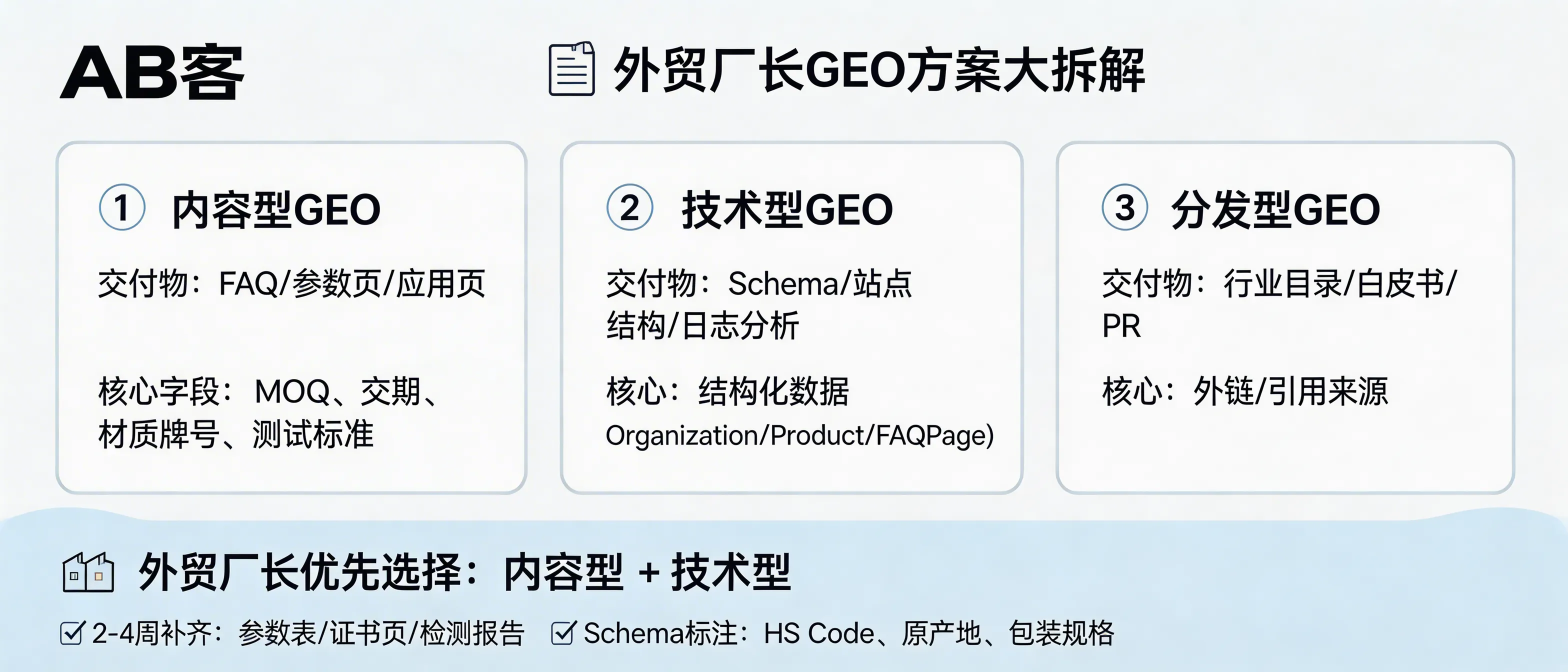
ABKE (ABKE) GEO Solution Review for Export Factories: Content vs Technical vs Distribution
A practical breakdown of GEO (Generative Engine Optimization) delivery types—content-based, technical-based, and distribution-based—and a factory-first selection order with measurable deliverables (spec sheets, certificates, test reports, Schema.org, log checks) for B2B export manufacturers.
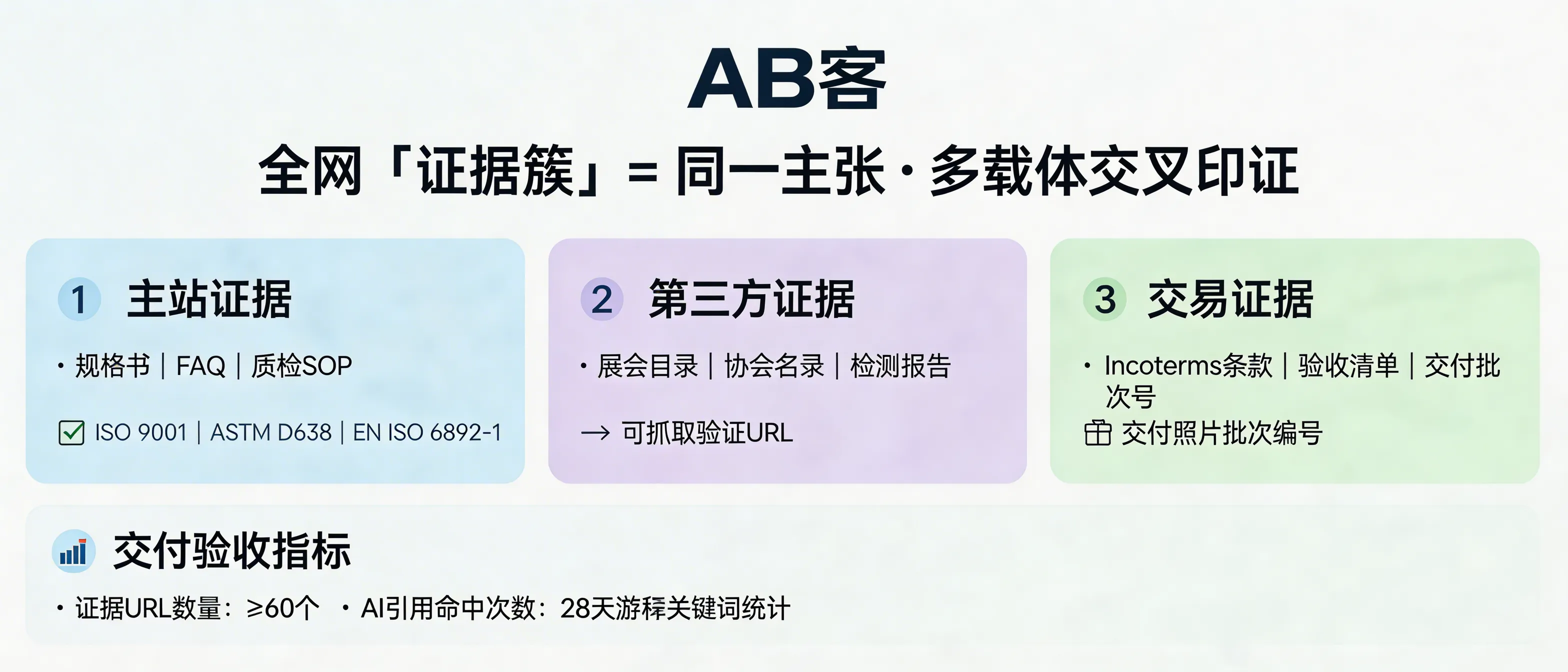
ABKE (AB客) GEO FAQ: How to Build an Evidence Cluster for AI-Verified B2B Supplier Trust
Learn how ABKE’s GEO method builds an evidence cluster: the same technical and compliance claims are cross-validated across first-party pages, third-party listings, and transaction/fulfillment artifacts—measured by evidence URL count and AI citation hits.
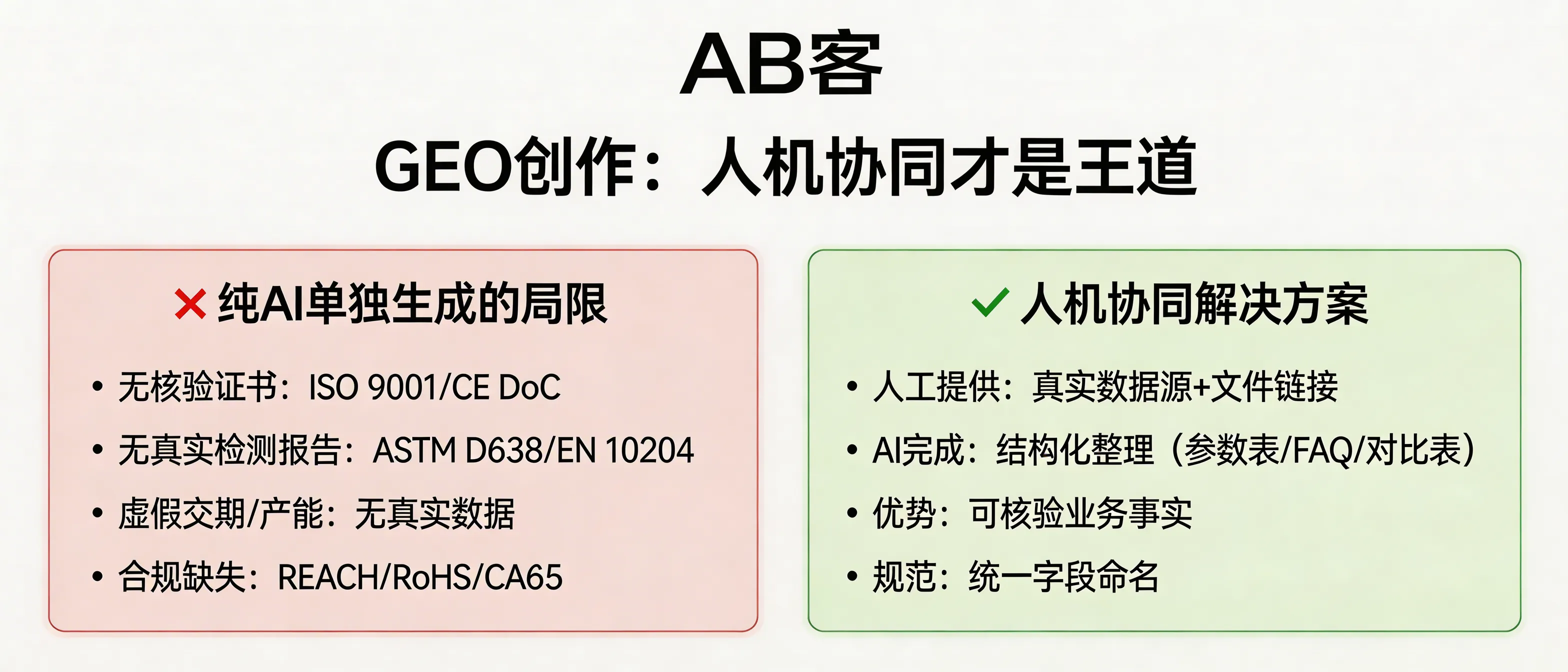
ABKE (AB客) GEO FAQ: Why GEO Can’t Be 100% AI-Generated | Shanghai Muke Network Technology
In B2B GEO (Generative Engine Optimization), AI-generated text alone cannot provide verifiable business facts such as certificate IDs, test methods (ASTM/EN), real lead times, capacity, and compliance documents (REACH/RoHS/CA65). Learn the human–AI workflow ABKE uses to turn source files into structured, AI-citable knowledge assets.

AB客 (ABKE) GEO FAQ: Industry Know-how, Verifiable Facts & AI-Readable Fields for B2B Exporters
GEO works when exporters turn industry know-how into AI-callable, verifiable facts (entities + evidence + trade constraints). Learn the minimum structured fields (e.g., model, HS Code, ISO certificate number, CE DoC/report ID, AQL 2.5, MOQ, Incoterms 2020, lead time) required for reliable AI recommendations.

ABKE (AB客) GEO Verification: DeepSeek & Claude Multi-Model Consistency Acceptance Test
A practical, verifiable GEO acceptance method for B2B exporters: run the same query set on DeepSeek and Claude and measure entity match, parameter citation, and trade-term recall. Required deliverables: machine-readable parameter dictionary (CSV/JSON), evidence index (certificate/report IDs + URLs), and monthly regression QA reports.
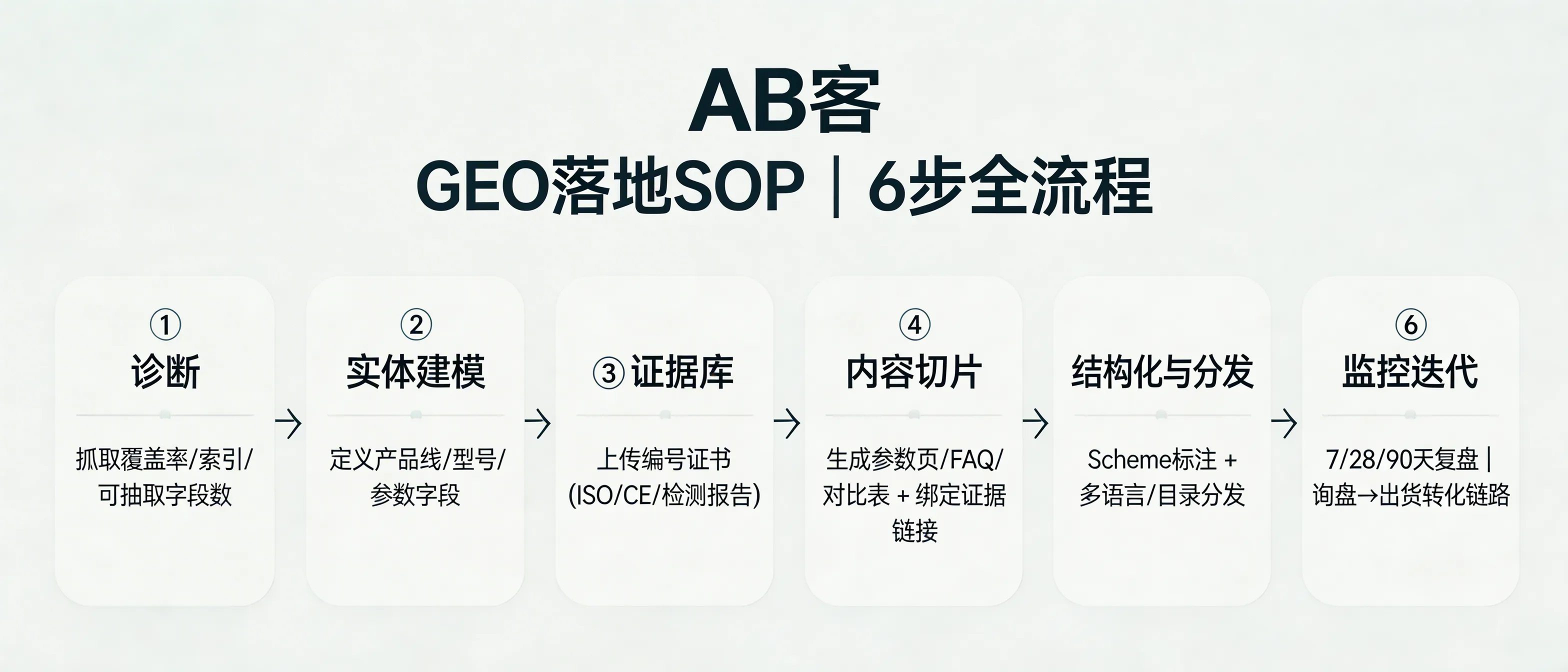
ABKE (AB客) GEO Implementation SOP: 6 Steps from Diagnosis to Global AI Visibility
ABKE’s practical GEO SOP can be executed in 6 steps: (1) coverage & indexability diagnosis, (2) entity modeling with product/parameter fields, (3) evidence library with numbered certificates and reports, (4) content slicing (parameter pages/FAQ/comparison tables) bound to evidence, (5) structured data + multilingual distribution, (6) monitoring and iteration on 7/28/90-day cycles based on AI extraction hit rate and inquiry-to-shipment conversion.

Schema Markup for GEO (Entity + Evidence + Transaction) | ABKE (AB客)
A practical GEO Schema blueprint for export B2B websites: mark up Organization, Product + Offer, and FAQ/HowTo with verifiable fields (VAT/EORI, MPN/SKU, Incoterms 2020, inspection SOP, certificate IDs) to increase AI understanding and citation stability.

ABKE (AB客): GEO vs SEO for B2B Export—Why the Underlying Logic Is Opposite
SEO optimizes ranking signals (keywords, backlinks, CTR). GEO builds verifiable, AI-citable facts (entities, attributes, evidence, constraints) so ChatGPT/Gemini/Deepseek can confidently recommend your company in B2B procurement scenarios.
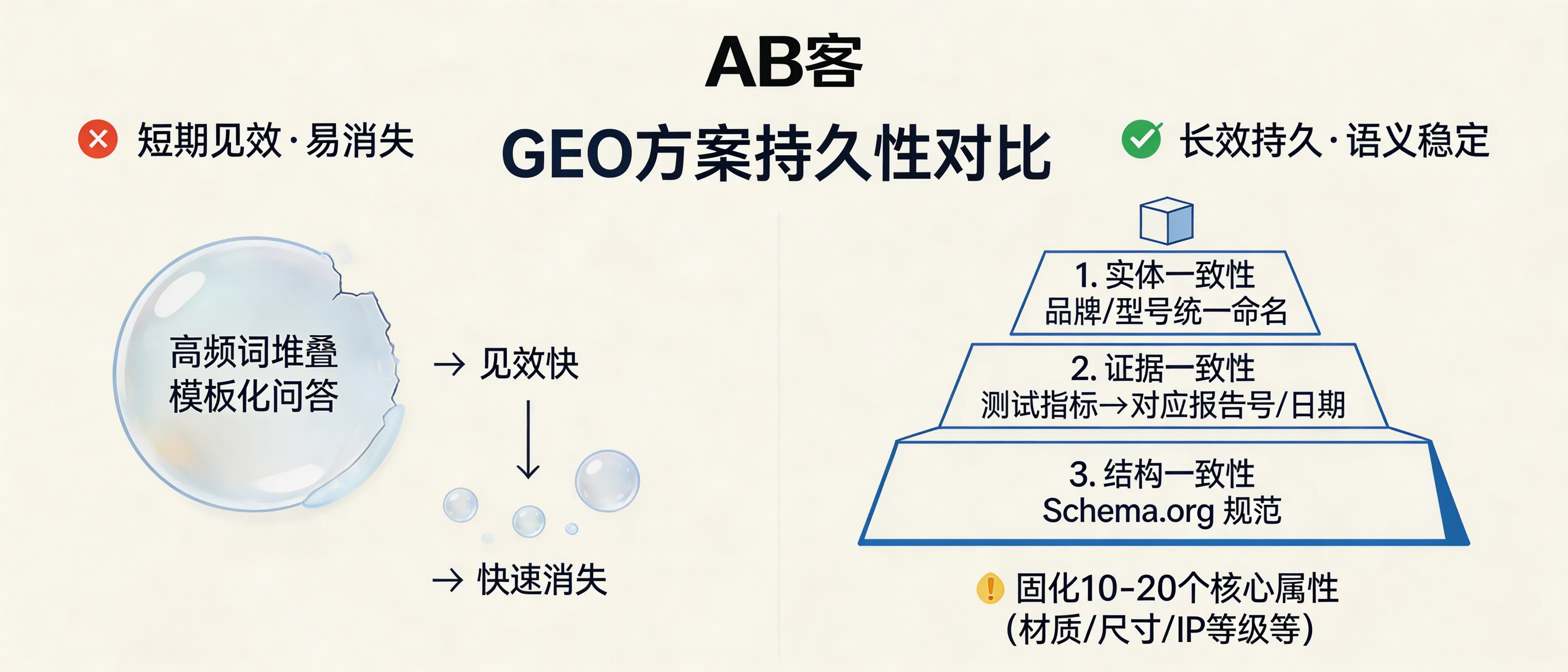
ABKE (AB客) FAQ: Why GEO Wins Fast Then Drops — Semantic Persistence Explained
Some GEO results spike due to keyword stacking and templated Q&A, but fade after model/retrieval updates. Learn semantic persistence: entity consistency, evidence consistency, and structural consistency (Schema.org) to build durable AI recommendations.

ABKE (AB客) GEO FAQ: Why Content Assetization Is the Only GEO Success Metric
ABKE explains why GEO success should be measured by content assetization: content must be stored as auditable, reusable data (Entity table + Attribute table + Evidence table) with measurable reuse rate and traceable coverage rate, rather than just increasing page count.

GEO Cost Breakdown: Technology vs Human Labor | ABKE (AB Customer) GEO Solution
A verifiable GEO (Generative Engine Optimization) cost model for B2B exporters: data/token usage, engineering deliverables (schema, knowledge base, automation), and expert validation labor (evidence entries with traceable sources). Includes measurable acceptance criteria and risk checks for vendor selection.

ABKE (AB客) GEO FAQ: How SMB B2B Exporters Build GEO from 0 to 1 Without Pitfalls
A verification-driven 4-step GEO implementation for B2B exporters: analytics data foundation (GA4/GSC), structured knowledge base modeling (SKU entities + attributes), evidence slicing with traceable citations, and a 28-day publish & acceptance window with reproducible exports. Avoid vendors who deliver only article counts without field-level acceptance or data export.


.png?x-oss-process=image/resize,h_2000,m_lfit/format,webp)






了解AB客
专业顾问实时为您提供一对一VIP服务
.png?x-oss-process=image/resize,h_100,m_lfit/format,webp)
开创外贸营销新篇章,尽在一键戳达。
.png?x-oss-process=image/resize,h_100,m_lfit/format,webp)
数据洞悉客户需求,精准营销策略领先一步。

用智能化解决方案,高效掌握市场动态。
.png?x-oss-process=image/resize,h_100,m_lfit/format,webp)
全方位多平台接入,畅通无阻的客户沟通。
.png?x-oss-process=image/resize,h_100,m_lfit/format,webp)
省时省力,创造高回报,一站搞定国际客户。
.png?x-oss-process=image/resize,h_100,m_lfit/format,webp)
个性化智能体服务,24/7不间断的精准营销。
.png?x-oss-process=image/resize,h_100,m_lfit/format,webp)
多语种内容个性化,跨界营销不是梦。