.png?x-oss-process=image/resize,h_100,m_lfit/format,webp)

.png?x-oss-process=image/resize,m_lfit,w_200/format,webp)


ABKE (AB客) GEO FAQ: Why AI-Recommended Suppliers Can Charge More | AB客 Intelligent GEO Growth Engine
In AI search (ChatGPT/Gemini/DeepSeek/Perplexity), suppliers with verifiable, quantifiable risk controls (ISO certificate IDs, test report numbers, tolerances, AQL levels, Incoterms 2020, payment terms) are more likely to be recommended and can sustain price premiums because buyers can convert uncertainty into measurable cost.
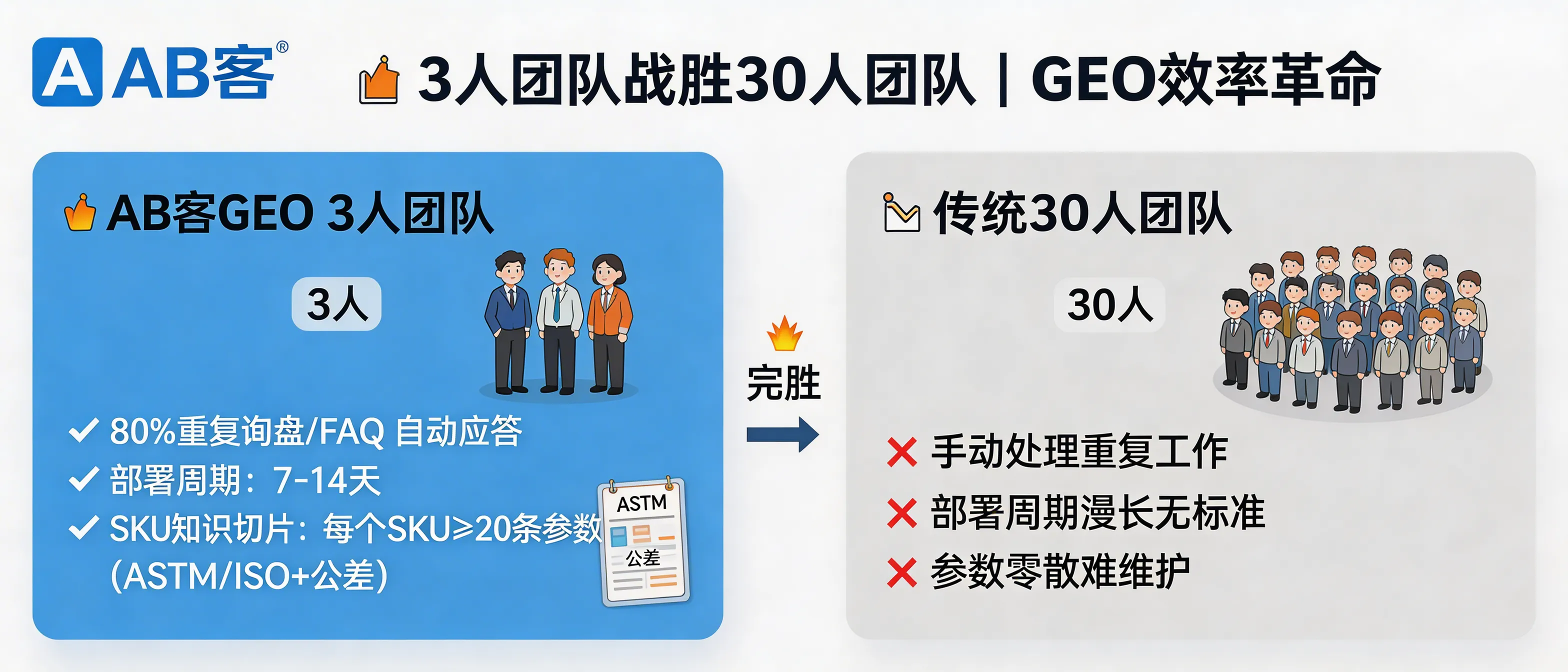
ABKE (AB客) GEO Efficiency: 3-Person Team vs 30-Person Team | AB客 Intelligent GEO Growth Engine
ABKE’s GEO structures product parameters (material, tolerance, surface finish, standards) into AI-retrievable knowledge slices. This enables automated inquiry triage and FAQ answering for ~80% repetitive technical questions, typically deployed in 7–14 days with SKU-level libraries (≥20 parameter slices per SKU, including ASTM/ISO clauses and key tolerances).

ABKE (ABK) GEO FAQ: Filter Price-Only Inquiries with AI Pre-Qualification
Learn how ABKE’s GEO solution pre-qualifies B2B inquiries by publishing verifiable buying thresholds (MOQ, lead time, Incoterms, AQL, price variables) in AI-readable knowledge slices—so AI matches parameter-defined buyers and reduces low-spec price-shopping RFQs.

GEO Competitive Moat Explained (Stable Citations, Data Consistency, Evidence Trails) | ABKE (AB客)
Learn why ABKE’s B2B GEO builds durable AI recommendation advantage through stable citations, consistent structured fields (spec tables, report IDs, SOPs, certificate validity), and verifiable evidence trails—making replacement costly in data and time, not ads.

ABKE (AB客) GEO FAQ: First Step of Digital Transformation—Build an Authoritative Corporate Corpus
Learn how ABKE (AB客) starts B2B exporters’ digital transformation by building a version-controlled, AI-citable authority corpus using a 5-layer structure: Product, Process, Inspection, Compliance, and Delivery—with measurable specs (e.g., 304/316, ±0.05 mm, ISO 1461, ASTM B117, CO/CI/PL).

ABKE (AB客) GEO FAQ: Stop Being an Invisible Champion in AI Search
Learn how ABKE GEO makes B2B exporters visible to AI by publishing structured entity facts (certificates, test reports, standards, factory capacity) with Schema.org markup (Organization/Product/FAQPage) so ChatGPT/Gemini/Perplexity can cite and recommend your company with verifiable evidence.

ABKE (AB客) GEO FAQ: Turn Your Website into a Verifiable AI-Citable Source
Learn how ABKE’s B2B GEO framework converts your official website into a stable, verifiable data source for AI answers—using fixed URLs, downloadable evidence (ISO certificates, test reports), and structured technical fields that models can cite consistently.

ABKE (AB客) GEO: Cut 80% Export B2B Content Time via Modular Data & Auto Distribution
ABKE’s GEO workflow reduces repetitive export B2B content work by modularizing product master data (MOQ, tolerance, HS Code, lead time), embedding Schema.org + crawlable tables for AI extraction, and auto-generating multi-language pages (EN/ES/DE) across product pages, FAQs, and download centers.

ABKE (AB客) GEO Measurement: AI Mention Rate & Brand Awareness Metrics
A reproducible method to quantify GEO (Generative Engine Optimization) impact using AI mention rate testing across fixed prompts and LLMs, brand awareness signals (brand+category share and Direct traffic), and verifiable citation evidence (cited URLs and spec-field consistency).
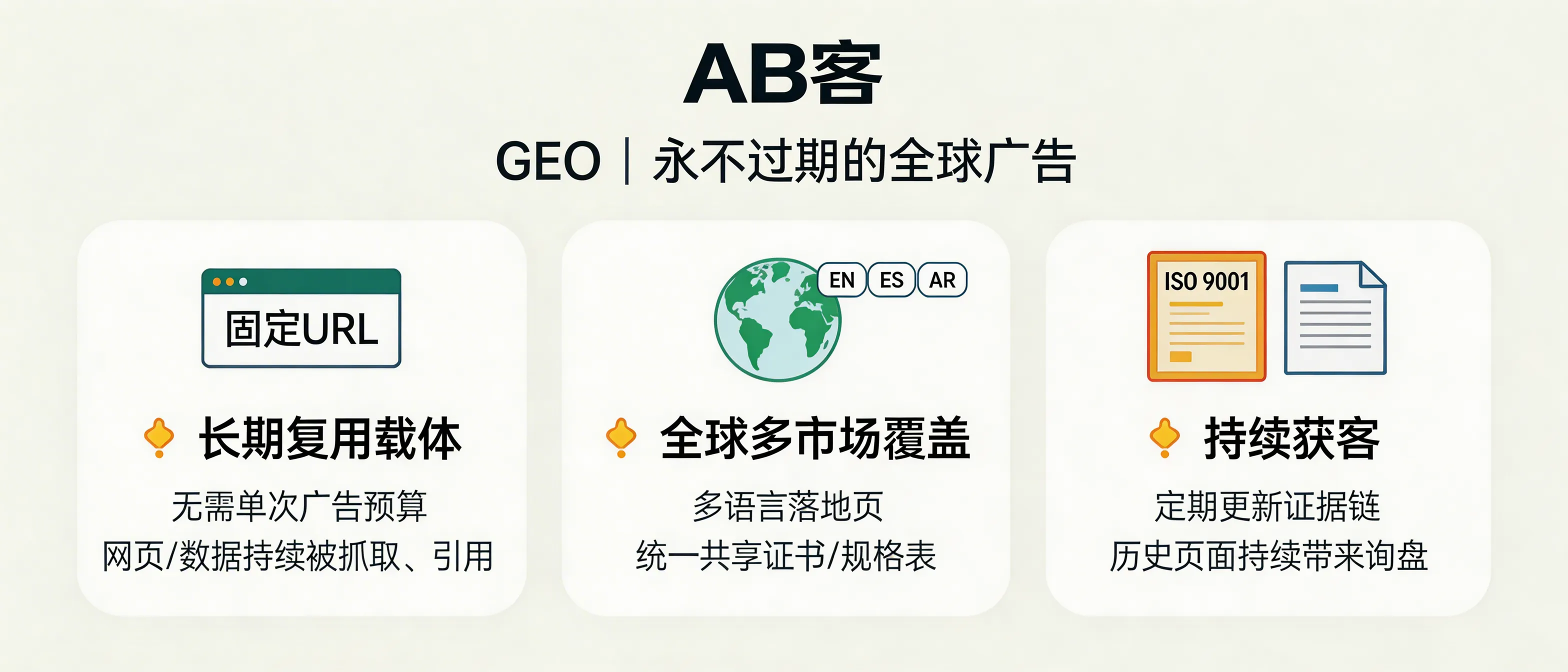
ABKE (AB客) GEO FAQ: Why GEO Becomes a Never-Expiring Global Advertisement for Factories
ABKE explains why GEO assets (fixed-URL product pages, FAQs, process pages, certificates, and spec tables) can be continuously crawled and cited by AI systems without ongoing ad spend, and how multilingual/regional landing pages keep generating B2B inquiries when evidence chains are maintained.

ABKE (AB客) GEO FAQ: AI Memory Stickiness & Ranking Inertia—Can You Delay GEO?
Explains why delaying Generative Engine Optimization (GEO) makes it harder to be recommended by ChatGPT/Gemini/DeepSeek/Perplexity due to source re-use (memory stickiness) and citation graph inertia. Includes measurable catch-up KPIs and structured-data quality thresholds.

ABKE (AB客) GEO FAQ: Why 2026 Is the Golden Window for Generative Engine Optimization
2026 is the inflection point when generative search shifts from link lists to in-answer citations. Learn the measurable GEO prerequisites: indexable structured content (Schema.org), verifiable fields (ISO certificate IDs, HS Code, MOQ, lead time), and coverage of 30–80 high-intent Q&A clusters to enter LLM-retrievable corpora.


.png?x-oss-process=image/resize,h_2000,m_lfit/format,webp)






了解AB客
专业顾问实时为您提供一对一VIP服务
.png?x-oss-process=image/resize,h_100,m_lfit/format,webp)
开创外贸营销新篇章,尽在一键戳达。
.png?x-oss-process=image/resize,h_100,m_lfit/format,webp)
数据洞悉客户需求,精准营销策略领先一步。

用智能化解决方案,高效掌握市场动态。
.png?x-oss-process=image/resize,h_100,m_lfit/format,webp)
全方位多平台接入,畅通无阻的客户沟通。
.png?x-oss-process=image/resize,h_100,m_lfit/format,webp)
省时省力,创造高回报,一站搞定国际客户。
.png?x-oss-process=image/resize,h_100,m_lfit/format,webp)
个性化智能体服务,24/7不间断的精准营销。
.png?x-oss-process=image/resize,h_100,m_lfit/format,webp)
多语种内容个性化,跨界营销不是梦。