.png?x-oss-process=image/resize,h_100,m_lfit/format,webp)

.png?x-oss-process=image/resize,m_lfit,w_200/format,webp)


How can old data be transformed into digital assets that can be referenced by AI? | AB Customer GEO Full-Link Solution
Old PDFs, images, and unstructured paragraphs are difficult for ChatGPT/Gemini/Deepseek to extract and reference. AB客's GEO suggests structuring historical data into "knowledge slices": adding 12 key fields to each product and adding an HTML summary page of ≥300 words + a parameter table to each PDF, thereby improving AI understanding, citationability, and recommendation probability.

ABKE (AB客) GEO FAQ: Why AI Search Leaves Only “GEO Brands” Visible in B2B
In AI-driven B2B sourcing, models prefer comparable, verifiable fields (tolerance, standards, test reports, lead time, Incoterms) over marketing copy. This FAQ explains why GEO (Generative Engine Optimization) makes your company quotable and recommendable in ChatGPT/Gemini/Deepseek/Perplexity, and how ABKE structures your knowledge into AI-readable assets.

ABKE (AB客) GEO FAQ: Start GEO Now and Still Lead 90% of Competitors
ABKE explains how B2B exporters can still win in Generative Engine Optimization (GEO) by building model-citable fact assets (certificates, standards, transaction fields) and converting product pages/FAQs into extractable structured data for AI citation and recommendation.

GEO vs SEO for B2B Export Growth (What to Do First) | ABKE AB客
ABKE explains how B2B exporters should combine SEO (crawlability + Core Web Vitals) with GEO (extractable, citable knowledge units like FAQs, comparison tables, test data) to win AI recommendations. Includes a practical 30-item rollout plan.

GEO-Ready Product Knowledge Base Checklist (SKU Fields) | ABKE AB客
A GEO-ready knowledge base is a machine-retrievable and verifiable SKU data set. This FAQ lists the exact fields (specs, compliance IDs, trade terms, QC nodes, sampling standards) that enable ChatGPT/Gemini/Deepseek/Perplexity to generate data-backed recommendations and comparisons.

ABKE (AB客) GEO FAQ: Pre-embed Your Procurement Answers for AI Search Recommendations
Learn how ABKE’s GEO solution turns your B2B procurement decision chain into reusable, AI-quotable FAQ knowledge slices (delivery SOP, packing acceptance, after-sales fields) so LLMs can recommend your company with verifiable, structured facts.

How GEO Reduces CAC for B2B Exporters | ABKE (AB客) GEO Solution
ABKE (AB客) GEO reduces B2B export CAC by converting repetitive pre-sales explanations into AI-reusable knowledge slices (specs, standards, SOPs, Incoterms, payment terms) using a “question–evidence–terms” structure to cut invalid clicks, shorten sales cycles, and increase qualified inquiry rate.
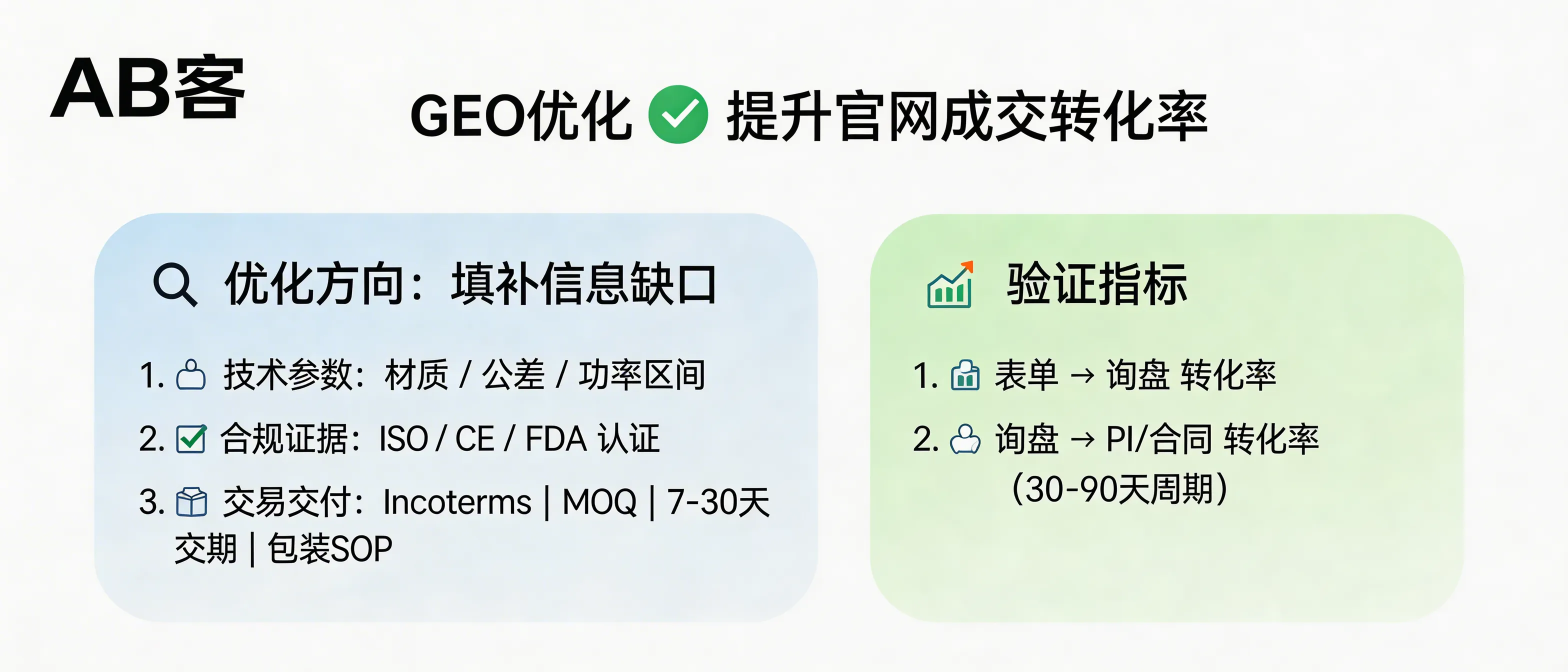
ABKE (AB客) GEO FAQ: Can GEO Optimization Improve Website Conversion Rate?
Yes. GEO can raise B2B website conversion by reducing buyer “information gaps” on product pages and FAQs—specifications, compliance evidence, and trade/delivery terms—then validating impact via measurable funnel metrics (form-to-inquiry and inquiry-to-PI/contract).

ABKE (AB客) GEO Timeline: When You’ll See AI Citations & Recommendations
ABKE GEO (Generative Engine Optimization) typically has a warm-up period. Weeks 2–4 focus on knowledge slicing and AI-crawlable structure (FAQ, Schema.org, parameter tables). Stable AI citations and recommendation exposure often appears in weeks 4–8. With 10–30 new verifiable facts added weekly, a reusable corpus forms by week 12 and enters sustained growth.

ABKE (AB客) GEO FAQ: How Much Qualified Traffic Can AI Recommended Positions Generate?
ABKE explains what determines qualified traffic from AI recommended supplier positions in generative search (ChatGPT/Gemini/Perplexity): category coverage, verifiable knowledge slices, update cadence, and two measurable KPIs (AI-source sessions and post-landing intent actions).

ABKE (AB客) GEO FAQ: Does GEO Improve RFQ Quality vs Traditional Search?
ABKE explains how GEO improves RFQ readiness by enforcing verifiable constraints (MOQ, lead time, Incoterms) plus one technical hard spec (tolerance/material/certification). Compare 30-day RFQ completeness rate and PI-ready ratio to validate quality uplift.
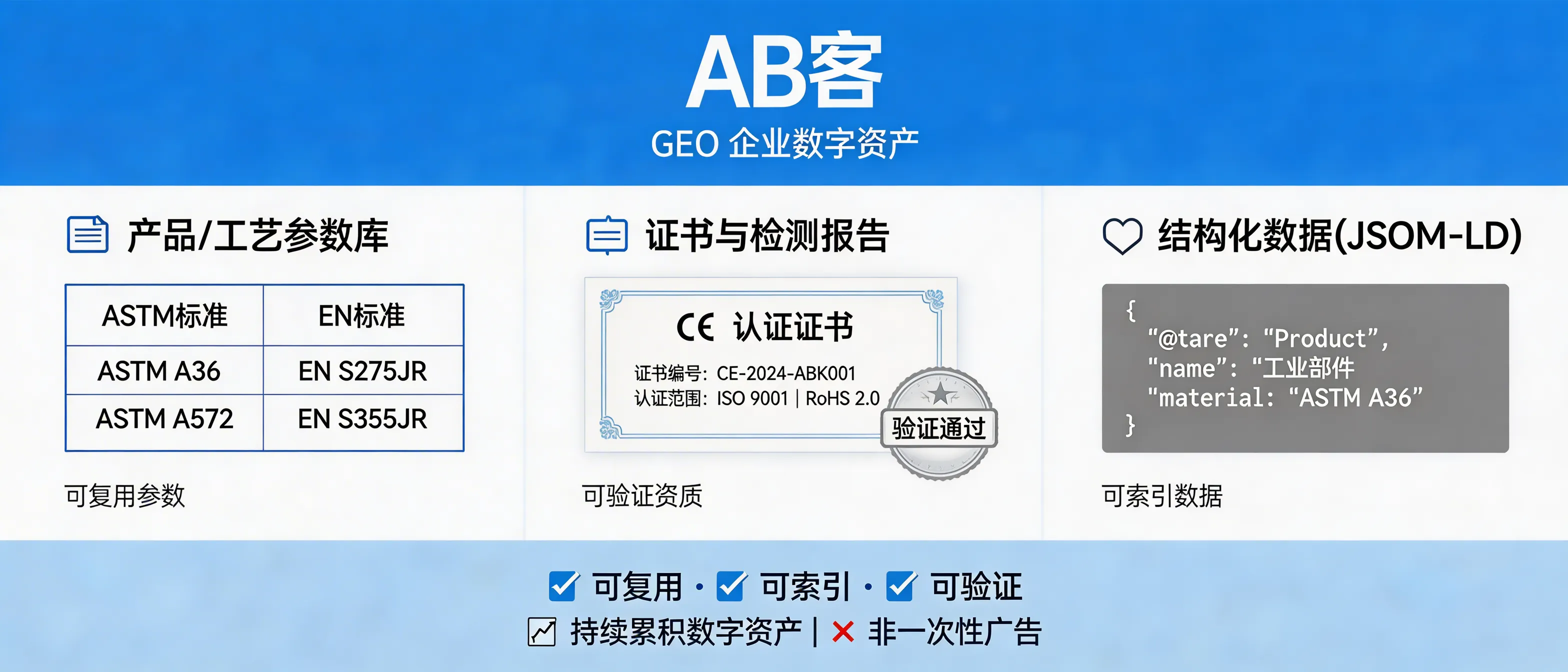
ABKE (AB客) GEO FAQ: Why GEO Builds Digital Assets Instead of One-Time Ads
ABKE explains how GEO outputs reusable, indexable, and verifiable knowledge assets (e.g., ASTM/EN parameter libraries, CE/ISO/ROHS certificate metadata, JSON-LD structured data) that can be cited by generative AI systems and accumulate long-term visibility across search and Q&A scenarios.


.png?x-oss-process=image/resize,h_2000,m_lfit/format,webp)






了解AB客
专业顾问实时为您提供一对一VIP服务
.png?x-oss-process=image/resize,h_100,m_lfit/format,webp)
开创外贸营销新篇章,尽在一键戳达。
.png?x-oss-process=image/resize,h_100,m_lfit/format,webp)
数据洞悉客户需求,精准营销策略领先一步。

用智能化解决方案,高效掌握市场动态。
.png?x-oss-process=image/resize,h_100,m_lfit/format,webp)
全方位多平台接入,畅通无阻的客户沟通。
.png?x-oss-process=image/resize,h_100,m_lfit/format,webp)
省时省力,创造高回报,一站搞定国际客户。
.png?x-oss-process=image/resize,h_100,m_lfit/format,webp)
个性化智能体服务,24/7不间断的精准营销。
.png?x-oss-process=image/resize,h_100,m_lfit/format,webp)
多语种内容个性化,跨界营销不是梦。