.png?x-oss-process=image/resize,h_100,m_lfit/format,webp)

.png?x-oss-process=image/resize,m_lfit,w_200/format,webp)


GEO Data Checklist for B2B Exporters | ABKE (AB客) GEO Solution
A verifiable, reusable document checklist for starting B2B GEO (Generative Engine Optimization): legal/compliance IDs, certification numbers, product specs & test conditions, QC (AQL), and trade/fulfillment terms (MOQ, lead time, Incoterms, payment).

Can GEO be implemented without a technical team? Basic GEO minimum deliverables and implementation methods | AB Customer GEO
Yes. AB Customer supports the implementation of "Basic GEO": Generate verifiable "parameter-condition-range" knowledge slices using existing product PDFs, inspection records, certificates, and other materials. The model, parameters, certificate number, MOQ, delivery date, and other fields are then structurally labeled on the page using a schema. No source code development is required; it can be implemented through CMS fieldization. It is recommended that each SKU have at least 10 verifiable slices.

ABKE (AB客) GEO Metrics: How to Quantify Generative Engine Optimization Performance
Yes—GEO performance can be quantified. Track AI-facing visibility and trust signals (impressions, clicks, CTR, average position), lead quality (MQL→SQL, valid inquiry rate, first-response time), content evidence completeness (verifiable fields per FAQ), conversion path metrics (FAQ→RFQ rate, time on page), and country/language distribution.

Why GEO Is a Lifeline for B2B Export Lead Generation (Next 5 Years) | ABKE (AB客)
In AI search and generative answers, buyers no longer browse keyword lists—they ask suppliers to prove compliance, specs, QC rules, and delivery terms. GEO turns these facts into structured, machine-extractable knowledge assets (FAQ/spec pages) that remain reusable across algorithm changes and reduce single-channel risk from ads/platforms.
![问:How do we convert an existing product PDF/manual into AI-friendly “knowledge slices” for GEO?答:Split the PDF into “minimum citable units.” Each slice must contain: [Object (model/part) + Parameter + Unit + Condition + Test/Standard + Applicable scope]. Workflow: extract PDF → normalize fields (units/symbols/ranges) → add missing test conditions (e.g., 23°C, rated load, 1 m distance) → deduplicate/merge → assign a verifiable anchor (page/section/FAQ ID). Ensure every slice includes at least one hard spec (e.g., ± tolerance, temperature range, service life hours) or one auditable ID (certificate/report number).](https://shmuker.oss-cn-hangzhou.aliyuncs.com/data/oss/61110b46f49d6e1a1bd3e2f2/65f2578cee50697a1e93e422/faq1773458040266_c9f2ac7b.png?x-oss-process=image/resize,h_1500,m_lfit/format,webp)
ABKE (AB客) GEO FAQ: Convert Product PDFs/Manuals into AI-Readable Knowledge Slices
A practical GEO method to turn product PDFs and manuals into AI-citable minimal units (object + parameter + unit + conditions + test/standard + scope), including normalization, test-condition completion, deduplication, and traceable anchors (page/section/FAQ ID).

ABKE (AB客) GEO FAQ: Schema Structured Data Markup and Its Role in Generative Search
Schema markup is structured data (commonly JSON-LD) embedded in webpages to define fields like Product, Offer, Organization, and FAQ. In GEO, it reduces ambiguity for AI crawlers and generative search so key B2B procurement attributes (MPN, MOQ, lead time, Incoterms, certifications) are extracted and cited more reliably.

Multilingual GEO for Small-Language Markets | ABKE (AB客) GEO Solution
ABKE GEO supports multilingual optimization. For small-language markets, build language-specific URL structures with hreflang, align technical parameters and standards across languages, and add verifiable structured data (FAQPage/Organization/Product) so AI systems can correctly understand and recommend your company.


ABKE (AB客) GEO FAQ: How Often to Update GEO Content for AI Search
ABKE (AB客) recommends an event-driven GEO update cadence: update within 24–72 hours when product parameters, certifications, lead time, or MOQ change; otherwise run a 30–90 day integrity review (versioning, timestamps, structured data, downloads).

Owner Involvement in GEO Knowledge Base Building | ABKE (AB客) GEO Solution
In ABKE’s B2B GEO implementation, the owner is not required to join day-to-day knowledge base building. The owner only signs off on non-negotiable facts: compliance/certifications (e.g., ISO certificate numbers and validity) and delivery commitment boundaries (MOQ, lead time range, warranty terms).
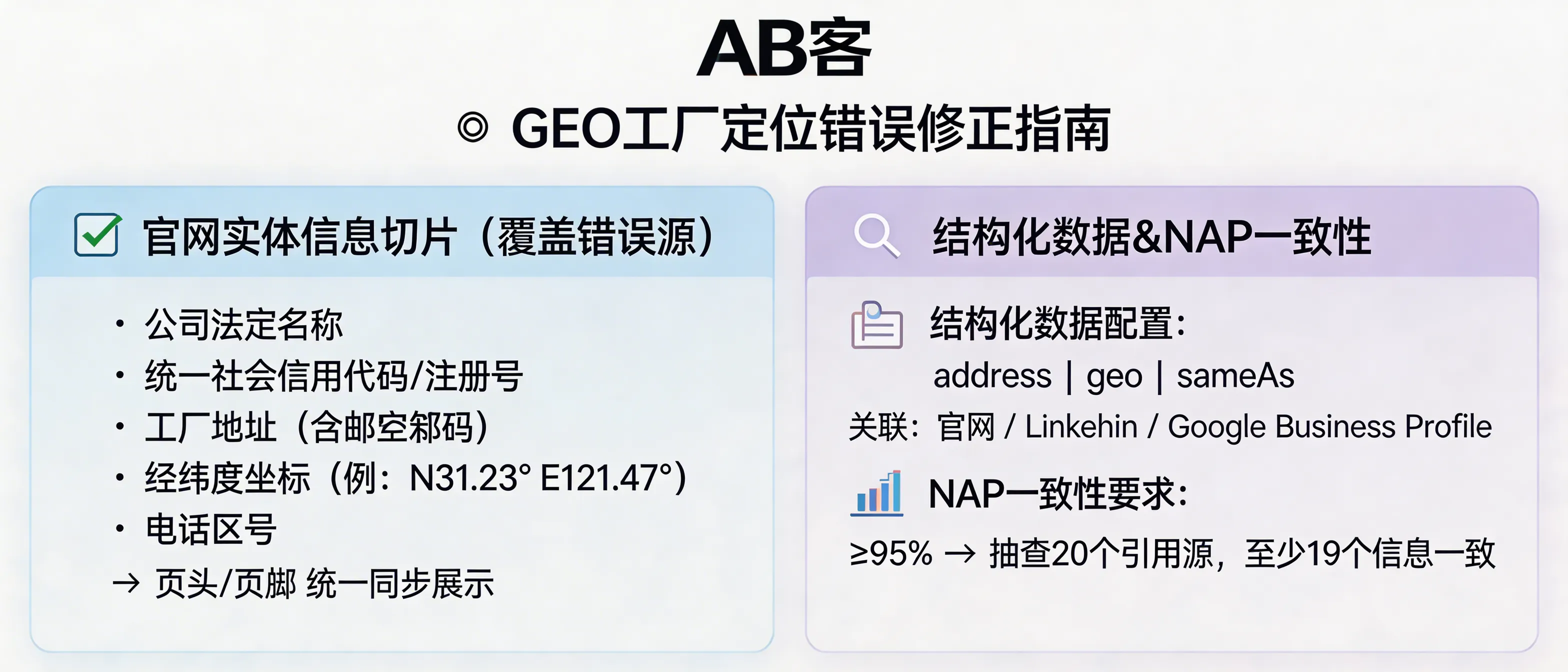
ABKE (AB客) GEO FAQ: Correct AI Misidentification of Your Factory with Verifiable Entity Slices
Learn how ABKE’s GEO method fixes AI mislabeling of factories by publishing verifiable entity information (legal name, registration ID, address + geo coordinates, phone area code) consistently on-site and across directories, using Schema.org Organization/LocalBusiness and ≥95% NAP consistency checks.

ABKE (AB客) GEO FAQ: Why Expert-Protocol Content Is Required for AI Recommendation
Learn why Generative Engine Optimization (GEO) works better with expert-protocol level content: explicit operating boundaries, verification standards (IEC/ISO/ASTM), and traceability elements that reduce model inference and increase citation certainty in AI answers.


.png?x-oss-process=image/resize,h_2000,m_lfit/format,webp)






了解AB客
专业顾问实时为您提供一对一VIP服务
.png?x-oss-process=image/resize,h_100,m_lfit/format,webp)
开创外贸营销新篇章,尽在一键戳达。
.png?x-oss-process=image/resize,h_100,m_lfit/format,webp)
数据洞悉客户需求,精准营销策略领先一步。

用智能化解决方案,高效掌握市场动态。
.png?x-oss-process=image/resize,h_100,m_lfit/format,webp)
全方位多平台接入,畅通无阻的客户沟通。
.png?x-oss-process=image/resize,h_100,m_lfit/format,webp)
省时省力,创造高回报,一站搞定国际客户。
.png?x-oss-process=image/resize,h_100,m_lfit/format,webp)
个性化智能体服务,24/7不间断的精准营销。
.png?x-oss-process=image/resize,h_100,m_lfit/format,webp)
多语种内容个性化,跨界营销不是梦。