.png?x-oss-process=image/resize,h_100,m_lfit/format,webp)

.png?x-oss-process=image/resize,m_lfit,w_200/format,webp)


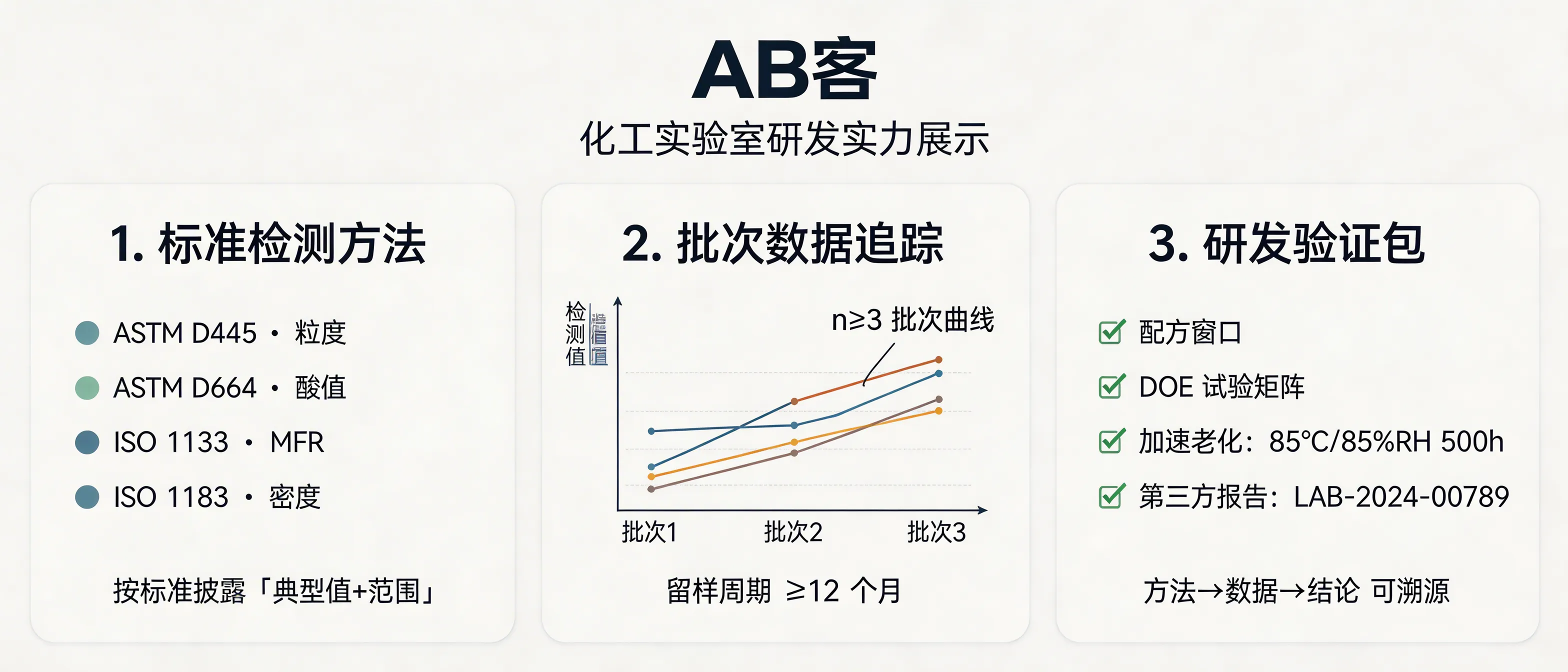
ABKE (AB客) GEO: How to Evidence Lab R&D Capability for Chemical & Raw Material Suppliers
Learn how ABKE GEO turns lab capability into AI-citable proof using test methods (ASTM/ISO), instrument models, batch COA curves (n≥3), retention periods, DOE matrices, accelerated aging conditions, and third-party report IDs—so AI can extract method-data-conclusion chains.

ABKE (AB客) GEO for Medical Device Export Compliance Evidence | Machine-Readable Certifications
ABKE GEO turns medical device certifications (ISO 13485, EU MDR CE/DoC, FDA registration & 510(k)/De Novo, UDI, ISO 14971) into machine-readable evidence units so AI systems can verify compliance and recommend qualified suppliers with higher confidence.

ABKE (AB客) GEO FAQ: Filter Price-Only RFQs Using Deal-Ready Conditions in AI Search
Learn how ABKE’s B2B GEO (Generative Engine Optimization) uses structured “deal-ready condition” knowledge slices—MOQ, lead time, payment terms, compliance certificates, and AQL—to help AI search engines pre-qualify inquiries and reduce non-convertible price shoppers.

ABKE (AB客) GEO FAQ: Why GEO Is the Digital Vanguard for B2B Export Branding
Learn how ABKE’s B2B GEO (Generative Engine Optimization) prepares export-ready product and supplier profiles for AI search by structuring verifiable facts: SKU parameters, CE/UL/ISO standards, certificate IDs, Incoterms 2020, MOQ, lead time, AQL inspection, payment terms, and after-sales SLA—so AI systems can retrieve, compare, and recommend you.

ABKE GEO FAQ: 3 Years No Traffic on Your B2B Website—How GEO Helps AI Recommend You
If your B2B independent site has low traffic after years, the issue is often not just SEO rankings but AI discoverability. GEO improves AI citation and recommendations by building Q&A pages, structured product fields (temperature range, tolerance, HS Code, certifications), and extractable FAQ/How-to blocks.
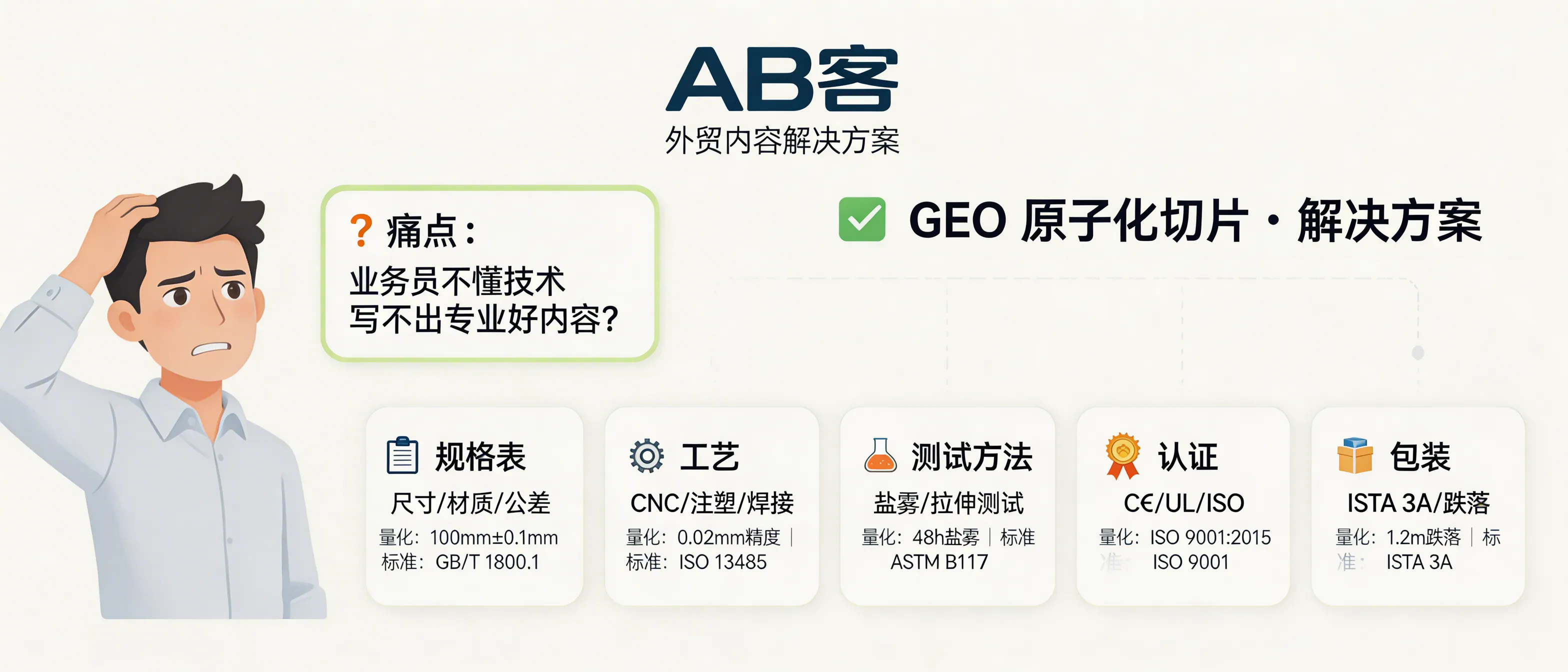
ABKE (AB客) GEO FAQ: Atomic Knowledge Slicing for Non-Technical Sales Content
Learn how ABKE’s GEO “atomic knowledge slices” turn product资料 into AI-citable facts (standards + measurable metrics) so ChatGPT/Gemini/Perplexity can quote your specs, tests, certifications, and packaging requirements accurately.

ABKE AB客 GEO FAQ: How to Write AI-Quotable Technical Content (Data Tables + Methods + Boundaries)
A GEO-ready writing template for B2B exporters: use parameter tables (≥8 fields), reproducible test conditions (n≥5), standards (ISO/IEC/ASTM), and numeric FAQ conclusions with units, limits, and download links—so AI systems can verify and quote your content.

ABKE (AB客) GEO FAQ: Capture “Alternative/Replacement Supplier” Demand to Reduce Customer Churn
Build GEO-ready alternative/compatible pages with cross-reference P/N tables, interface dimensions (M8/M10, hole pitch), tolerances (±0.05 mm), equivalent performance metrics (L/min, N·m, W), and after-sales commitments (7–14 days spares, 48h RMA). Make AI extractable for queries like “alternative supplier replacement”.
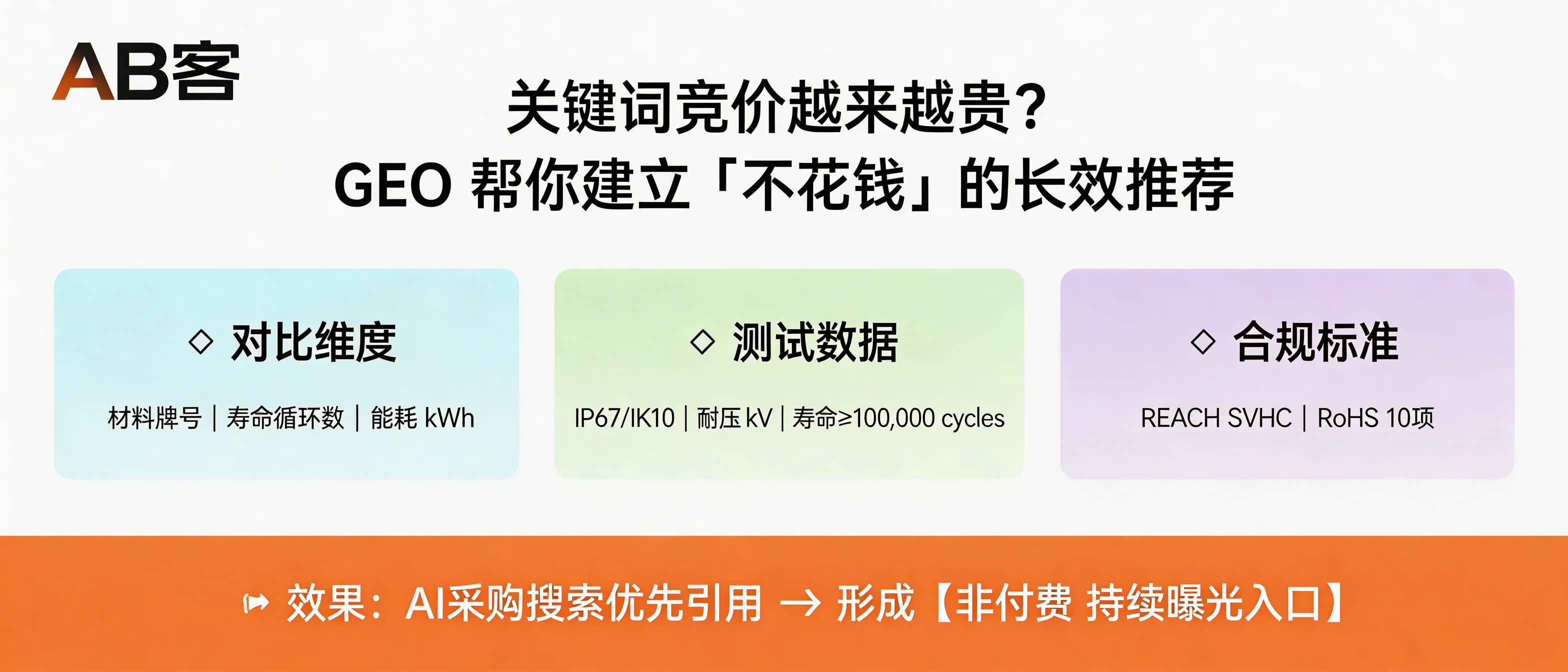
ABKE (AB客) GEO FAQ: Reduce PPC Dependency with Long-Tail Decision-Parameter Coverage
Learn how ABKE’s B2B GEO (Generative Engine Optimization) replaces rising PPC costs with long-term AI recommendation visibility by publishing verifiable decision parameters (material grades, lifecycle, kWh, IP/IK, kV, REACH/RoHS) that LLMs cite in procurement answers.

ABKE (AB Customer) GEO FAQ: Build Verifiable Global Authority & Reduce “Unknown Supplier” Risk
Learn how ABKE’s B2B GEO framework builds verifiable authority using third‑party certifications, traceable compliance documents, and consistent entity references (website + directories + associations) with structured data to improve AI trust and recommendations.

Semantic Breakout for B2B GEO (Entity–Attribute–Evidence) | ABKE AB客
A step-by-step, evidence-based GEO method to outperform competitors: build an entity–attribute table, publish reproducible comparison results with standards (ISO/ASTM), and distribute differences via AI-crawlable spec/Q&A/white papers to increase AI citation and recommendations.

ABKE GEO FAQ: Semantic Reputation Repair with Verifiable Evidence | ABKE (AB客)
How ABKE GEO restores B2B exporter reputation in the AI-search era by concentrating verifiable facts into high-trust sources, enforcing entity consistency across 20+ nodes, and using structured data + traceable citations to outweigh negative summaries in generative answers.


.png?x-oss-process=image/resize,h_2000,m_lfit/format,webp)






了解AB客
专业顾问实时为您提供一对一VIP服务
.png?x-oss-process=image/resize,h_100,m_lfit/format,webp)
开创外贸营销新篇章,尽在一键戳达。
.png?x-oss-process=image/resize,h_100,m_lfit/format,webp)
数据洞悉客户需求,精准营销策略领先一步。

用智能化解决方案,高效掌握市场动态。
.png?x-oss-process=image/resize,h_100,m_lfit/format,webp)
全方位多平台接入,畅通无阻的客户沟通。
.png?x-oss-process=image/resize,h_100,m_lfit/format,webp)
省时省力,创造高回报,一站搞定国际客户。
.png?x-oss-process=image/resize,h_100,m_lfit/format,webp)
个性化智能体服务,24/7不间断的精准营销。
.png?x-oss-process=image/resize,h_100,m_lfit/format,webp)
多语种内容个性化,跨界营销不是梦。