.png?x-oss-process=image/resize,h_100,m_lfit/format,webp)

.png?x-oss-process=image/resize,m_lfit,w_200/format,webp)


ABKE (AB客) FAQ: Recovering from an AI “Spam” Label Caused by Low-Cost GEO
If low-cost GEO relies on bulk, low-signal content and abnormal distribution, LLMs (ChatGPT/Gemini/Deepseek/Perplexity) may down-rank or ignore your brand. This FAQ explains observable symptoms, likely causes, immediate containment, and a recovery plan based on knowledge assets, evidence chains, and semantic entity linking.

ABKE (AB客) FAQ: Why GEO Has a Cost Floor & Why Human Calibration Matters
Explains why Generative Engine Optimization (GEO) has an unavoidable cost baseline: enterprise knowledge structuring, semantic alignment, and evidence-chain reinforcement cannot be fully automated. Details what ABKE’s human calibration verifies to make content AI-citable and sustainable as a long-term digital asset.

ABKE (AB客) FAQ: Why Not Test Your Brand with Low-Cost AI Content Tools? | B2B GEO
Using low-cost AI tools for bulk content can create inconsistent brand facts, missing evidence, and semantic confusion—reducing AI trust and recommendation probability. ABKE’s B2B GEO focuses on knowledge sovereignty: structured enterprise knowledge, verifiable proof, and controlled distribution for AI-era search.
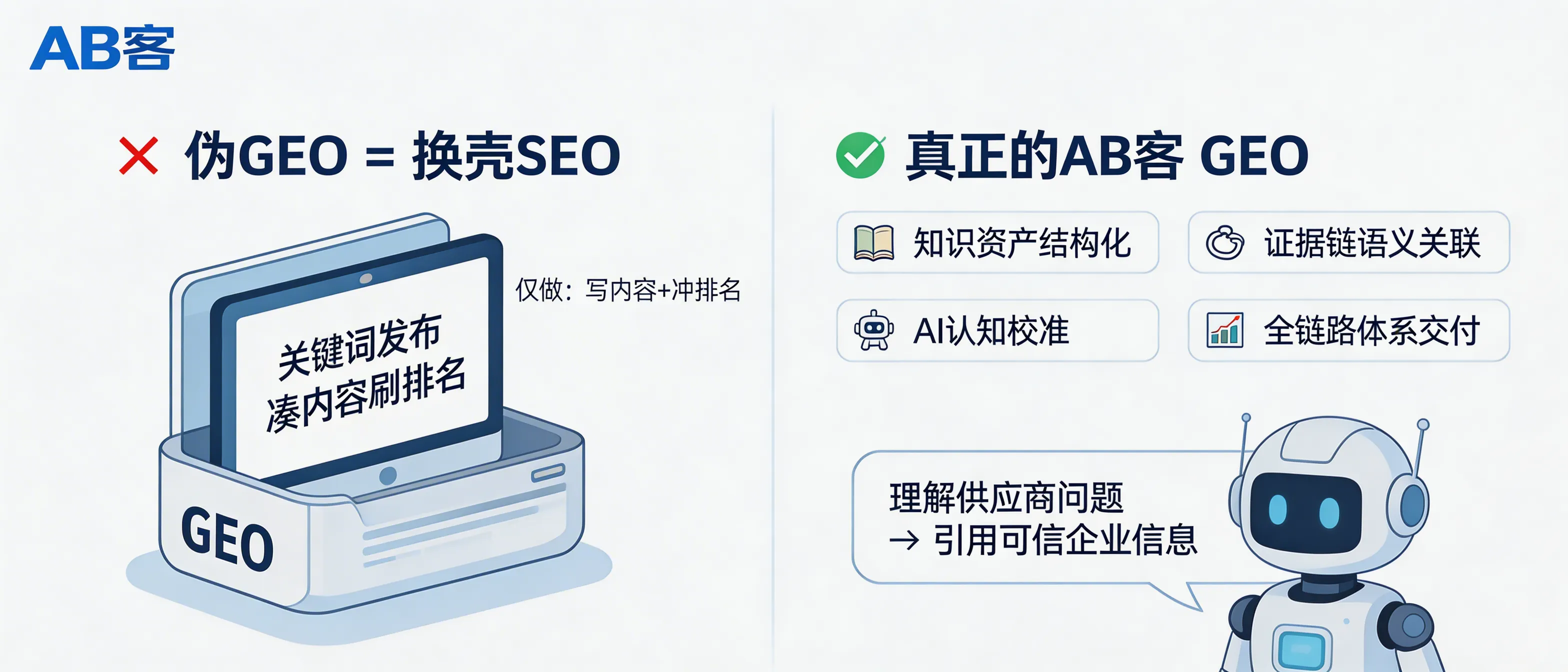
ABKE (AB客) FAQ: How to Identify “Rebranded SEO” vs Real B2B GEO
Learn the objective criteria to distinguish real B2B Generative Engine Optimization (GEO) from SEO rebranding: knowledge modeling, evidence chains, knowledge slicing, entity linking, AI cognition calibration, and closed-loop conversion.

ABKE (AB客) GEO FAQ: Auditing Low-Cost Providers’ “Case Pools” for Real AI Recommendations
Many GEO “cases” only show short-term exposure or controllable-channel metrics, not stable recommendations in mainstream AI Q&A. This FAQ explains an evidence-based audit checklist and the end-to-end indicators ABKE (AB客) uses: knowledge asset deposition, semantic entity linking, traceable distribution, and a closed-loop customer reach-to-CRM process.
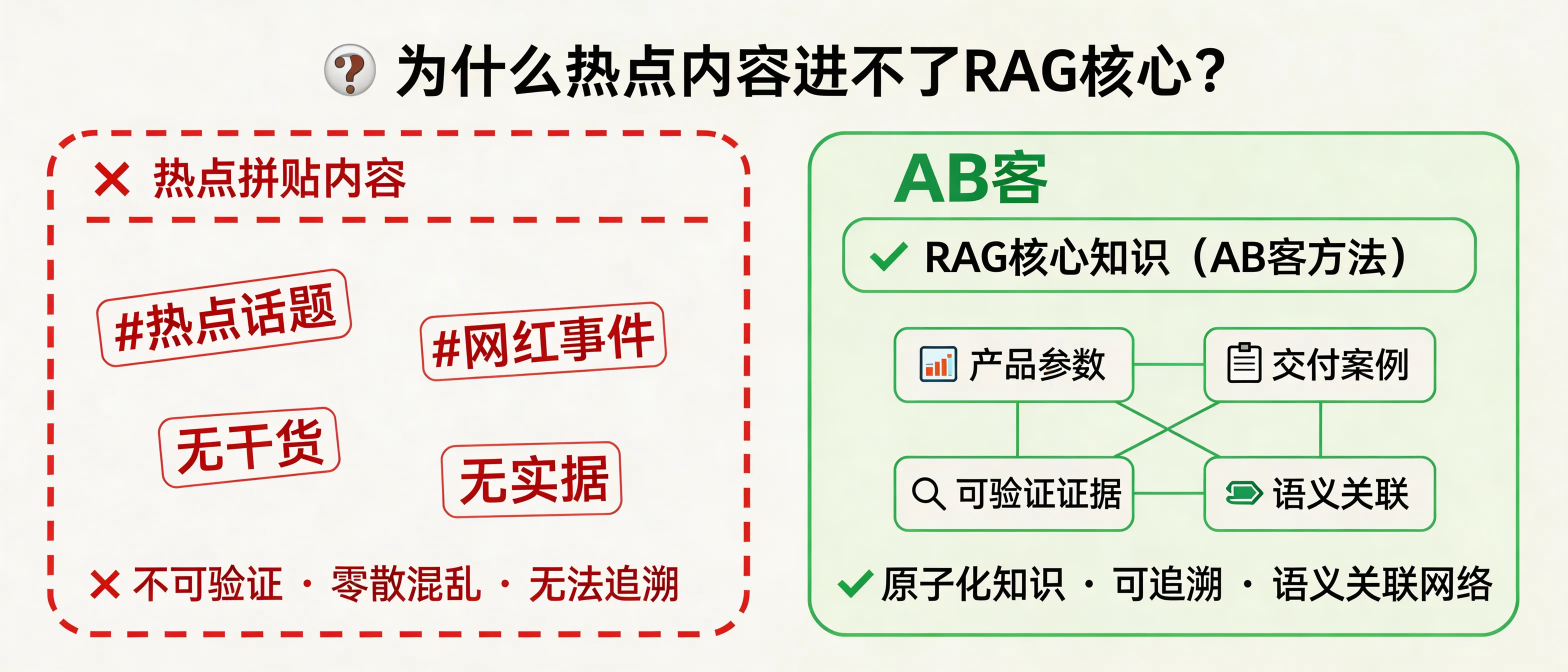
ABKE (AB客) FAQ: Why Trend-Chasing Content Fails RAG & How GEO Builds Retrievable Proof
RAG retrieval favors verifiable, traceable, well-structured knowledge tied to real-world entities. Learn why “hot-topic” content is rarely retrievable and how ABKE’s B2B GEO turns enterprise know-how into atomic evidence, semantic links, and a publishable knowledge network for AI search.

ABKE (AB客) FAQ: Black-Hat GEO Risks and Compliance Boundaries in Generative AI Search
A technical FAQ explaining what “black-hat GEO” is, which manipulation tactics (fabricated content, mass spam, fake endorsements, entity spoofing) can damage long-term AI trust signals, and how ABKE’s compliant GEO framework (knowledge sovereignty + evidence chain + semantic linking) reduces risk.

ABKE (AB客) GEO FAQ: If They Don’t Read Your Technical Manual, Don’t Hire Them
In B2B export, AI recommendations depend on verifiable technical evidence. Learn why “template GEO content” without reading your manuals fails, and how ABKE builds structured knowledge assets (FAQ, whitepapers, evidence chains) aligned with real engineering capability.

ABKE (AB客) FAQ: Why “Auto-Built + AI-Filled” Sites Fail in B2B Export | GEO Approach
Explains why fully automated sites with AI-filled content often lead to content homogeneity, weak evidence, and poor information architecture for AI retrieval—reducing trust and conversions. Introduces ABKE’s GEO approach: semantic websites + structured knowledge + continuous optimization.

ABKE (AB客) GEO FAQ: Why “100% AI Platform Coverage” Claims Are Not Technically Verifiable
No vendor can technically guarantee 100% coverage across all AI answer engines because each platform has different retrieval sources, citation mechanisms, and update cycles. ABKE (AB客) increases the probability of being retrieved and cited via semantic website clusters, structured knowledge bases, and a multi-channel distribution network, then iterates with measurable feedback signals.
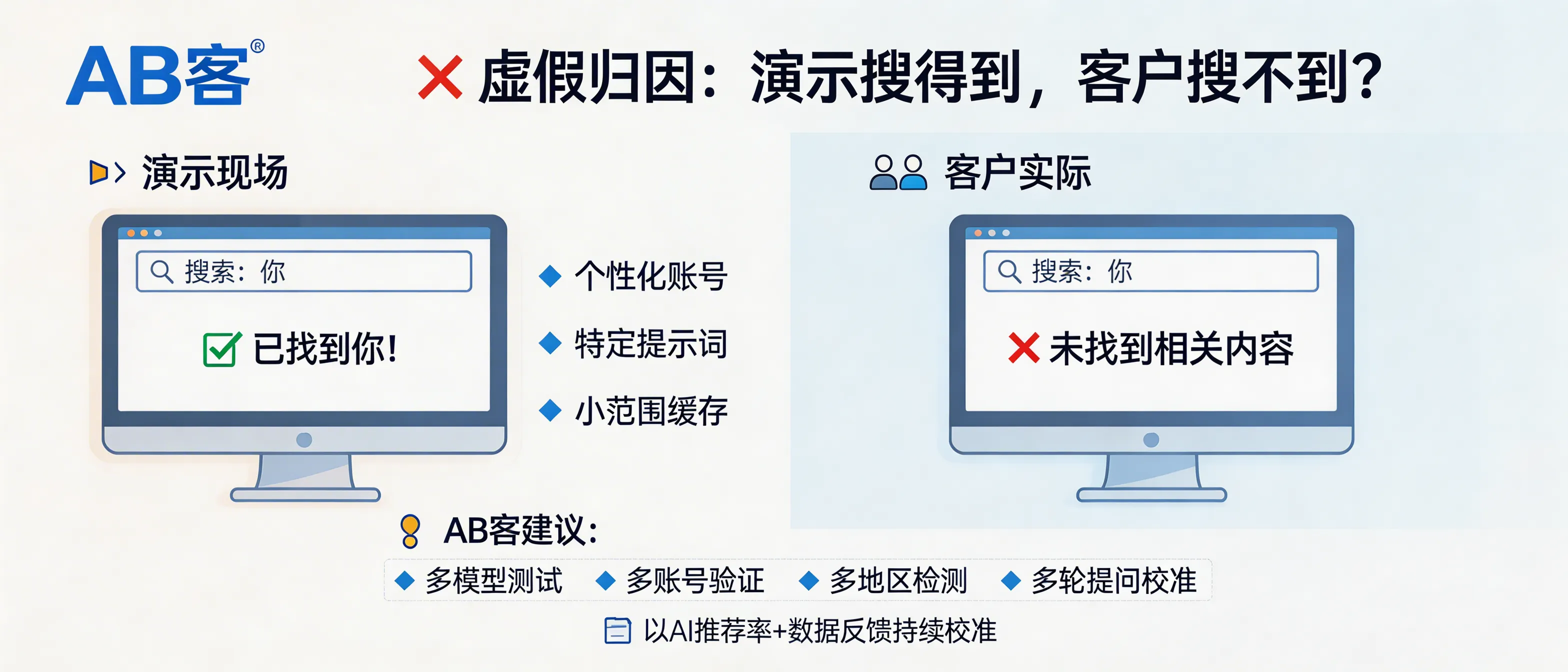
ABKE (AB客) FAQ: Demo Visibility vs Real AI Recommendations (False Attribution in GEO)
Some GEO demos can show your brand in AI answers using personalized accounts, prompt engineering, cache/history effects, or limited test environments. ABKE recommends reproducible testing across models, accounts, regions, and repeated queries—tracking citation sources and AI recommendation rate over time.
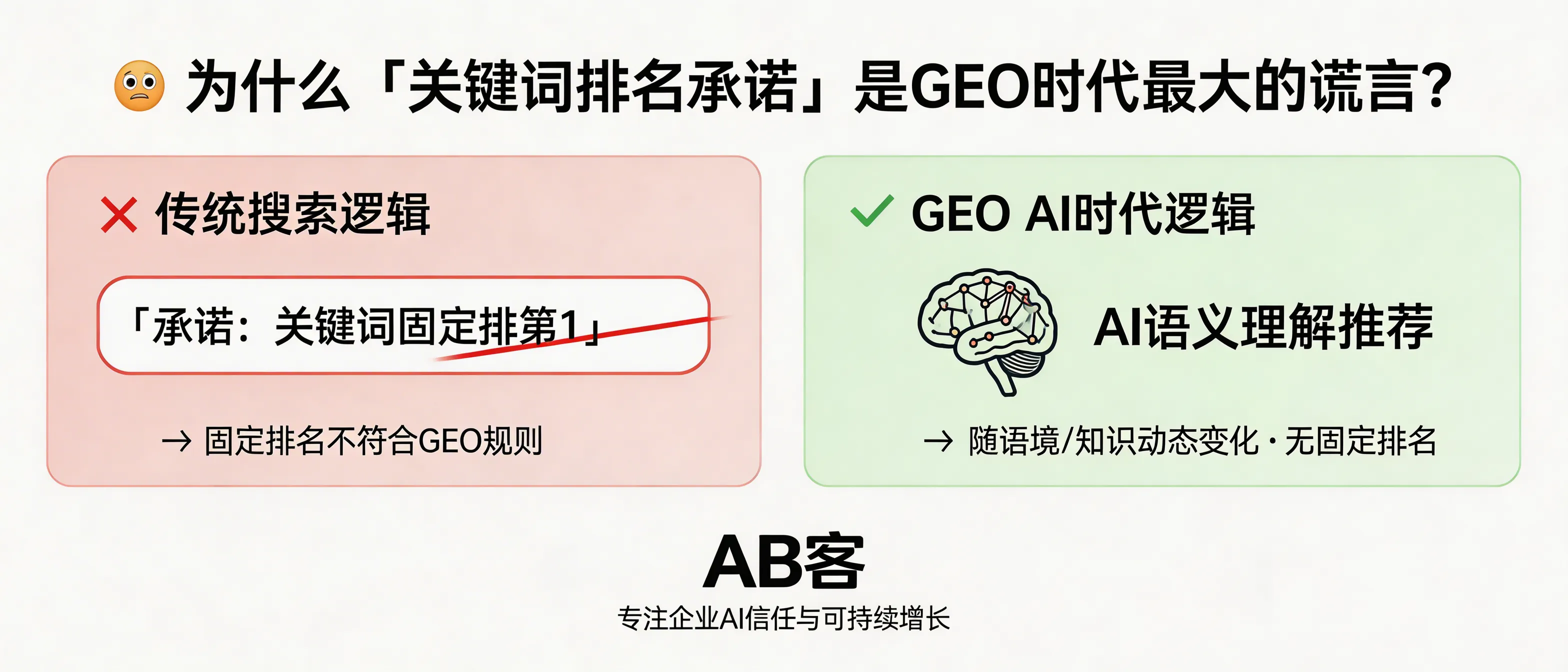
ABKE (AB客) FAQ: Why “Guaranteed Keyword Ranking” Fails in the GEO Era
In the GEO era, buyers ask AI systems (ChatGPT, Gemini, Deepseek, Perplexity) for supplier recommendations. Keyword-ranking guarantees target classic search positions, but AI answers are generated from semantic understanding, context, and knowledge networks. ABKE focuses on building AI-readable, evidence-based knowledge assets so your company can be understood and trusted—rather than selling a single ranking metric.


.png?x-oss-process=image/resize,h_2000,m_lfit/format,webp)






了解AB客
专业顾问实时为您提供一对一VIP服务
.png?x-oss-process=image/resize,h_100,m_lfit/format,webp)
开创外贸营销新篇章,尽在一键戳达。
.png?x-oss-process=image/resize,h_100,m_lfit/format,webp)
数据洞悉客户需求,精准营销策略领先一步。

用智能化解决方案,高效掌握市场动态。
.png?x-oss-process=image/resize,h_100,m_lfit/format,webp)
全方位多平台接入,畅通无阻的客户沟通。
.png?x-oss-process=image/resize,h_100,m_lfit/format,webp)
省时省力,创造高回报,一站搞定国际客户。
.png?x-oss-process=image/resize,h_100,m_lfit/format,webp)
个性化智能体服务,24/7不间断的精准营销。
.png?x-oss-process=image/resize,h_100,m_lfit/format,webp)
多语种内容个性化,跨界营销不是梦。