.png?x-oss-process=image/resize,h_100,m_lfit/format,webp)

.png?x-oss-process=image/resize,m_lfit,w_200/format,webp)


ABKE (AB客) GEO FAQ: Why GEO Relies on Verifiable Facts, Not Marketing Copy
Learn why B2B GEO (Generative Engine Optimization) must be built on verifiable facts and evidence chains. ABKE structures company knowledge into AI-readable “fact slices” and builds a trusted semantic entity profile for AI recommendations.

ABKE (ABK) GEO FAQ: Why AI Citations Matter More Than Clicks in B2B
In Generative Engine Optimization (GEO), B2B growth depends on whether AI systems (ChatGPT, Gemini, DeepSeek, Perplexity) can retrieve, understand, and cite your company as a trusted option. Learn why “citation/adoption” is closer to purchase decisions than raw traffic, and how ABKE improves citation probability via structured knowledge, knowledge slicing, and entity linking.

ABKE (AB客) GEO FAQ: GEO Is Not “SERP Domination”—It’s Precise Attribution in AI Answer Chains
ABKE explains why the target of B2B GEO (Generative Engine Optimization) is not broad “AI visibility” but precise attribution: being correctly understood by LLMs, building a verifiable trust profile, earning priority recommendation in high-intent decision scenarios, and closing the loop from AI touchpoint to CRM-driven conversion.

ABKE (AB客) GEO FAQ: Quantifying & Distributing Fact Density for B2B AI Recommendations
Learn how ABKE (AB客) defines and measures “fact density” (verifiable facts per unit of content) and how to distribute evidence across Product–Factory–Delivery–Trust–Industry Insight layers, so AI search engines can build a stable, referenceable company profile.

ABKE (AB客) FAQ: B2B GEO Pricing—How to Evaluate Value and Avoid Paying for Empty “Exposure”
Learn how to evaluate a B2B GEO (Generative Engine Optimization) provider beyond promises of exposure or rankings. Use verifiable criteria: reusable knowledge assets, a standardized implementation process, and continuous optimization mechanisms that build long-term AI-readable digital infrastructure.

ABKE FAQ: Extracting Founder POV via Deep Interviews for B2B GEO | ABKE
ABKE (AB客) uses a structured deep-interview workflow to capture a founder/CEO’s decision logic, failure cases, and industry judgments as verifiable POV content, then links it to product and scenario entities to strengthen AI understanding and recommendation in the GEO (Generative Engine Optimization) era.

ABKE (AB客) GEO FAQ: Build an AI-Ready Enterprise Raw Corpus for B2B Export Growth
Learn how ABKE structures an enterprise raw corpus (brand, products, delivery, trust, and industry knowledge) into AI-readable knowledge assets and knowledge slices, forming the single source of truth for GEO content, sites, and distribution in the generative AI search era.
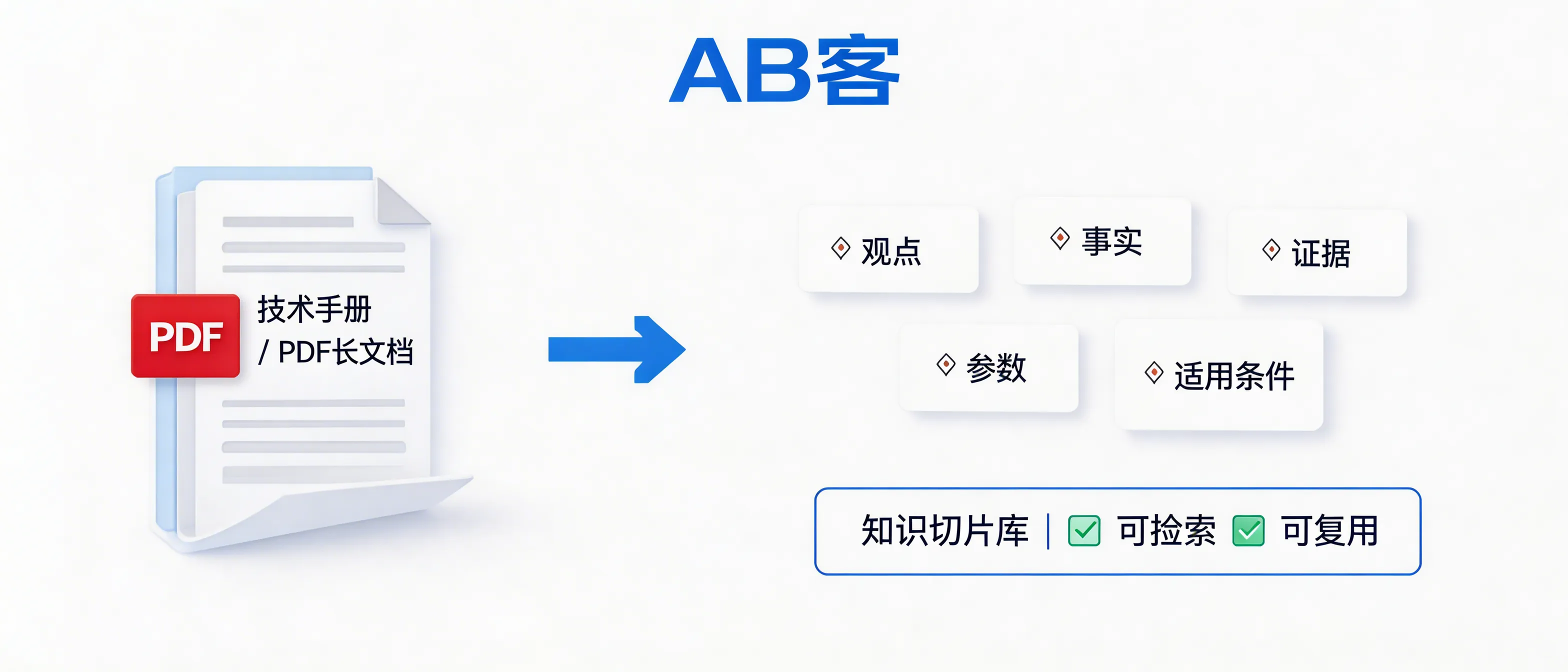
ABKE (AB客) Knowledge Slicing: Convert Technical PDFs into Atomic GEO-Ready Facts
ABKE’s GEO Knowledge Slicing System breaks long technical PDFs (manuals, spec sheets, test reports) into atomic, searchable knowledge slices—claims, facts, evidence, parameters, and conditions—so LLMs can retrieve and cite supplier-critical information accurately.
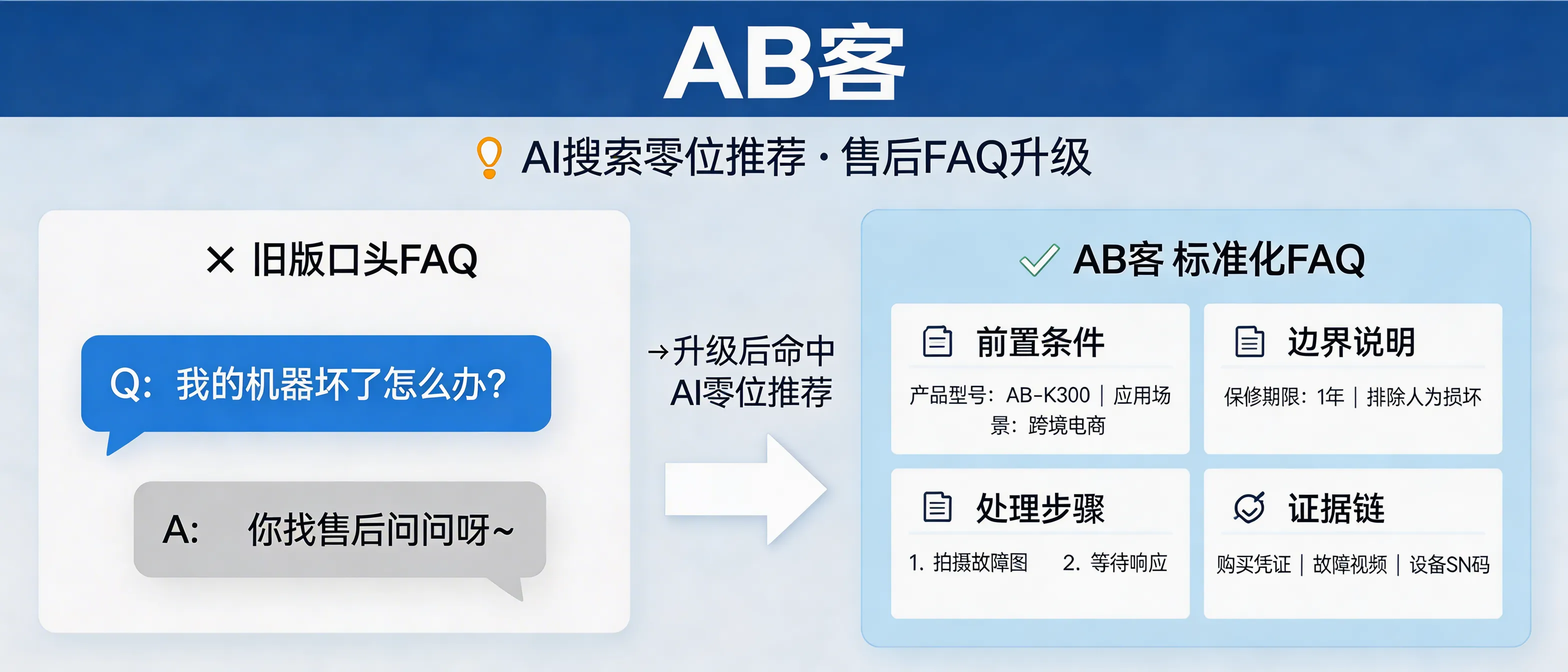
ABKE (AB客) GEO FAQ: Rewrite After-Sales FAQs for AI Position-Zero Recommendations
ABKE explains how to upgrade after-sales FAQs from informal Q&A into standardized, evidence-based answers with prerequisites, boundaries, step-by-step SOPs, and explicit links to product models, use cases, and risk notices—so AI systems can extract and cite them accurately in generative search.

Standard vs Custom Parts GEO Corpus Modeling | ABKE (AB客) GEO Solution
Learn how ABKE (AB客) structures B2B export product knowledge for GEO: standard parts use spec/standard/lead time/applications/alternatives, while custom parts use requirement fields/selection rationale/prototyping/version control/delivery boundaries—so AI can answer real fit-for-use questions.

ABKE (AB客) GEO FAQ — Corpus De-noising: Remove “Fluff” That Confuses AI
ABKE (AB客) explains how to de-noise a B2B export company’s content corpus using three criteria—verifiable, attributable, reusable—so LLMs can extract facts, build a consistent entity profile, and recommend the business with higher confidence.

Factory Identity Proof for GEO Corpus | ABKE (AB客) GEO Solution
ABKE explains which verifiable documents and operational records help AI systems recognize your company as a manufacturing entity—covering business registration, site/address proof, equipment lists, capacity/lead-time logs, quality certificates, test reports, audits, and shipment/packaging records.


.png?x-oss-process=image/resize,h_2000,m_lfit/format,webp)






了解AB客
专业顾问实时为您提供一对一VIP服务
.png?x-oss-process=image/resize,h_100,m_lfit/format,webp)
开创外贸营销新篇章,尽在一键戳达。
.png?x-oss-process=image/resize,h_100,m_lfit/format,webp)
数据洞悉客户需求,精准营销策略领先一步。

用智能化解决方案,高效掌握市场动态。
.png?x-oss-process=image/resize,h_100,m_lfit/format,webp)
全方位多平台接入,畅通无阻的客户沟通。
.png?x-oss-process=image/resize,h_100,m_lfit/format,webp)
省时省力,创造高回报,一站搞定国际客户。
.png?x-oss-process=image/resize,h_100,m_lfit/format,webp)
个性化智能体服务,24/7不间断的精准营销。
.png?x-oss-process=image/resize,h_100,m_lfit/format,webp)
多语种内容个性化,跨界营销不是梦。