.png?x-oss-process=image/resize,h_100,m_lfit/format,webp)

.png?x-oss-process=image/resize,m_lfit,w_200/format,webp)


Expert Protocols for Engineer-Grade AI Content | ABKE (AB客) GEO Solution
ABKE (AB客) codifies your technical standards, evidence rules, and engineering writing style into Expert Protocols, so AI-generated GEO content stays factual, auditable, and easy for LLMs to cite across ChatGPT/Gemini/DeepSeek/Perplexity.

ABKE (AB客) GEO FAQ: 5 Steps to Structure Messy R&D Notes for AI Search
A practical 5-step method used in ABKE’s Enterprise Knowledge Asset System and Knowledge Slicing System to convert scattered R&D notes into structured, evidence-backed knowledge slices that can be crawled, understood, and cited by AI search.

ABKE (AB客) GEO FAQ: Digitizing Historical Records into AI-Citable Knowledge Assets
ABKE’s B2B GEO solution turns historical enterprise materials (case files, test reports, certifications, delivery records) into structured, searchable knowledge slices that AI systems can retrieve and cite for supplier recommendations.

ABKE (AB客) GEO FAQ: Extract Hidden Needs from Reviews & Build an AI-Readable Corpus
ABKE’s B2B GEO solution structures customer reviews by scenario, pain points, decision factors, and evidence types, then converts them into knowledge slices for the enterprise knowledge asset system and high-weight FAQ corpus—improving how AI models understand capability boundaries and trust signals.

ABKE GEO Terminology Dictionary (Entity Glossary) for B2B Export | ABKE
ABKE’s B2B GEO solution helps exporters build a multilingual terminology dictionary/entity library that standardizes product, material, process, and standard names with verified definitions—improving AI translation consistency and semantic linking across ChatGPT, Gemini, Deepseek, and more.

GEO Corpus Granularity Control (Too Thin vs Too Thick) | ABKE AB客 GEO Solution
Explain how GEO knowledge-slice granularity affects AI retrieval, verification, and recommendation. Learn the measurable risks of over-slicing or under-slicing, and how ABKE (AB客) balances “retrievable” and “verifiable” for B2B export GEO.

ABKE (AB客) GEO FAQ: How to Structure ISO/SGS Certifications into a Trust Evidence Cluster
ABKE (AB客) structures ISO, SGS, and other certifications into machine-readable trust evidence clusters (scope, standard number, validity, issuer, verification link, applicable products and factory) so AI systems can verify and cite your compliance with higher certainty.

ABKE GEO FAQ: Converting Trade Show Sales Scripts into AI-Readable Knowledge Slices | ABKE
ABKE (ABKE GEO) turns trade show sales talk tracks into structured, verifiable “intent–standard question–evidence–standard answer” knowledge slices, linked to products, certifications, test data, and cases—so generative AI can understand, reference, and recommend your company with higher confidence.

ABKE (AB客) GEO FAQ: Keeping AI Answers Updated with Latest Capacity & Equipment Data
Learn how ABKE’s B2B GEO solution uses a structured Knowledge Asset System plus continuous optimization to synchronize production capacity, equipment lists, and delivery capabilities across your website and distributed channels—reducing the risk of AI citing outdated information.

ABKE GEO: Turn Internal Training Decks into AI-Citable B2B Lead Assets
ABKE restructures internal training materials (process, quality control, delivery SOPs, and objection handling) into AI-readable FAQs, technical guides, and white papers, then publishes and distributes them across your website and platforms so AI systems can understand, cite, and recommend your company during B2B supplier evaluation.
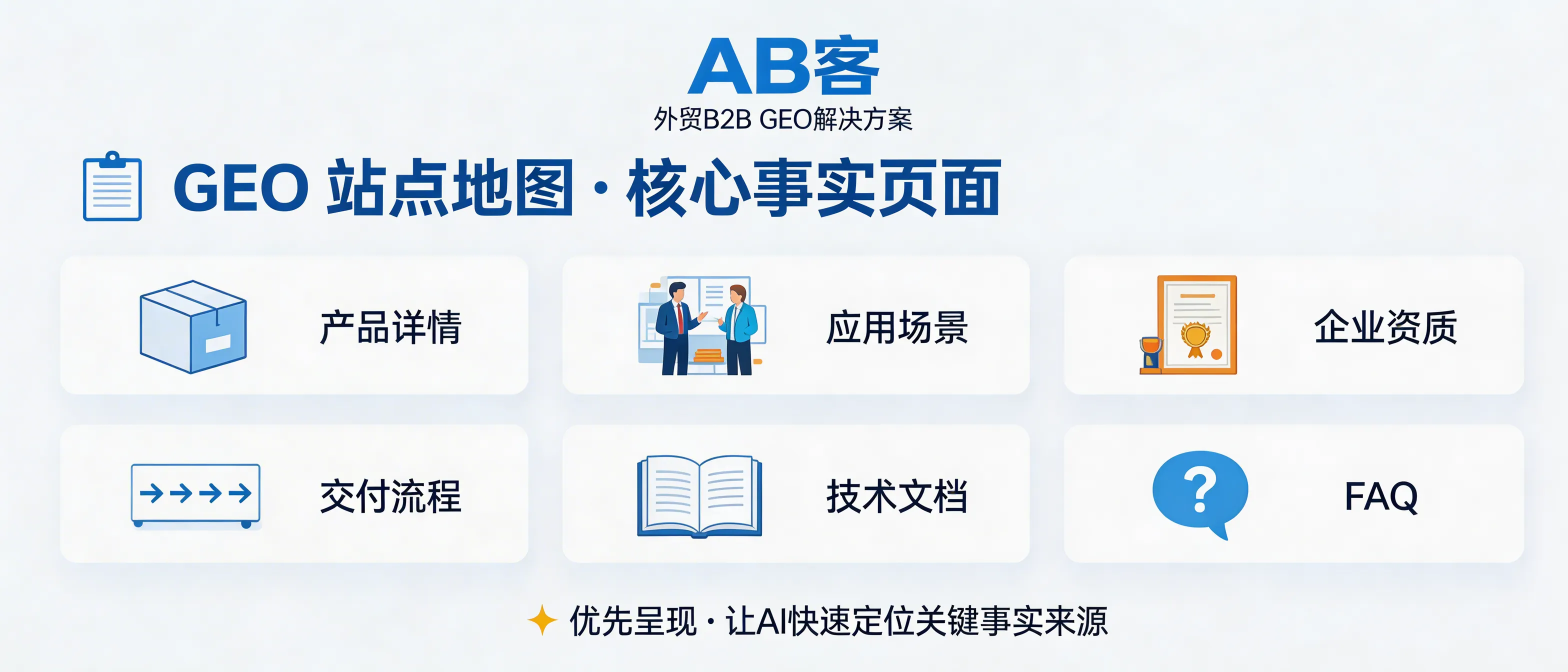
ABKE (AB客) GEO Sitemap Upgrade: Mark Core Fact Pages for AI Citation
In ABKE’s B2B GEO framework, a Sitemap is not only an index for crawling—it is a priority map that highlights verifiable fact pages (product specs, use cases, certifications, delivery SOP, technical docs, FAQs) so AI systems can locate reliable sources faster.

ABKE (AB客) GEO FAQ: Entity Linking Optimization for Brand–Product–Factory Trust
Learn how ABKE GEO builds a verifiable Brand–Product–Factory–Certification–Case entity network using structured knowledge assets, knowledge slicing, consistent naming, traceable URLs, and semantic associations—so AI systems can attribute your products to real manufacturing and delivery capability.


.png?x-oss-process=image/resize,h_2000,m_lfit/format,webp)






了解AB客
专业顾问实时为您提供一对一VIP服务
.png?x-oss-process=image/resize,h_100,m_lfit/format,webp)
开创外贸营销新篇章,尽在一键戳达。
.png?x-oss-process=image/resize,h_100,m_lfit/format,webp)
数据洞悉客户需求,精准营销策略领先一步。

用智能化解决方案,高效掌握市场动态。
.png?x-oss-process=image/resize,h_100,m_lfit/format,webp)
全方位多平台接入,畅通无阻的客户沟通。
.png?x-oss-process=image/resize,h_100,m_lfit/format,webp)
省时省力,创造高回报,一站搞定国际客户。
.png?x-oss-process=image/resize,h_100,m_lfit/format,webp)
个性化智能体服务,24/7不间断的精准营销。
.png?x-oss-process=image/resize,h_100,m_lfit/format,webp)
多语种内容个性化,跨界营销不是梦。