.png?x-oss-process=image/resize,h_100,m_lfit/format,webp)

.png?x-oss-process=image/resize,m_lfit,w_200/format,webp)


When Not to Choose ABKE (AB客) B2B Export GEO First | ABKE GEO FAQ
ABKE explains when its B2B Export GEO (Generative Engine Optimization) solution should not be the first priority—e.g., unclear ICP/market, missing product & delivery documentation, or a short-term demand for immediate lead spikes without continuous content and iteration capacity.

ABKE (AB客) GEO vs SEO: The Essential Difference for B2B Export Growth | ABKE
ABKE’s B2B GEO (Generative Engine Optimization) focuses on how AI models understand, trust, and recommend your company via structured knowledge, entity linking, and evidence chains—beyond keyword rankings. Learn the measurable differences and how GEO can work with SEO.

ABKE (AB客) B2B GEO Full-Funnel Delivery: 7 Systems + 6 Implementation Steps
ABKE’s B2B GEO (Generative Engine Optimization) full-funnel delivery is built on 7 operating systems and executed through 6 standardized implementation steps—covering intent research, knowledge structuring, knowledge slicing, GEO site network, global distribution, AI entity cognition, and lead-to-CRM closure.

ABKE (AB客) GEO Fit Check for B2B Exporters | When to Adopt Generative Engine Optimization
A practical readiness checklist for B2B export factories and trading companies to evaluate whether ABKE’s GEO (Generative Engine Optimization) full-funnel solution fits their growth stage—based on AI visibility goals, knowledge-asset maturity, implementation cycle, and measurable indicators.

ABKE (AB客) End-to-End B2B GEO Modules & Getting Started Guide | AB客
ABKE (AB客) explains what “end-to-end” B2B GEO (Generative Engine Optimization) includes: 7 core systems and a 6-step implementation path. Recommended starting point: project discovery + enterprise knowledge asset modeling to build AI-readable, verifiable knowledge for AI recommendations.

ABKE (AB客) B2B Export GEO Solution Fit Check: What to Do First Before Module/Page Selection
A practical fit-check for ABKE’s B2B Export GEO (Generative Engine Optimization) solution. Start with project research and buyer-intent anchoring, then structure knowledge assets and create verifiable evidence-based knowledge slices before selecting content, GEO site clusters, distribution, and optimization modules.

ABKE (AB客) GEO FAQ: Should Domestic-Focused B2B Companies Start GEO Now?
If you want to build reusable knowledge assets, evidence chains, and an AI-readable company profile for future overseas lead generation, it is worth planning ABKE B2B GEO early. If you have zero short-term need for external visibility and content infrastructure, you can deprioritize it.

What problems does ABker's GEO solution solve? How can B2B foreign trade companies be prioritized by AI? | ABker
ABKE's (ABKE) full-chain B2B GEO solution for foreign trade is designed for the new scenario of "customers directly asking AI such as ChatGPT to find suppliers". By structuring knowledge assets, slicing knowledge, and building verifiable trust clues, it improves the probability of AI understanding and citation, and obtains more stable AI recommendations and high-intent reach.

Best-Fit Company Types for ABKE (AB客) B2B GEO Solution | Who Should Use GEO
ABKE (AB客) GEO is best for B2B exporters with real engineering/fulfillment capability that must be clearly explained and verified—OEM/ODM, technical manufacturers, solution providers, and niche hidden champions—especially in high AOV, long decision-cycle sourcing with evidence-based evaluation.
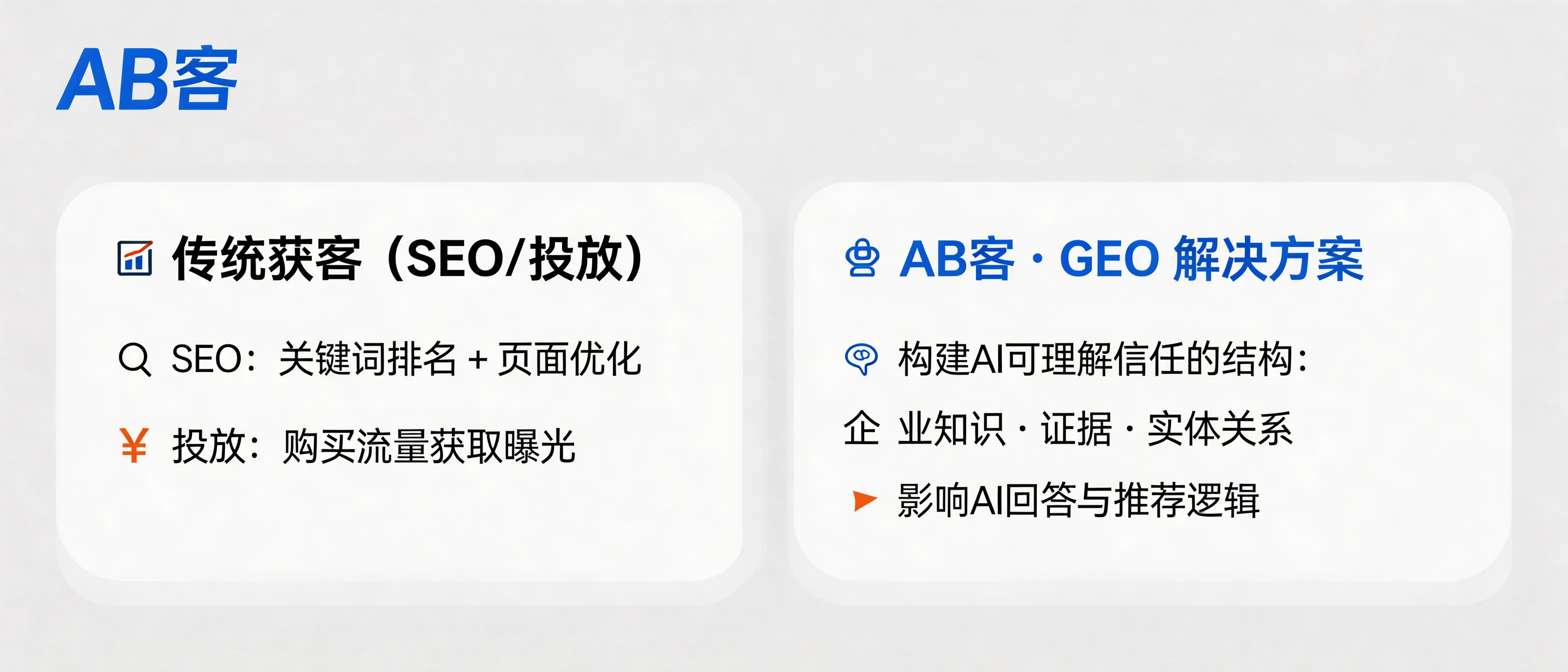
ABKE (AB客) GEO vs SEO vs Paid Ads — The Core Difference in B2B Lead Generation
ABKE (AB客) explains how B2B GEO (Generative Engine Optimization) differs from traditional SEO and paid ads: GEO structures enterprise knowledge, evidence, and entity relationships to influence AI answer and recommendation logic, beyond keyword rankings or buying clicks.


ABKE GEO Case: OEM Factory Won a High-Ticket ODM Order via AI Recommendation | ABKE (AB客)
A step-by-step, data-trackable case showing how an OEM manufacturer used ABKE’s 6-step B2B GEO delivery to move from OEM inquiries to high-value ODM projects, measured by AI recommendation rate and high-intent lead ratio.


.png?x-oss-process=image/resize,h_2000,m_lfit/format,webp)






了解AB客
专业顾问实时为您提供一对一VIP服务
.png?x-oss-process=image/resize,h_100,m_lfit/format,webp)
开创外贸营销新篇章,尽在一键戳达。
.png?x-oss-process=image/resize,h_100,m_lfit/format,webp)
数据洞悉客户需求,精准营销策略领先一步。

用智能化解决方案,高效掌握市场动态。
.png?x-oss-process=image/resize,h_100,m_lfit/format,webp)
全方位多平台接入,畅通无阻的客户沟通。
.png?x-oss-process=image/resize,h_100,m_lfit/format,webp)
省时省力,创造高回报,一站搞定国际客户。
.png?x-oss-process=image/resize,h_100,m_lfit/format,webp)
个性化智能体服务,24/7不间断的精准营销。
.png?x-oss-process=image/resize,h_100,m_lfit/format,webp)
多语种内容个性化,跨界营销不是梦。