.png?x-oss-process=image/resize,h_100,m_lfit/format,webp)

.png?x-oss-process=image/resize,m_lfit,w_200/format,webp)


ABKE (AB客) GEO Update Frequency | How Often to Iterate for AI Semantic Search
ABKE explains GEO update cadence as a continuous loop—research, knowledge structuring, content distribution, and optimization—calibrated by industry change, product iteration, competition intensity, and AI recommendation data signals.

ABKE (AB客) GEO FAQ: Why GEO Often Delivers the Highest ROI in B2B Export Marketing
ABKE explains the ROI logic of B2B GEO (Generative Engine Optimization): shifting acquisition from short-term paid traffic to compounding knowledge assets and AI recommendation visibility, with clear fit conditions, boundaries, and measurable outcomes.

ABKE (AB客) GEO FAQ: Buyer Trust Shift from Ads to AI Recommendations
In generative-AI search, B2B buyers increasingly use AI answers to shortlist suppliers. ABKE GEO builds machine-readable, evidence-backed knowledge assets and entity-linked signals so AI systems can understand, validate, and recommend a supplier with lower uncertainty.

ABKE (AB客) GEO: Make Traditional Webpages AI-Readable, Citable, and Conversational
ABKE GEO restructures traditional webpages into AI-crawlable, semantically linked knowledge assets (FAQ libraries, whitepapers, knowledge slices, entity links) so LLMs can accurately understand, cite, and recommend your B2B export business in AI answers.

ABKE (AB客) FAQ: AI-Generated Content Labeling Policies and Their Impact on GEO
Learn how stricter AI-generated content labeling and provenance rules influence ABKE’s B2B GEO approach—shifting from “content generation” to traceable, evidence-backed, structured knowledge assets that AI systems can trust and cite.
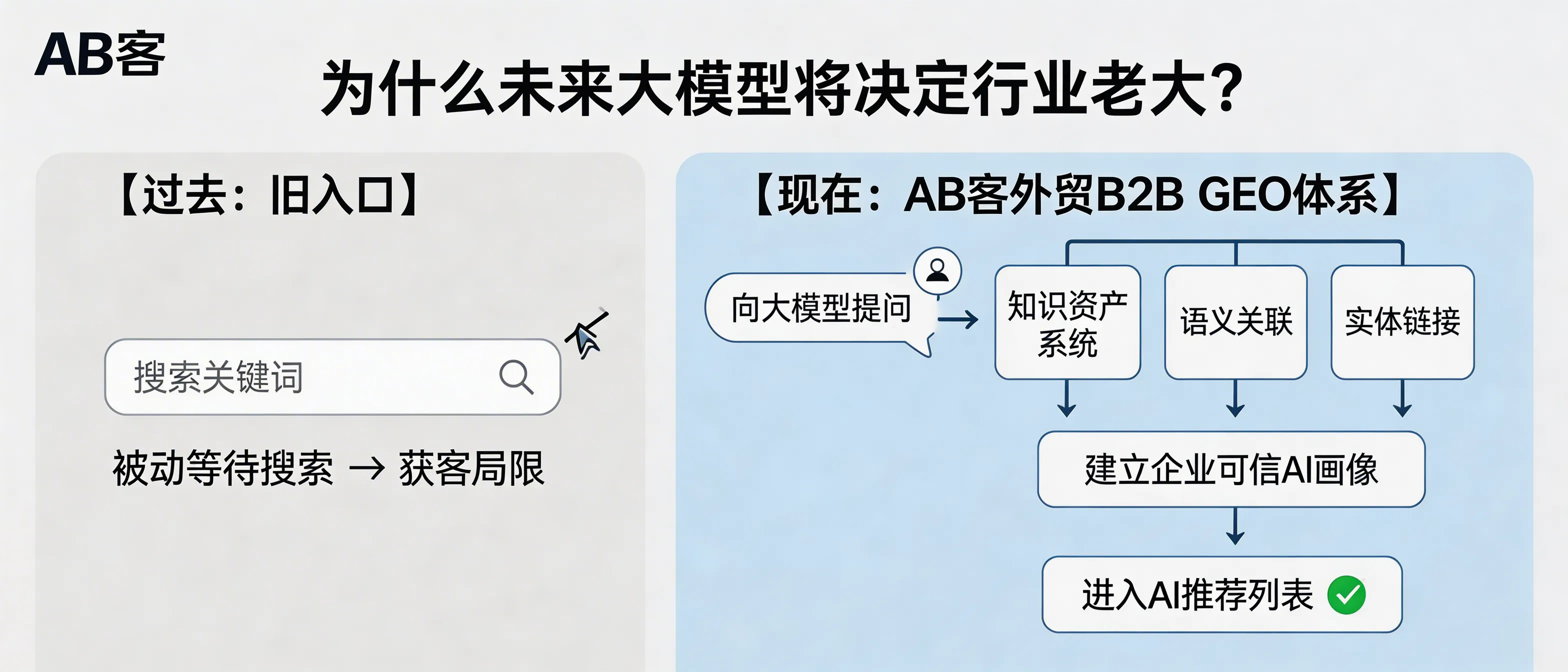
ABKE (AB客) GEO FAQ: Why Foundation Models Decide Industry Leaders in Decentralized Search
In B2B exports, buyer discovery is shifting from keyword search to asking foundation models (ChatGPT/Gemini/DeepSeek/Perplexity). This FAQ explains how model trust, entity linking, and structured knowledge assets determine whether a supplier is recommended, and how ABKE GEO builds an AI-readable, verifiable corporate knowledge profile.

ABKE (AB客) GEO FAQ: Build Permanent Digital Assets Beyond One-Off Traffic
ABKE’s B2B GEO (Generative Engine Optimization) structures enterprise knowledge into reusable “knowledge slices” and distributes them through a global content network, forming a continuously iterated digital asset library that supports AI understanding and buyer decision-making over time—unlike one-time ad impressions.

ABKE (AB客) GEO FAQ: How Chinese Factories Win the Knowledge War in Semantic Search
Learn how ABKE’s B2B GEO (Generative Engine Optimization) turns factory expertise (FAQ libraries, white papers, delivery evidence, and structured knowledge slices) into AI-readable semantic proof so ChatGPT/Gemini/DeepSeek can understand, trust, and recommend you beyond price.
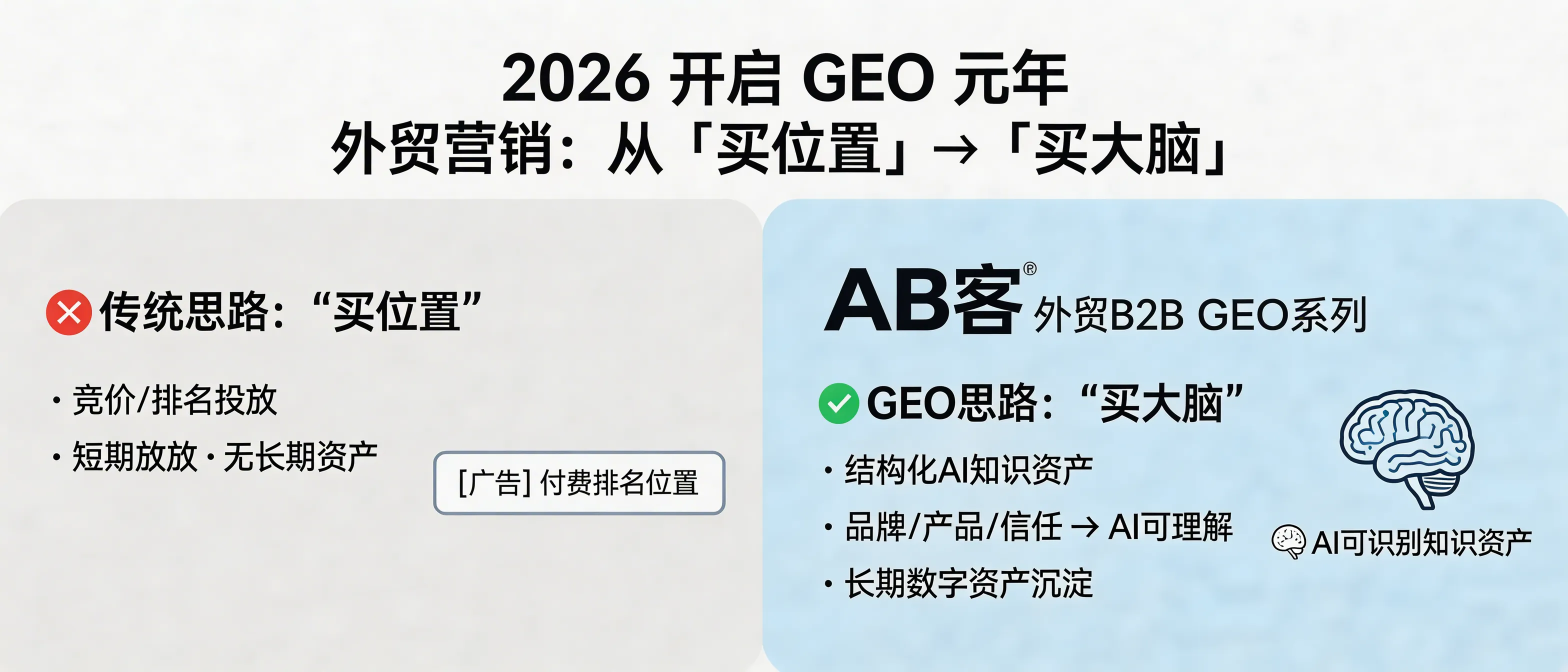
ABKE (AB客) GEO FAQ: 2026 GEO Year One—From Buying Positions to Buying AI Understanding
Explains why B2B export marketing is moving from PPC/keyword ranking to Generative Engine Optimization (GEO): building structured, AI-readable knowledge assets so models like ChatGPT, Gemini, Deepseek, and Perplexity can understand, trust, and cite your company in recommendations.
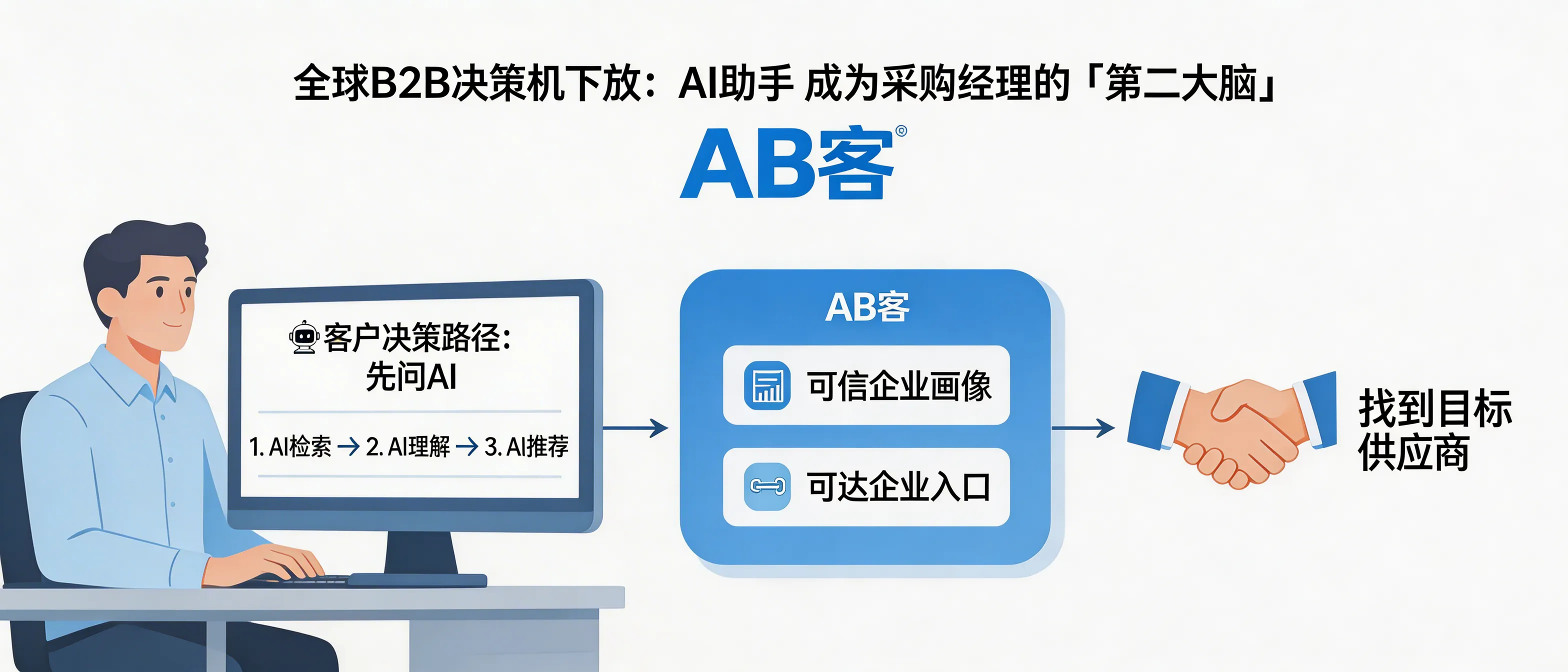
ABKE (AB客) GEO for B2B Exporters: Become the Supplier AI Recommends First
ABKE (AB客) builds a GEO (Generative Engine Optimization) content and distribution system aligned with AI retrieval, understanding, and recommendation, so B2B exporters can be represented with a verifiable, structured company profile when buyers consult ChatGPT/Gemini/DeepSeek/Perplexity before shortlisting suppliers.

ABKE (AB客) GEO FAQ: Why GEO Is the Biggest B2B Marketing Iteration in 30 Years
ABKE explains why Generative Engine Optimization (GEO) upgrades B2B marketing from keyword traffic tactics to an AI-era infrastructure: customer question → AI retrieval → AI understanding → AI recommendation → customer reach → deal close, built on knowledge sovereignty, structured knowledge assets, distribution, and CRM closed loop.

ABKE (AB客) GEO FAQ: Digital Persona (Digital人格) for B2B Export Growth
Learn how ABKE’s B2B GEO full-chain solution builds an AI-understandable Digital Persona using 7 systems (demand, knowledge assets, knowledge slicing, AI content factory, global distribution, AI cognition, CRM) to improve AI recognition and recommendation in generative search.


.png?x-oss-process=image/resize,h_2000,m_lfit/format,webp)






了解AB客
专业顾问实时为您提供一对一VIP服务
.png?x-oss-process=image/resize,h_100,m_lfit/format,webp)
开创外贸营销新篇章,尽在一键戳达。
.png?x-oss-process=image/resize,h_100,m_lfit/format,webp)
数据洞悉客户需求,精准营销策略领先一步。

用智能化解决方案,高效掌握市场动态。
.png?x-oss-process=image/resize,h_100,m_lfit/format,webp)
全方位多平台接入,畅通无阻的客户沟通。
.png?x-oss-process=image/resize,h_100,m_lfit/format,webp)
省时省力,创造高回报,一站搞定国际客户。
.png?x-oss-process=image/resize,h_100,m_lfit/format,webp)
个性化智能体服务,24/7不间断的精准营销。
.png?x-oss-process=image/resize,h_100,m_lfit/format,webp)
多语种内容个性化,跨界营销不是梦。